
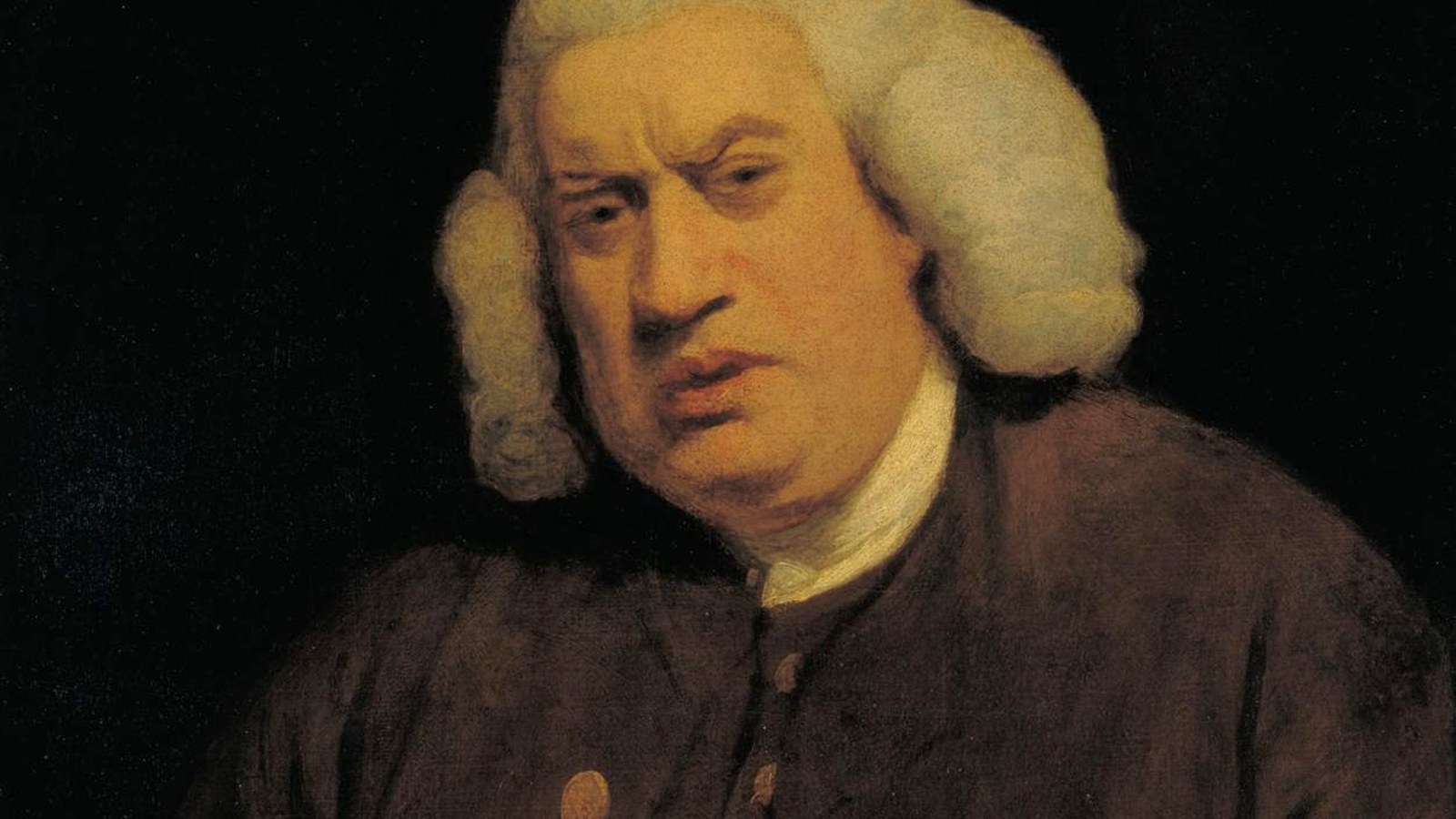
18 September 2026 marks 317 years since the birth of Samuel Johnson in Lichfield, England. Encyclopaedia Britannica and the London house-museum record the date. He is a central figure of eighteenth-century English letters, not the inventor of the dictionary as a genre.
He spent a period at Pembroke College, Oxford, without completing the degree, for want of money. He moved to London and wrote poetry, essays, biographies, criticism and prose. His reputation grew gradually, through learning and through the cadence of his prose.
“A Dictionary of the English Language” appeared in 1755. It was not the first English dictionary. Its importance lies in scale, literary quotations and the method of definition. Johnson worked for roughly nine years, with a few assistants, and illustrated usage from authors he treated as authorities.
Other works remain in the critical canon: the philosophical tale “Rasselas”, the edition of Shakespeare’s plays and “Lives of the English Poets”. Each is a distinct project, not a footnote to the dictionary.
The public image was also shaped by James Boswell’s 1791 biography. The book preserves conversations and habits, but it is also the biographer’s literary construction. It should not be read as a neutral transcript.
The anniversary does not require hagiography. It records the birth date, the 1755 dictionary and its limit: a reference work, not “the first” dictionary of the language.
Three hundred and seventeen years on, Johnson remains a landmark of British lexicography and criticism through these documented books, not through slogans about one man inventing English.
Image: Joshua Reynolds, Samuel Johnson. Wikimedia Commons, public domain. Cropped to 16:9.
Source consulted: Encyclopaedia Britannica — Samuel Johnson; Dr Johnson’s House — Samuel Johnson and the Dictionary.




0 Comments
No comments on this article yet. Be the first!