


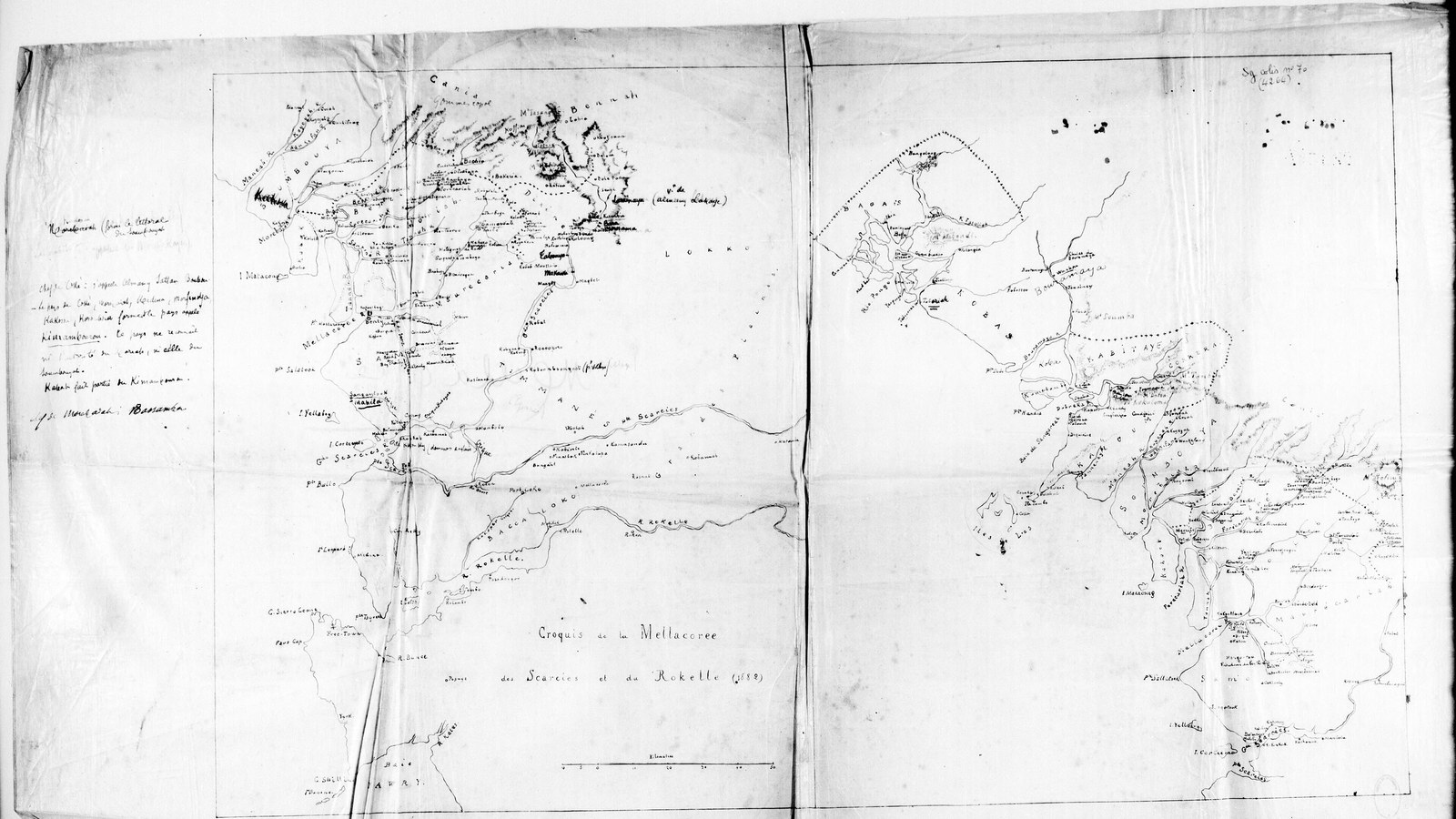
Queen Victoria and the President of the French Republic wanted to settle questions over territories occupied or claimed north of Sierra Leone, on the West Coast of Africa. The convention was signed at Paris on 28 June 1882. British plenipotentiary: Richard Bickerton Pemell, Viscount Lyons, ambassador extraordinary to the French Government. French plenipotentiary: Louis Charles de Saulces de Freycinet, minister of foreign affairs. Full powers were found in good and true form.
Article I: the line of demarcation between the territories occupied or claimed by Great Britain and France north of Sierra Leone shall be drawn between the basins of the Rivers Searcies and Mellicourie. Its exact position was to be fixed on the spot by commissioners appointed under Article VII. The line had nevertheless to be drawn so as to ensure to Great Britain complete control of the Searcies Rivers and to France complete control of the Mellicourie River.
The point and factory of Mahela, and the adjacent water communication, were to belong to whichever nation the inquiry found needed them for control of the Searcies or of the Mellicourie. If the water at Mahela opened into both rivers, the line was to start on the coast from the centre of the stream joining the sea at Mahela, assigning to Great Britain the communication with the Searcies and to France that with the Mellicourie.
Article II: the Island of Yelboyah, and all islands claimed or possessed by Great Britain south of the line as far as the southern limits of the British Colony of Sierra Leone, were recognised as British. The Island of Matacong, and all islands claimed or possessed by France north of the line as far as the Rio Nunez, were recognised as French, with the exception of the Isles de Los, which were to continue to belong to Great Britain. Hertslet notes their cession by the King and Chiefs of the Bago Country on 6 July 1818, and their later cession to France under Article VI of the Convention of 8 April 1904.
Article III: the Queen engaged to abstain from holding any territory, and from exercising or countenancing British political influence, between the Article I line and the Rio Nunez; nothing in the article affected French rights on the stream of the Rio Nunez or to the north of that river. Article IV: the President of the French Republic engaged to the same abstention between the line and the northern limit of the Republic of Liberia.
Article V: British subjects in the French possessions on the West Coast of Africa, and French citizens in the British possessions there, were to receive equality of treatment as regards the protection of life and property. Article VI: the right to hold real property was accorded to French citizens in the British possessions as to aliens in the United Kingdom, and to British subjects in the French possessions as to aliens in France. Article VII: each side appointed two commissioners; they were to meet at Sierra Leone to begin work within six months after the exchange of ratifications, or sooner. Questions they could not settle were to go to the two governments.
Article VIII: the convention was to be ratified, and the ratifications exchanged at Paris as soon as possible. Signatures: Lyons and C. de Freycinet. Hertslet records that it was not formally ratified, but that both Powers accepted it as a binding arrangement; it was published in the Journal officiel of 28 March 1883. The French Chamber of Deputies refused ratification. The on-the-spot delimitation provided for in 1882 was not carried into effect.
The Paris arrangement of 10 August 1889 took up and extended the line, to the 10th parallel and the 13th meridian west of Paris. Later instruments followed on 26 June 1891, 21 January 1895, the 1896 demarcation procès-verbaux, and notes of 1898, 1904 and 1911. This is not the convention of 8 April 1904 that ceded the Isles de Los, and not the 1889 arrangement. The cover is the 1882 sketch of the Mellacorée, Scarcies and Rokelle, the coastal map of the dispute.
Sources: Anglo-French Convention of 1882; Hertslet, The Map of Africa by Treaty, vol. II, no. 224 (Paris, 28 June 1882).










0 Comments
No comments on this article yet. Be the first!