


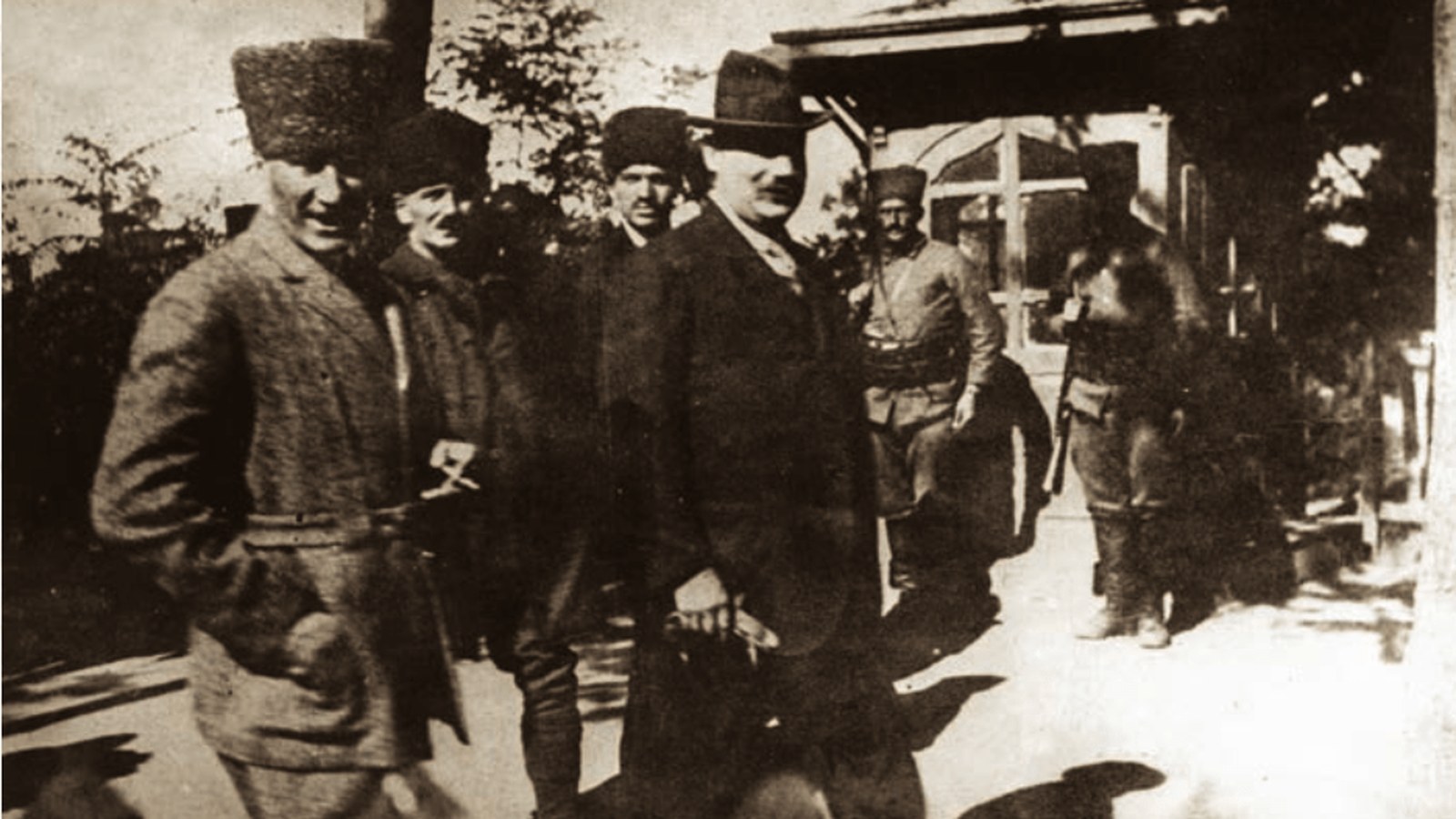
The Franco-Turkish war in Cilicia followed the 1920 Treaty of Sèvres, which had given France a zone of influence, in the line of the Sykes-Picot agreements. The Grand National Assembly in Ankara did not recognise Sèvres. Talks at Angora were led by the diplomat Henry Franklin-Bouillon, a former minister, and Yusuf Kemal Bey, foreign minister of the Assembly’s government. Photographs of 13 June 1921 show Franklin-Bouillon beside Mustafa Kemal.
On 20 October 1921, in Ankara, the Angora Agreement, also called the Franklin-Bouillon Pact, was signed. Article 1, in the text kept by France Mémoire, declares that the state of war ceases from the moment of signature; armies, civil authorities and populations are to be notified at once. Article 2 frees prisoners of war and all French or Turkish persons detained, at the expense of the party holding them. Article 5 grants a full amnesty in the evacuated regions.
Article 3 allows at most two months for withdrawal: Turkish troops to the north, French troops to the south of the line in Article 8. A mixed commission, named by the military commanders, regulates the evacuation. The line starts from the Mediterranean immediately south of Payas, passes Meidan Ekbis (left to Syria), bends south-east between Karnaba and Kilis, then follows the Baghdad railway to Nusaybin, with the track on Turkish territory. From there the old road to Cizre (Jazirat ibn Umar) remains Turkish, though both countries may use it.
France thus ceded to Turkey towns and districts of the Adana and Aleppo vilayets: Adana, Osmaniye, Marash, Aintab, Kilis, Urfa, Mardin, Nusaybin and Cizre. In return the Ankara government recognised French sovereignty over the Mandate of Syria. Article 7 gives the sanjak of Alexandretta a special administrative regime: Turkish is an official language, and Turkish inhabitants have the right to cultural development.
Article 9 leaves the tomb of Suleyman Shah — grandfather of Osman I — in Syria, but “with its appurtenances, the property of Turkey”, which may post guards and fly the Turkish flag. Article 6 confirms the minority rights recognised in the National Pact, on the basis of the Entente conversations. Article 10, in the Turkish version of the act, assigns a French group the working of the Baghdad railway between Pozantı and Nusaybin, with the Adana branches.
The agreement was registered in the League of Nations Treaty Series on 30 August 1926. The French renunciation was recognised at the Armistice of Mudanya, and the new border was confirmed by the Treaty of Lausanne in 1923. The 1921 Turkish-Syrian frontier has remained, in the main, that of today, apart from the later case of Hatay.
Sources: Treaty of Ankara (1921); France Mémoire, Les accords d'Angora (20 octobre 1921).










0 Comments
No comments on this article yet. Be the first!