


After Amiens the Hundred Days Offensive pushed the German army back to the Hindenburg Line. Meuse–Argonne and the St Quentin Canal opened a pincer. Salonica knocked Bulgaria out on 29 September; Mudros and Vittorio Veneto cut the Ottoman Empire and Austria-Hungary. At Spa on 29 September Ludendorff demanded an immediate armistice and acceptance of the Fourteen Points, so that blame would fall on the parliamentary parties. On 3 October Prince Max of Baden became chancellor. Wilson demanded withdrawal from occupied territories, an end to the submarines and, on 23 October, the Kaiser’s abdication. The sailors’ revolt at Wilhelmshaven, the proclamation of the republic on 9 November and the handover of the chancellery to Friedrich Ebert opened the way for a civilian delegation.
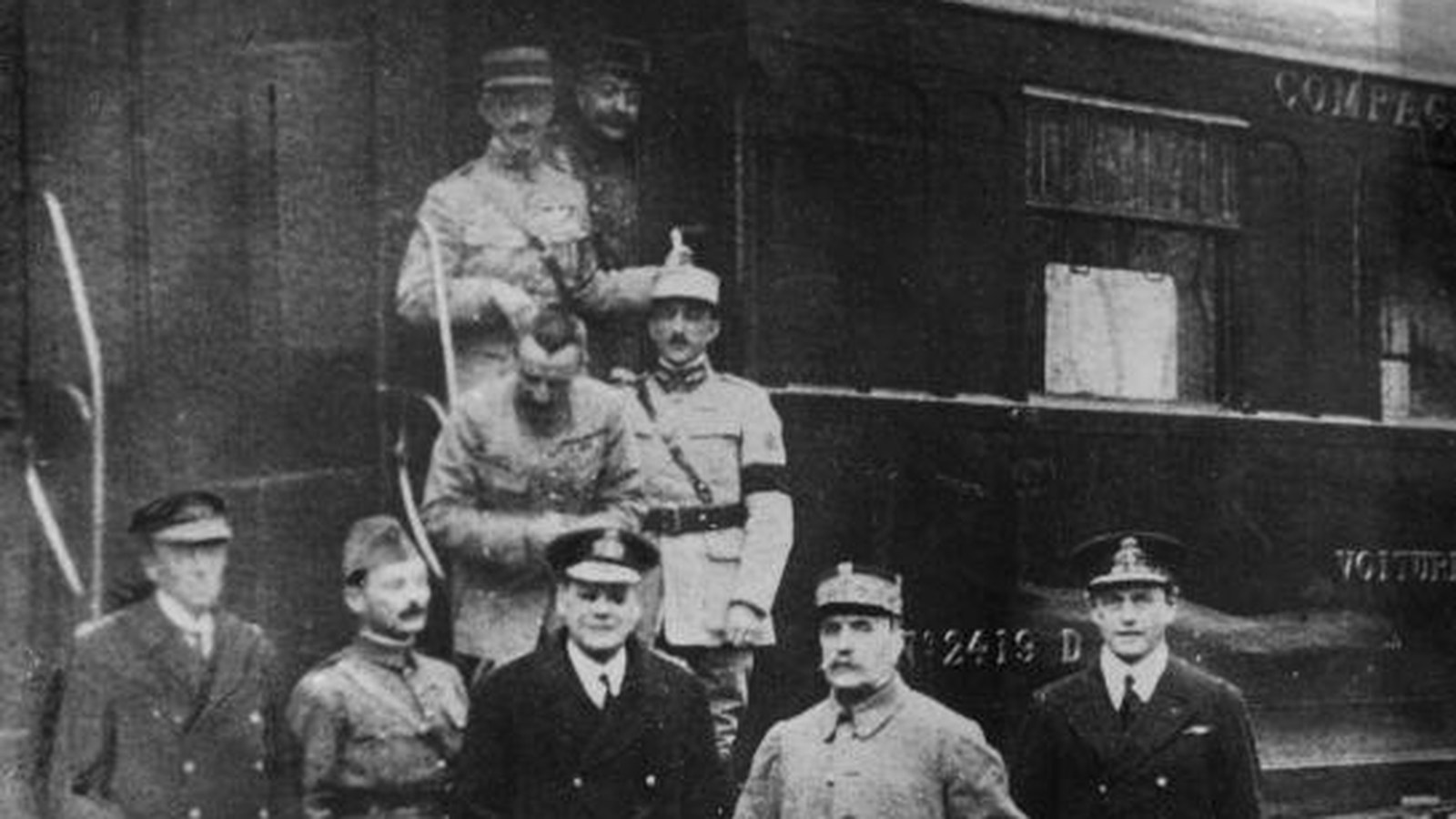
The Armistice of Compiègne was signed on 11 November 1918 at 5 a.m. French time, in Marshal Ferdinand Foch’s private railway carriage, on a siding in the forest near Compiègne. It came into force at 11 a.m. Paris time. For the Entente the signatories were Foch and Admiral Rosslyn Wemyss; for Germany, Matthias Erzberger, Count Alfred von Oberndorff, Major-General Detlof von Winterfeldt and Captain Ernst Vanselow. Erzberger’s delegation crossed the front on 8 November and was given 72 hours. Foch appeared twice: to ask what they wanted and to see the signatures. Ebert ordered the signing on 10 November, after a message from Hindenburg.
The 35 articles, presented on 8 November, are punitive. Article 1 stops operations on land and in the air six hours after signature. Article 2 requires the evacuation of Belgium, France, Alsace-Lorraine and Luxembourg within 14 days; troops still there become prisoners of war. Article 4 surrenders 5,000 guns, 25,000 machine guns, 3,000 minenwerfer and 1,700 aircraft. Article 5 empties the left bank of the Rhine; Mainz, Koblenz and Cologne, with 30-kilometre bridgeheads on the right bank, are occupied; a 10-kilometre neutral zone runs to the Swiss frontier. The total delay is 31 days. The upkeep of the occupying troops falls on Germany.
Article 7 delivers 5,000 locomotives, 150,000 wagons and 5,000 motor lorries. Article 10 releases Allied prisoners without reciprocity; German prisoners wait for the preliminaries of peace. Articles 12–15 withdraw German troops from Austria-Hungary, Romania, Turkey and, when the Allies decide, from Russia, to the frontiers of 1 August 1914, and renounce Brest-Litovsk and Bucharest. Article 17 evacuates East Africa. Article 19 demands reparation, restitution of the Belgian National Bank deposit and of the Russian and Romanian gold.
At sea, article 22 surrenders all submarines within 14 days. Article 23 intern six battle cruisers, ten battleships, eight light cruisers and 50 destroyers. Article 26 keeps the blockade, with a clause on provisioning Germany “to the extent recognized as necessary”. Article 34 gives the armistice 30 days, extendable, with a permanent international armistice commission. The signatures: Foch, Wemyss, Erzberger, Oberndorff, Winterfeldt, von Salow.
The armistice was prolonged three times, until peace was ratified at 4:15 p.m. on 10 January 1920. Versailles, signed on 28 June 1919, took over the Rhineland occupation. In Germany the High Command pushed the blame onto the socialists in Berlin — the seed of the “stab in the back” that haunted the Weimar Republic. In the forest of Compiègne the same carriage was brought back in 1940, when Hitler imposed the armistice on France.
Sources: Armistice of 11 November 1918; FirstWorldWar.com, Allied Armistice Terms, 11 November 1918.










0 Comments
No comments on this article yet. Be the first!