


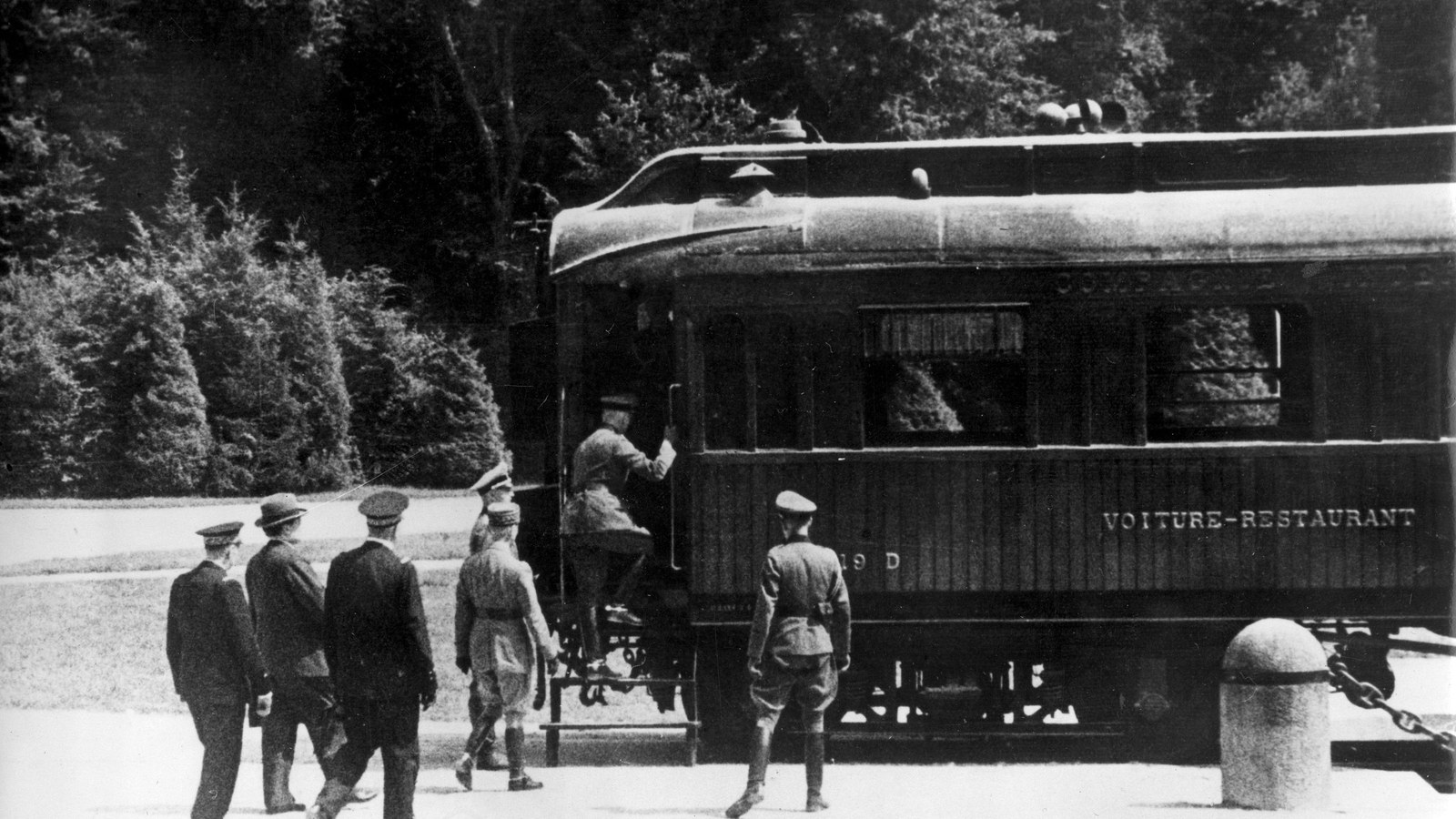
Reynaud resigned on 16 June. Petain took the government. The armistice was signed in the Forest of Compiegne on 22 June 1940, at 6:50 p.m. German summer time, in the same Foch railway car as in 1918. For the OKW: Wilhelm Keitel, commissioned by Hitler. For France: Charles Huntziger, chairman of the delegation; Leon Noel; Rear Admiral Le Luc; Generals Parisot and Bergeret. Hitler heard the preamble on 21 June, then left, as Foch had in 1918. Huntziger telephoned Bordeaux, to Weygand.
Article 1: cessation of fighting against the German Reich in France, colonies, protectorates, mandates and on the seas; units already encircled lay down their arms. Article 2: occupation of territory north and west of the line on the attached map. The appendix: from the Swiss border at Geneva, through Dole, Paray-le-Monial, Bourges, about twenty kilometres east of Tours, then along the Tours-Angouleme-Libourne line, through Mont-de-Marsan and Orthez, to the Spanish border. Article 3: the Reich exercises all rights of an occupying power; the intention to limit occupation of the west coast after hostilities with England. The French Government may choose its seat in unoccupied territory or in Paris.
Article 4: demobilisation, except units needed for domestic order, whose strength Germany and Italy will fix. Article 8: the war fleet is to collect in designated ports and demobilise under German or Italian control, except units for the colonial empire. The Reich solemnly declares it does not intend to use the fleet in harbours under German control for war, save for coast guard and minesweeping, and will make no demand for the fleet at a peace. Article 18: France bears the costs of the occupation troops. Article 19: surrender of German prisoners and, on demand, of Germans named by the Reich, including in the colonies. Article 20: French troops in German camps remain prisoners of war until a peace treaty.
Article 23: the agreement becomes effective when France also reaches an agreement with Italy; hostilities stop six hours after Italy notifies the Reich. Article 24: valid until a peace treaty; Germany may terminate it at once if France fails to fulfil its obligations. The Franco-Italian armistice, 24 June. The cease-fire, 25 June. No final peace was signed. The free zone was occupied in November 1942, Case Anton.
This is not the armistice of 11 November 1918, and not the Franco-Dutch treaty of 1624, also at Compiegne. The cover is restaurant car 2419 D, on the day of signing; the French delegation boards.
Sources: Armistice of 22 June 1940; Armistice Agreement between the German High Command of the Armed Forces and French Plenipotentiaries, Compiègne, June 22, 1940.










0 Comments
No comments on this article yet. Be the first!