


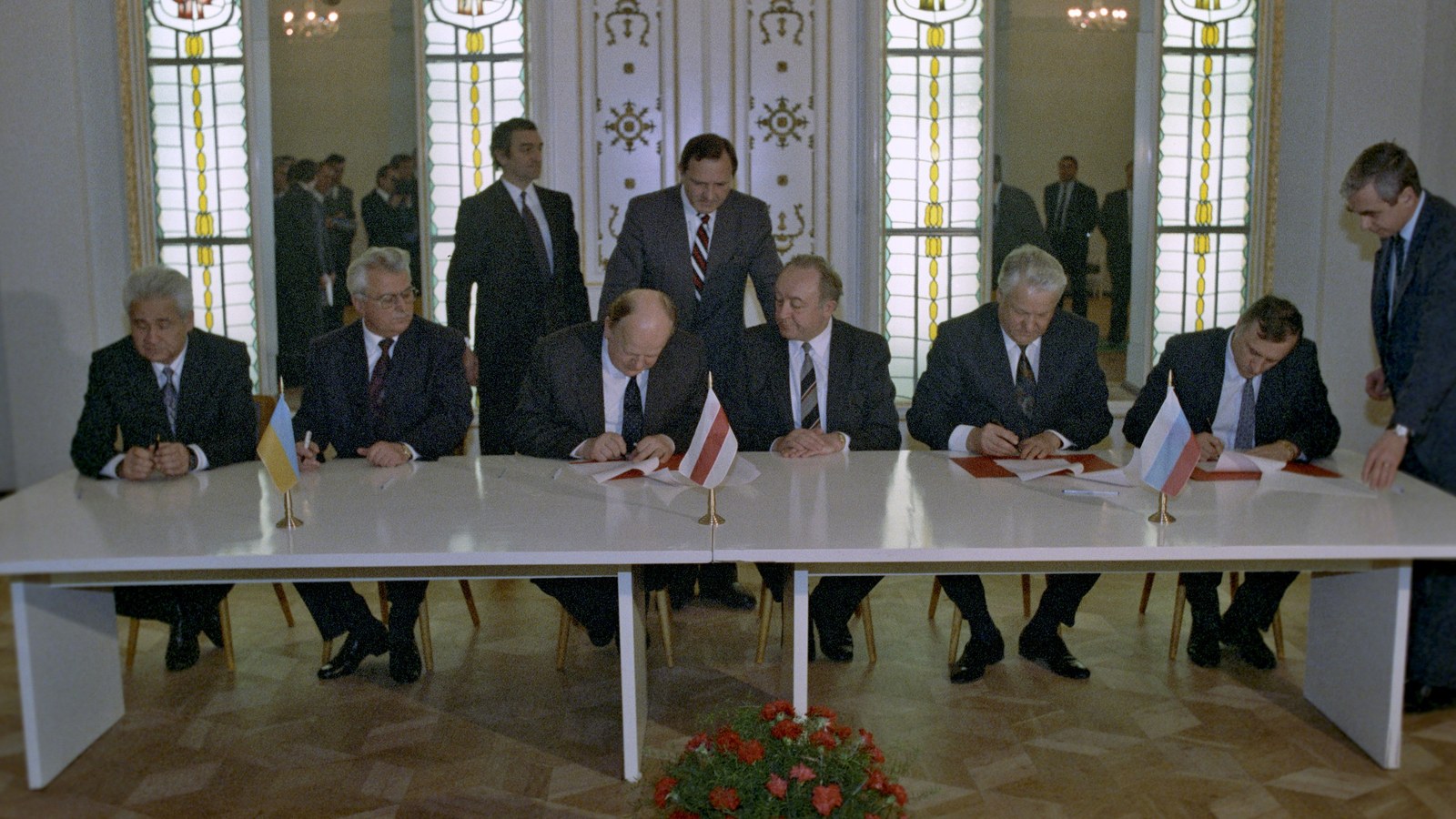
After the failed August 1991 putsch, the Novo-Ogaryovo draft for a Union of Sovereign States was left without Ukraine. The 1 December referendum showed that Kyiv was leaving. On 30 November Boris Yeltsin told George H. W. Bush that he could not imagine a union without Ukraine and that the tie with Kyiv mattered more than those with the Asian republics. The Soviet secession law of 3 April 1990 was not used. The three relied on the 1922 Treaty on the Creation of the USSR and on the 1969 Vienna Convention: Transcaucasia, the fourth 1922 signatory, had ceased to exist in 1936.
The Agreement on the creation of the Commonwealth of Independent States was signed on 8 December 1991, at the state dacha near Viskuli in the Belovezhskaya Forest, Belarus, de jure in Minsk. For Belarus the signatories were parliamentary chairman Stanislav Shushkevich and Prime Minister Vyacheslav Kebich; for the RSFSR, President Boris Yeltsin and First Deputy Prime Minister Gennady Burbulis; for Ukraine, President Leonid Kravchuk and Prime Minister Vitold Fokin. The depositary is Belarus. The Belarusian, Russian and Ukrainian texts are equally authentic. Immediately after the signing Yeltsin telephoned Bush and read him Article 6.
The preamble states that “the USSR, as a subject of international law and a geopolitical reality, ceases to exist”. Article 1 constitutes the Commonwealth of Independent States. Article 2 guarantees equal rights to citizens regardless of nationality, and the same rights to citizens of the other Parties. Article 3 places national minorities under protection. Article 5 recognises territorial integrity and existing borders within the Commonwealth, with freedom of movement. Article 6 preserves a common military-strategic space under unified command, including control of nuclear weapons, and respects the aspiration to nuclear-free-zone status.
Article 7 assigns to the common coordinating institutions foreign-policy coordination, the economic space, customs, transport, the environment, migration and organised crime. Article 8 recognises the planetary character of the Chernobyl disaster. Article 11 forbids, from the moment of signature, the application of the norms of third states, including the former USSR. Article 12 guarantees the international obligations arising from Soviet treaties. Article 13 opens the agreement to the member states of the former union. Article 14 fixes the seat of the coordinating bodies in Minsk and ends the activity of USSR organs on the members’ territory. Suspension requires one year’s notice.
The Verkhovna Rada in Kyiv and the Supreme Council of Belarus ratified on 10 December; the Supreme Soviet of the RSFSR, on 12 December, also denounced the 1922 treaty and recalled the Russian deputies from the USSR Supreme Soviet. Gorbachev objected that the fate of a multinational state could not be settled by three leaders. On 21 December, in Alma-Ata, eleven of the twelve remaining republics — all except Georgia — signed the protocol that restated the end of the USSR. Gorbachev resigned on 25 December; the next day the Soviet of Republics voted the Union out of existence. Russia took the Soviet Union’s United Nations seat, including the Security Council.
The RIA Novosti photograph, credited to Yu. Ivanov, shows the table at Viskuli. The original deposited in the State Archive of the Russian Federation was reported missing by the Belarusian foreign ministry in 2013, when Shushkevich asked for it for his memoirs.
Sources: Belovezha Accords; CIS Executive Committee, Agreement on the establishment of the Commonwealth of Independent States (Minsk, 8 December 1991).









0 Comments
No comments on this article yet. Be the first!