


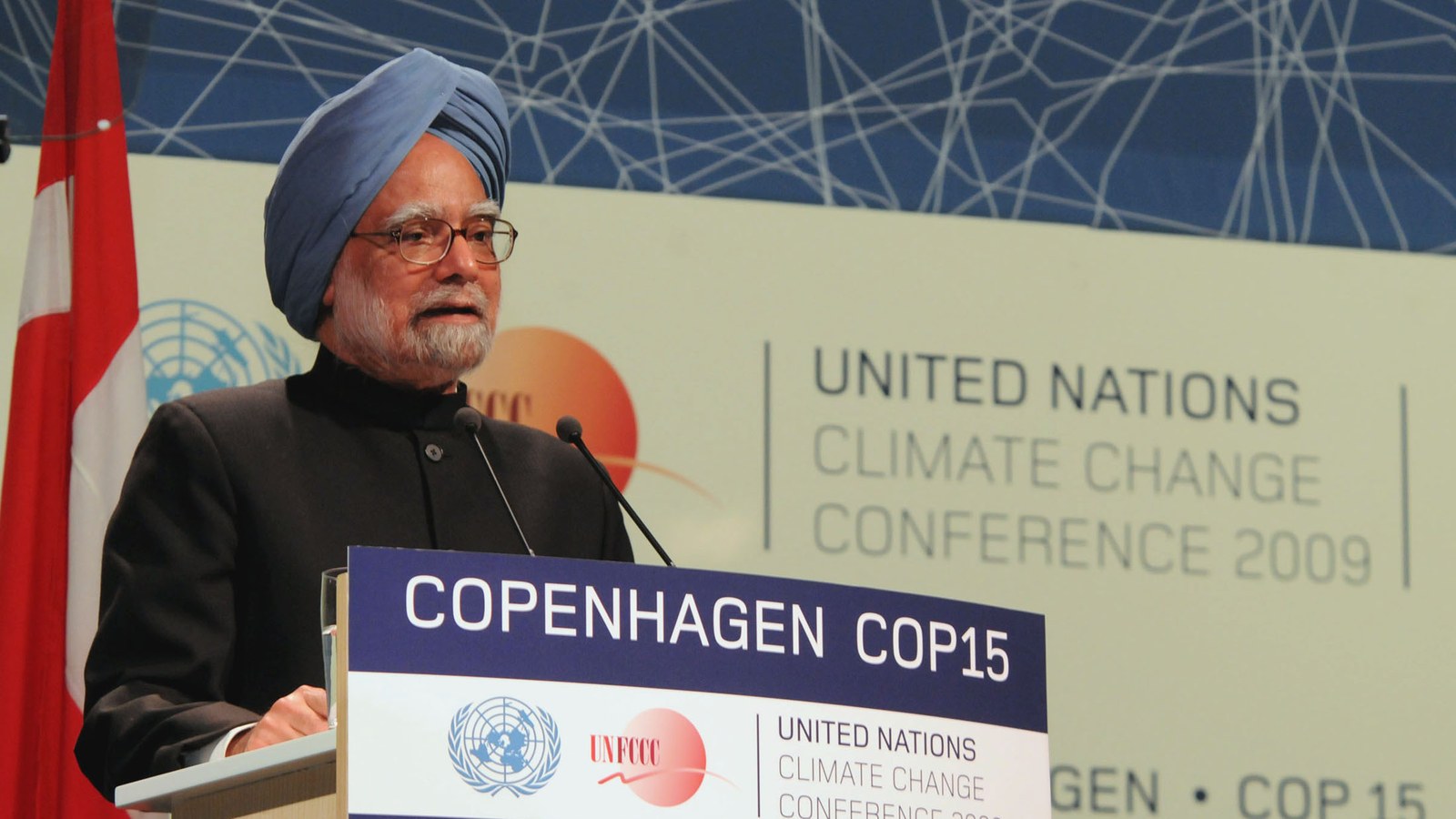
On 18 December 2009, in Copenhagen, the Conference of the Parties to the United Nations Framework Convention on Climate Change takes note, by decision 2/CP.15, of the Copenhagen Accord. The text is agreed by heads of State, heads of Government, ministers and other heads of delegation present at the conference and is declared operational immediately. It is not an instrument subject to ratification.
Paragraph 1 underlines that climate change is one of the greatest challenges of our time and a strong political will to combat it urgently, in accordance with the principle of common but differentiated responsibilities and respective capabilities. To achieve the ultimate objective of the Convention — to stabilize greenhouse gas concentrations in the atmosphere at a level that would prevent dangerous anthropogenic interference — it recognizes the scientific view that the increase in global temperature should be below 2 degrees Celsius. Paragraph 2 requires deep cuts in global emissions, as documented by the IPCC Fourth Assessment Report, and cooperation in achieving the peaking of emissions as soon as possible, recognizing that the time frame for peaking will be longer in developing countries, where social and economic development and poverty eradication remain first and overriding priorities.
Paragraph 3 addresses adaptation to the adverse effects of climate change and the potential impacts of response measures. It requires enhanced action and international cooperation, especially for those that are particularly vulnerable: least developed countries, small island developing States and Africa. Developed countries shall provide adequate, predictable and sustainable financial resources, technology and capacity-building.
Paragraph 4 commits Annex I Parties to implement, individually or jointly, quantified economy-wide emissions targets for 2020, to be submitted to the secretariat by 31 January 2010 in the format of Appendix I; those that are also Parties to the Kyoto Protocol will thereby further strengthen the emissions reductions initiated there. Delivery of reductions and financing by developed countries will be measured, reported and verified. Paragraph 5 provides that non-Annex I Parties will implement mitigation actions, including those in Appendix II, by the same date; least developed countries and small island developing States may undertake actions voluntarily and on the basis of support. Actions will be subject to domestic measurement, reporting and verification, with national communications every two years; nationally appropriate mitigation actions seeking international support will be recorded in a registry and subject to international measurement, reporting and verification, with national sovereignty respected.
Paragraph 6 recognizes the crucial role of reducing emissions from deforestation and forest degradation and agrees on positive incentives through a mechanism including REDD-plus. Paragraph 7 decides to pursue various approaches, including markets, to enhance the cost-effectiveness of mitigation, and incentives for low-emitting economies.
Paragraph 8 requires scaled up, new and additional, predictable and adequate funding. The collective commitment by developed countries is to provide new and additional resources approaching USD 30 billion for 2010–2012, with balanced allocation between adaptation and mitigation, adaptation being prioritized for the most vulnerable. In the context of meaningful mitigation actions and transparency on implementation, developed countries commit to a goal of mobilizing jointly USD 100 billion a year by 2020, from public and private, bilateral and multilateral sources. A significant portion should flow through the Copenhagen Green Climate Fund. Paragraph 9 establishes a High Level Panel on potential sources of revenue. Paragraph 10 establishes the Copenhagen Green Climate Fund as an operating entity of the financial mechanism of the Convention. Paragraph 11 establishes a Technology Mechanism, guided by a country-driven approach. Paragraph 12 calls for an assessment of implementation to be completed by 2015, including consideration of strengthening the long-term goal, including in relation to temperature rises of 1.5 degrees Celsius.
It is not the Kyoto Protocol of 1997. It is not the Paris Agreement of 2015.
Image: Manmohan Singh at COP15, Copenhagen; Prime Minister Office of India, 18 December 2009; GODL-India, Wikimedia Commons. Cropped to 16:9.
Source consulted: Copenhagen Accord. Treaty text: Copenhagen Accord, decision 2/CP.15, Copenhagen, 18 December 2009.










0 Comments
No comments on this article yet. Be the first!