


On 18 March 1962, at Évian-les-Bains, the Government of the French Republic and the Algerian National Liberation Front (F.L.N.) close the talks opened on 7 March. Louis Joxe, Minister of State for Algerian Affairs, and Krim Belkacem, for the Algerian delegation, sign. The official instruments are not styled a treaty: they are the governmental declarations of 19 March 1962, published in the Journal officiel the next day. A cease-fire is concluded. Military operations and the armed struggle come to an end throughout Algerian territory on 19 March 1962 at 12 noon.
Chapter I of the General Declaration: the vote on self-determination will enable the electors to say whether they wish Algeria to be independent and, in that case, whether they wish France and Algeria to co-operate under the conditions defined by the declarations. The vote takes place throughout Algerian territory, in fifteen Departments; the results of the voting offices are totalled and proclaimed for the entire territory. Until self-determination: a Provisional Executive and a Court of Law and Order; the Republic is represented by a High Commissioner, depositary of its powers in Algeria, particularly defence, security and the maintenance of law and order in the last resort. Those institutions, in particular the Provisional Executive, are installed as soon as the cease-fire enters into force. The F.L.N. is considered a legal political body. Persons interned, whether in France or in Algeria, are released within a maximum of twenty days from the cease-fire. An amnesty is proclaimed immediately; persons held in custody are released. Persons in refuge abroad may return; commissions sitting in Morocco and Tunisia facilitate that return. The vote: not less than three months and not more than six months after the Executive is installed.
Chapter II: if the solution of independence and co-operation is adopted, the content of the declarations is binding on the Algerian State. The Algerian State exercises its full and complete sovereignty internally and externally, including national defence and foreign affairs; it freely establishes its institutions and chooses its political and social regime; it subscribes unreservedly to the Universal Declaration of Human Rights; its institutions rest on democratic principles and on equality of political rights without discrimination of race, origin or religion; it applies, in particular, the guarantees to which citizens of French civil status are entitled. No one is subject to police or judicial measures on account of opinions expressed before the self-determination vote, or of acts committed before the proclamation of the cease-fire. No Algerian shall be forced to leave Algerian territory or prevented from leaving it. French citizens of ordinary civil status who meet the residence tests enjoy, ipso facto, for three years from self-determination, Algerian civil rights, and may not exercise French civil rights at the same time; thereafter they acquire Algerian nationality by applying for registration on the electoral rolls, or, failing that, the benefit of an establishment convention. Property rights are respected; no dispossession without fair compensation previously established.
Co-operation: Algeria guarantees the interests of France and the rights acquired by individuals and legal entities; France grants technical and cultural assistance and preferential financial aid, for three years, renewable, at a level equivalent to programmes then in operation. Algeria belongs to the franc area, with its own currency and its own foreign-exchange assets; transfers between the two countries are free, under conditions compatible with Algeria’s economic and social development. In the Departments of the Oases and the Saoura: a technical body for Saharan co-operation, with membership representing both sides equally; the Algerian State issues mining entitlements and enacts mining legislation in full sovereignty; French interests are assured through the Saharan petroleum code as it then stands, preference, other offers being equal, to French companies, and payment in French francs for Saharan hydrocarbons up to the supply of France and the other countries of the franc area.
Chapter III, if independence and co-operation are adopted: French forces, whose strength is gradually reduced from the cease-fire, are withdrawn from the frontiers of Algeria as soon as self-determination is realized; their strength is reduced to 80,000 men within twelve months of that date; repatriation is completed by the end of a second period of twenty-four months; military installations are evacuated pari passu. Algeria leases to France the use of the air and naval base at Mers-el-Kébir for fifteen years from self-determination, renewable by agreement; France recognizes the Algerian character of the territory of the base. Algeria also grants the use of certain military airfields, grounds, sites and installations. Chapter IV: differences by peaceful settlement, conciliation or arbitration; failing agreement on those procedures, each of the two States may have direct recourse to the International Court of Justice.
Chapter V: upon the official announcement provided for in article 27 of the regulations on self-determination, the instruments corresponding to those results are drawn up. If independence and co-operation are adopted, France immediately recognizes the independence of Algeria; the transfer of powers is effected forthwith; the rules in the General Declaration and the accompanying declarations enter into force at the same time. The Provisional Executive organizes, within three weeks, elections for the Algerian National Assembly, to which it transfers its powers.
The United Nations Treaty Series, volume 507, number 7395, registers on 24 August 1964 the exchange of letters at Paris and Rocher Noir of 3 July 1962, constituting an agreement, together with the declarations adopted on 19 March 1962 at the close of the Evian talks. This is not the proclamation of independence of 3 July 1962, and not the French referendum of 8 April 1962, in which the electors approved those same governmental declarations.
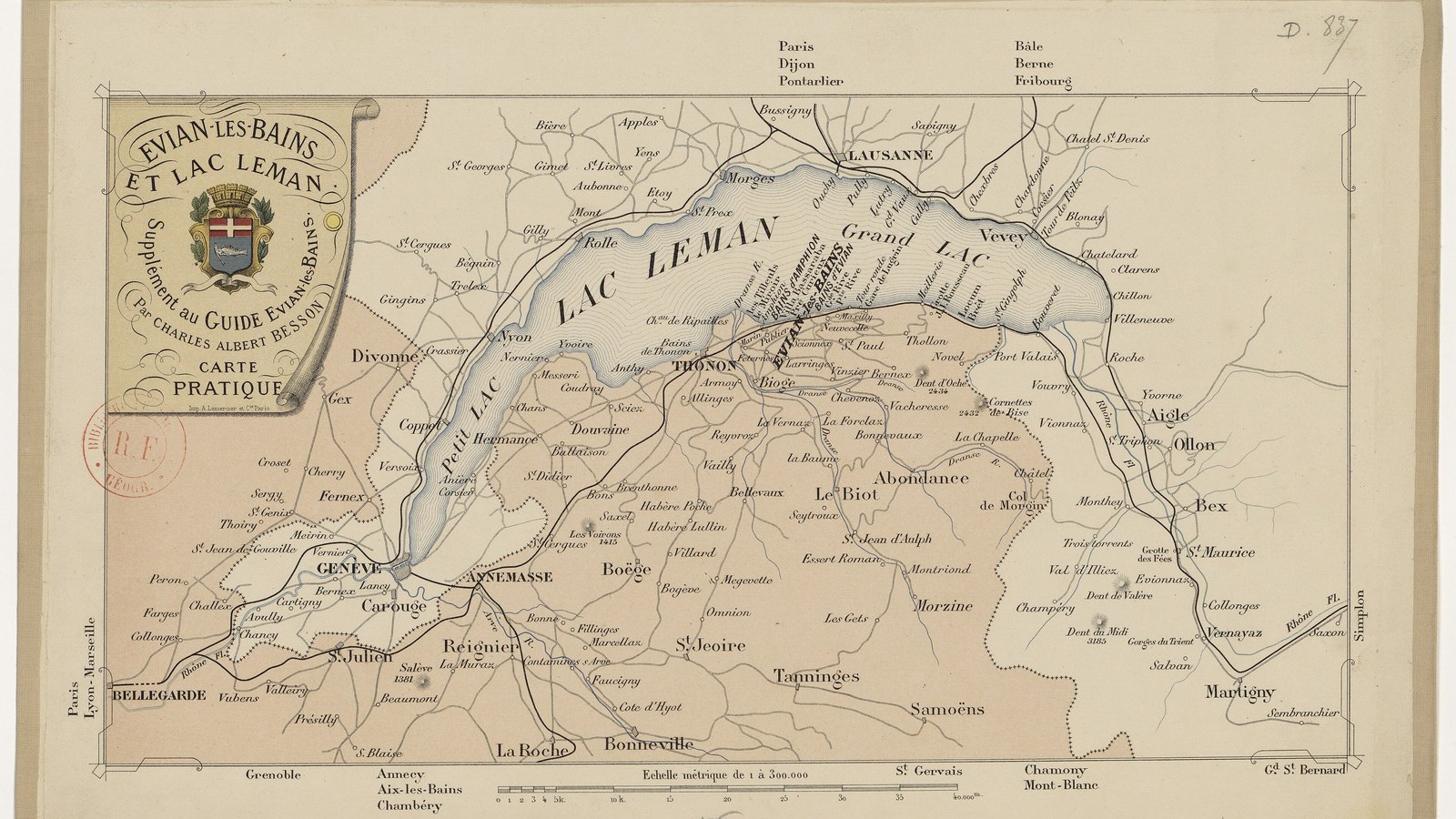
Image: Charles-Albert Besson, map of Évian-les-Bains and Lake Geneva, nineteenth-century guide, public domain, Bibliothèque nationale de France / Wikimedia Commons. Cropped to 16:9.
Source consulted: Évian Accords. Treaty text: UNTS vol. 507, no. 7395: Declarations adopted on 19 March 1962 at the close of the Evian talks.










0 Comments
No comments on this article yet. Be the first!