


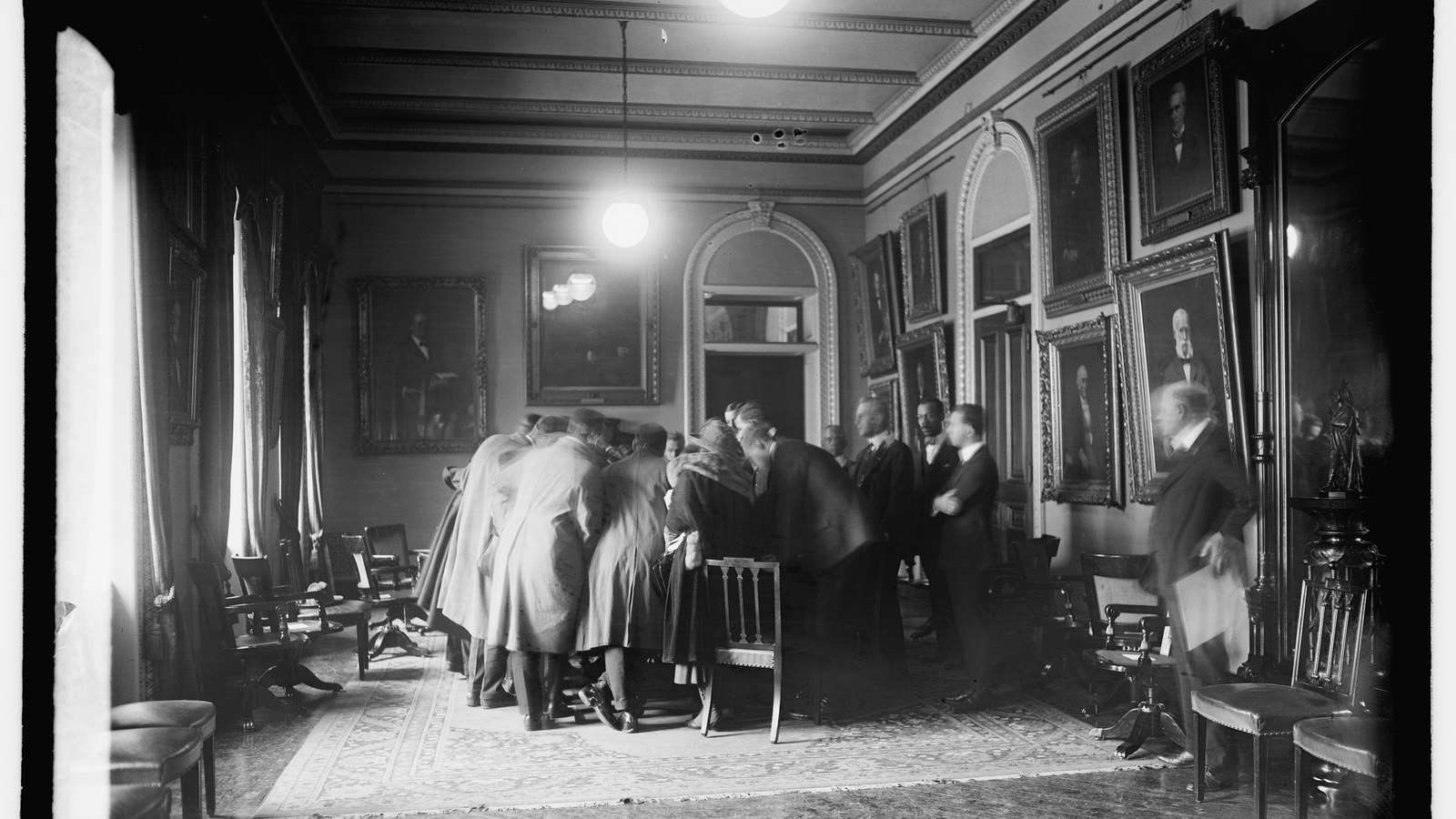
On 13 December 1921, in Washington, the United States, the British Empire, France and Japan sign the treaty relating to insular possessions and insular dominions in the region of the Pacific Ocean. The American plenipotentiaries are Charles Evans Hughes, Henry Cabot Lodge, Oscar W. Underwood and Elihu Root. For the British Empire, Arthur James Balfour, Baron Lee of Fareham and Auckland Campbell Geddes sign, together with the delegates of Canada, Australia, New Zealand, South Africa and India. France is represented by Rene Viviani, Albert Sarraut and Jules Jusserand; Japan by Baron Tomosaburo Kato, Baron Kijuro Shidehara, Prince Iesato Tokugawa and Masanao Hanihara.
The preamble states the purpose: the preservation of the general peace and the maintenance of the parties' rights in relation to their insular possessions and insular dominions in the Pacific. The authentic texts are French and English. The original remains in the archives of the Government of the United States, which transmits certified copies to the other signatory Powers.
Article I binds the parties, as between themselves, to respect their rights in relation to those possessions and dominions. If a controversy arises among them out of any Pacific question involving those rights, is not satisfactorily settled by diplomacy and is likely to affect the harmonious accord among them, the other High Contracting Parties shall be invited to a joint conference to which the whole subject will be referred for consideration and adjustment.
Article II provides that if those rights are threatened by the aggressive action of any other Power, the parties shall communicate with one another fully and frankly in order to arrive at an understanding as to the most efficient measures to be taken, jointly or separately, to meet the exigencies of the particular situation. Article III fixes the duration: ten years from the time the treaty takes effect, after which it continues in force subject to the right of any party to terminate it upon twelve months' notice.
Article IV requires ratification as soon as possible in accordance with the constitutional methods of each party, and provides that the treaty shall take effect on the deposit of ratifications, which shall take place at Washington. Thereupon the agreement between Great Britain and Japan concluded at London on 13 July 1911 shall terminate. The Government of the United States will transmit to all the Signatory Powers a certified copy of the proces-verbal of the deposit. Deposit took place later, on 17 August 1923; the United States proclaimed the treaty on 21 August 1923.
A supplementary declaration, signed the same day, records two understandings. The treaty shall apply to the Mandated Islands in the Pacific Ocean, provided that this shall not be deemed an assent by the United States to the mandates and shall not preclude later agreements with the Mandatory Powers. The controversies referred to in the second paragraph of Article I shall not embrace questions which, according to principles of international law, lie exclusively within the domestic jurisdiction of the respective Powers.
It is not the Five-Power Naval Treaty signed at Washington on 6 February 1922, and not the Nine-Power Treaty relating to China, signed the same day. It is not the Anglo-Japanese Alliance of 1902, which Article IV brings to an end only upon the deposit of ratifications, by terminating the 1911 renewal.
Image: Correspondents viewing the Four-Power Treaty, Washington, 13 December 1921; National Photo Company Collection; public domain, Wikimedia Commons. Cropped to 16:9.
Source consulted: Four-Power Treaty. Treaty text: Treaty between the United States of America, the British Empire, France, and Japan, Washington, 13 December 1921.











0 Comments
No comments on this article yet. Be the first!