
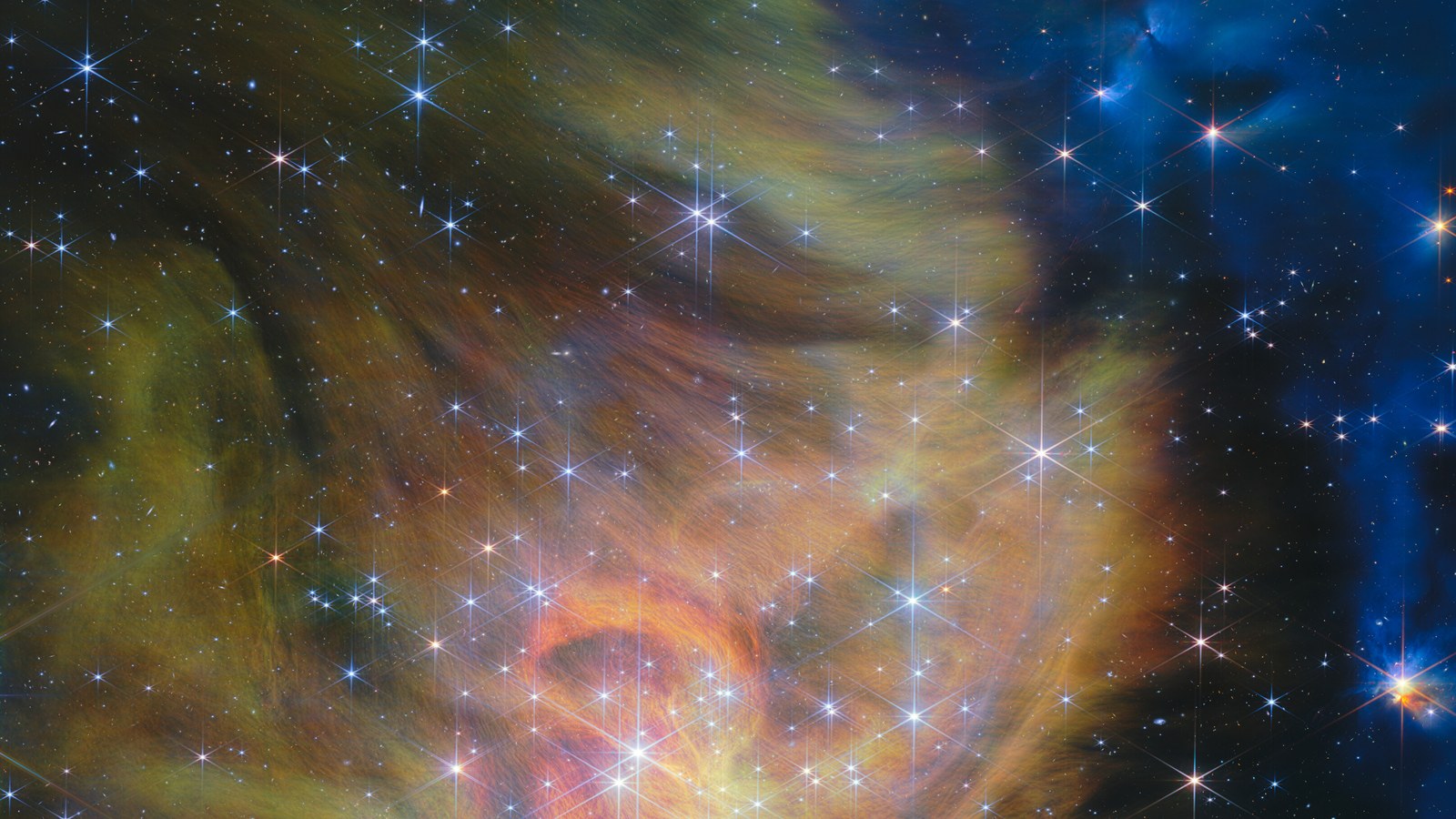
NASA published on 15 September 2026 a panorama of the star-forming region IC 348, taken with the James Webb Space Telescope and described as one of the largest Webb images released to the public so far. IC 348 lies about 1,000 light-years away in the constellation Perseus.
The NIRCam image highlights clouds of gas and dust, young stars and jets from protostars. A team led by Kevin Luhman (Pennsylvania State University) used NIRCam in 2024 to select candidates, then NIRSpec in 2025 for spectroscopy. The observations identified brown dwarfs with masses as low as about twice that of Jupiter — around 0.19% of the Sun’s mass. NASA describes them as the least massive brown dwarfs known, below what some star-formation models predict.
Brown dwarfs form through the collapse of molecular clouds, as stars do, but never become hot enough to fuse ordinary hydrogen into helium. One of the extremely light objects shows signs of a disk, raising the possibility that still smaller bodies could form around an object of planetary mass. Spectra also revealed a feature attributed to an unidentified hydrocarbon previously seen in the atmospheres of the lowest-mass brown dwarfs.
The panorama includes Herbig-Haro objects, including HH 797 and HH 211, produced when jets from very young stars crash into surrounding gas. The data come from General Observer program 4866. The astronomical image is a filter composite, not a natural-colour view. Another Webb image published today on RoAdevăr looks at galaxy M64.
Image: NASA, ESA, CSA, Kevin Luhman (PSU), Catarina Alves de Oliveira (ESA), Mahdi Zamani (ESA/Webb). NIRCam composite, not natural colour. Cropped to 16:9.
Source consulted: NASA’s Webb Reveals Dynamic Panorama of Star Formation | NASA Science; Webb reveals stunning panorama of star formation | ESA/Webb.









0 Comments
No comments on this article yet. Be the first!