


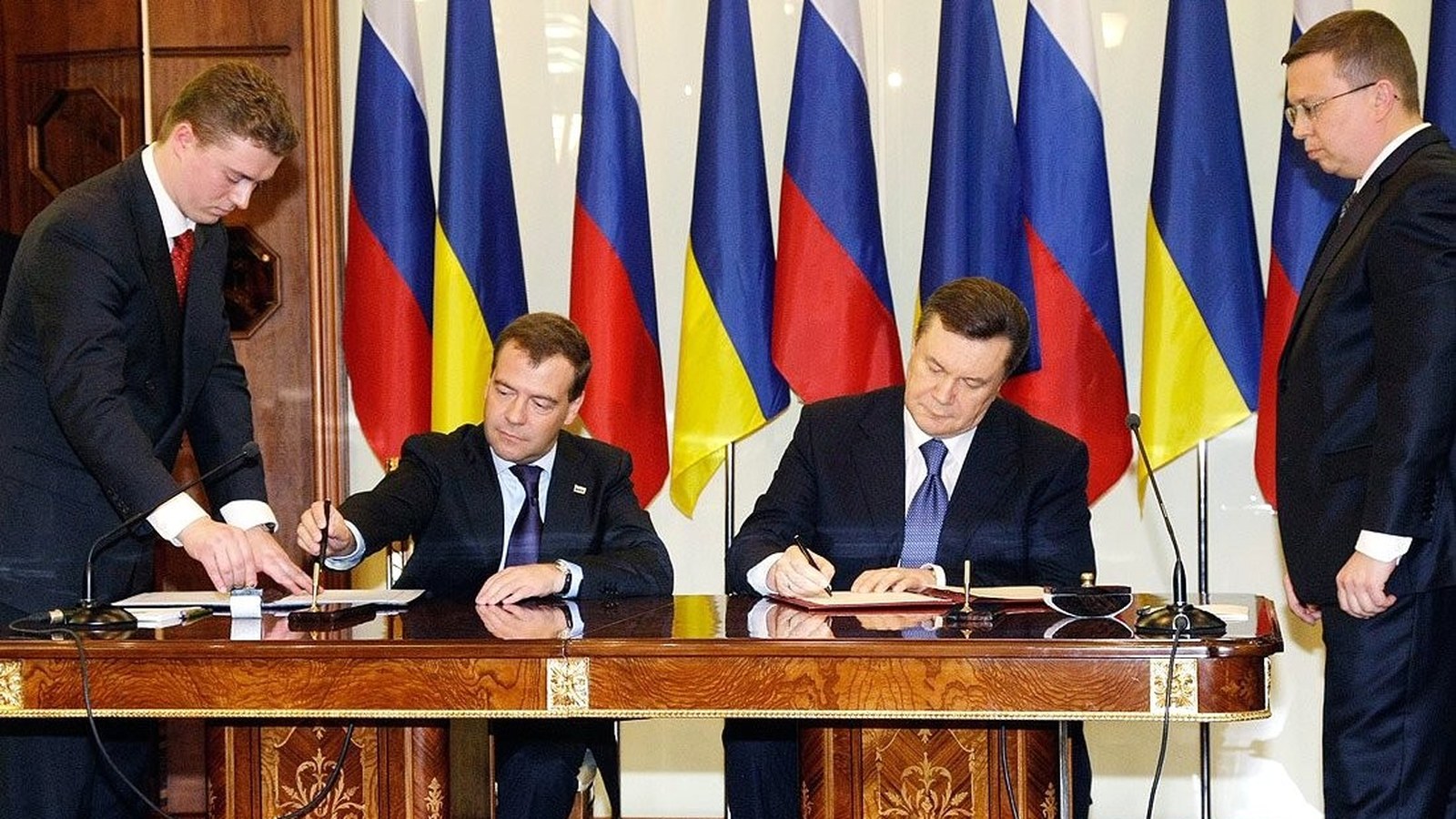
In 1997 Kiev and Moscow partitioned the Black Sea Fleet and left the Sevastopol base on a Russian lease until 2017. Under Viktor Yushchenko, the Ukrainian government said the term would not be extended. After Viktor Yanukovych’s election, Prime Minister Mykola Azarov and energy minister Yuriy Boyko went to Moscow, in March 2010, to ask for cheaper gas. The agreement, three articles, was signed on 21 April 2010, in Kharkiv. For Ukraine: Yanukovych. For Russia: Dmitry Medvedev. The original, in duplicate, Ukrainian and Russian, of equal force.
Article 1 extends, from 28 May 2017, the three basic 28 May 1997 accords: the status and conditions of the stationing, the parameters of the fleet’s partition, and the mutual settlements. Plus twenty-five years, to 28 May 2042, with automatic five-year renewals unless either party gives written notice, a year in advance, that it wants to stop.
Article 2: the rent, also from 28 May 2017, is one hundred million dollars a year, plus the sums from the gas discount applied from the day the agreement enters into force. The cut, of up to one hundred dollars per thousand cubic metres, off the Naftogaz–Gazprom contract price, on the agreed volume: if the price is 333 dollars or above, one hundred come off; if it is lower, thirty per cent of the price. The sums accumulate year by year and are held as Ukraine’s obligation, discharged by Article 1, that is by the extension of the stationing.
Article 3 requires ratification. It enters into force on the last notice that each party has completed its domestic procedures. The Rada and the Duma ratified on the same day, 27 April 2010. In Kyiv: 236 votes in favour, none against, of 450 seats; 212 deputies absent. Eggs, smoke bombs and fists flew in the chamber. Ukrainian law 2153-VI. For Ukraine, the agreement took effect on 14 May 2010.
The opposition called the text a sale of national interest. Yulia Tymoshenko said it violated the Constitution, which bars foreign military bases after 2017. Our Ukraine called for Yanukovych’s impeachment. Taras Kuzio wrote that the bill passed without real debate and that public support was won by a lie about cheaper gas: a later IMF agreement required utility prices to rise.
After the annexation of Crimea, Putin asked the Duma, on 28 March 2014, to denounce the fleet agreements, including the Kharkiv Pact. The Duma voted the unilateral denunciation on 31 March 2014, 433 votes. The Prosecutor General opened a case against Yanukovych. In 2022 former ministers Kostyantyn Hryshchenko and Oleksandr Lavrynovych were charged in absentia with high treason for the signing. The cover is Medvedev and Yanukovych at the Kharkiv signing table; the Commons original is 1100 by 678 pixels.
Sources: Kharkiv Pact; Угода між Україною та Російською Федерацією з питань перебування Чорноморського флоту Російської Федерації на території України.









0 Comments
No comments on this article yet. Be the first!