


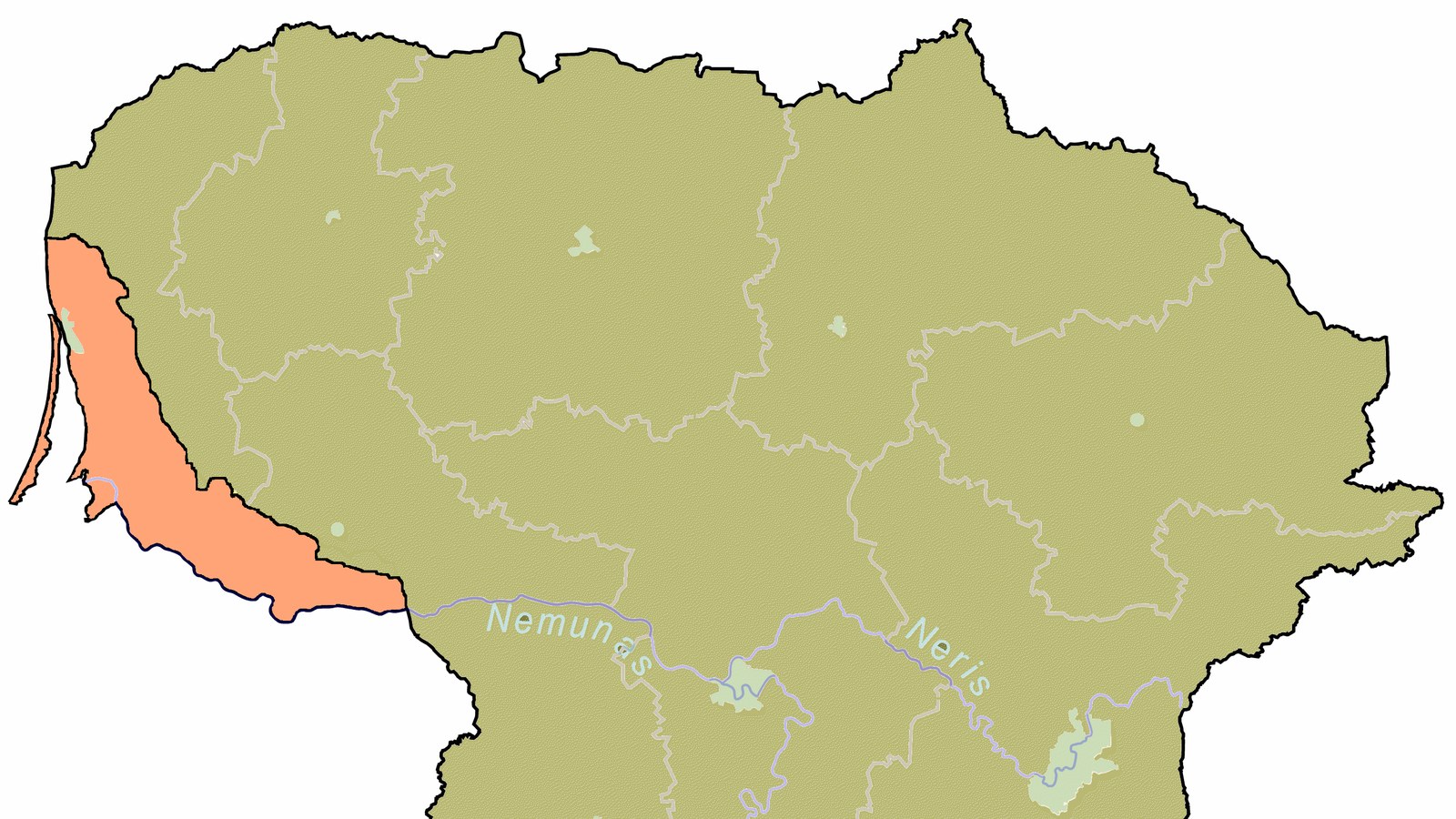
In Paris, on 8 May 1924, the Marquess of Crewe, British ambassador, Raymond Poincaré, president of the Council and French foreign minister, Baron Camillo Romano Avezzana, Italian ambassador, Viscount Ishii Kikujirō, Japanese ambassador, and Ernestas Galvanauskas, president of the Lithuanian Council and foreign minister, signed the Convention concerning the Territory of Memel. The British Empire, France, Italy and Japan, signatories with the United States of the Treaty of Versailles, transfer to Lithuania, subject to the convention, all rights and titles ceded by Germany under Article 99 of the peace treaty over the land between the Baltic Sea, the north-eastern frontier of East Prussia and the former German–Russian frontier.
Versailles had detached the territory from Germany and placed it under Allied administration, with a French garrison. In January 1923 the Klaipėda Revolt put local control in Lithuanian hands. The Conference of Ambassadors recognised the transfer on 16 February 1923; Lithuania accepted on 13 March. This convention is not that revolt, nor Article 99 of 1919, nor the League Council’s adoption of the text on 14 March 1924 after Norman Davis’s commission reported.
Talks chaired by Jules Laroche stalled while the Allied drafts reserved wide Polish rights in the port. Lithuania, having broken diplomatic relations with Warsaw over Vilnius, rejected those clauses. The League Council adopted the text in March 1924 despite Polish protests. The signed version gives Poland no special regime in the harbour.
Article 2 places the Memel Territory, under Lithuanian sovereignty, as a unit with legislative, judicial, administrative and financial autonomy within the statute in Annex 1. Article 3 binds Lithuania to Annex 2 on the port and Annex 3 on transit. Article 4 requires repayment of occupation and administration costs and half the delimitation costs. Articles 5–7 transfer German state property, with the stated exceptions, and tie Lithuania to Articles 254 and 256 of Versailles, with a first mortgage in favour of the Reparation Commission.
Former German nationals over 18, domiciled in the territory at least since 10 January 1920, acquire Lithuanian nationality ipso facto; they may opt for German nationality within 18 months of Lithuanian ratification and must then move to Germany within two years. Military service is deferred until 1 January 1930. Article 15 forbids transfer of sovereignty without the consent of the contracting parties. Article 17 lets any League Council member flag an infraction; differences of law or fact go, on request, to the Permanent Court of International Justice.
The statute, 38 articles, is enacted in Lithuania’s name. The president of the republic appoints a governor; the territory has a diet elected for three years and a five-member Directorate that remains in office while it has the diet’s confidence. Lithuanian and German are equal official languages. The port is of international concern: a three-member Harbour Board — one appointed by the Lithuanian government, one by the Directorate, the third by the League, who must not be a citizen of a Neman riparian state — administers, operates and develops the harbour. The transit annex guarantees freedom of transit, especially timber on the Neman. The convention is not the German ultimatum of 1939, which demanded the territory’s return.
Article 18 states that the French and English texts are equally authentic, that ratifications are deposited in Paris, and that the act enters into force once they are deposited. A single copy remains in the archives of the French Republic. Lithuania registered the convention with the League Secretariat; British ratification was deposited in Paris on 25 August 1925, after which the act had full effect among the Entente powers.
Image: Memel Territory within Lithuania; Wiskandar, CC BY-SA 3.0, Wikimedia Commons. Cropped to 16:9.
Source consulted: Klaipėda Convention. Treaty text: UKTS Cmd. 2541: Convention respecting the Memel Territory, 8 May 1924.










0 Comments
No comments on this article yet. Be the first!