


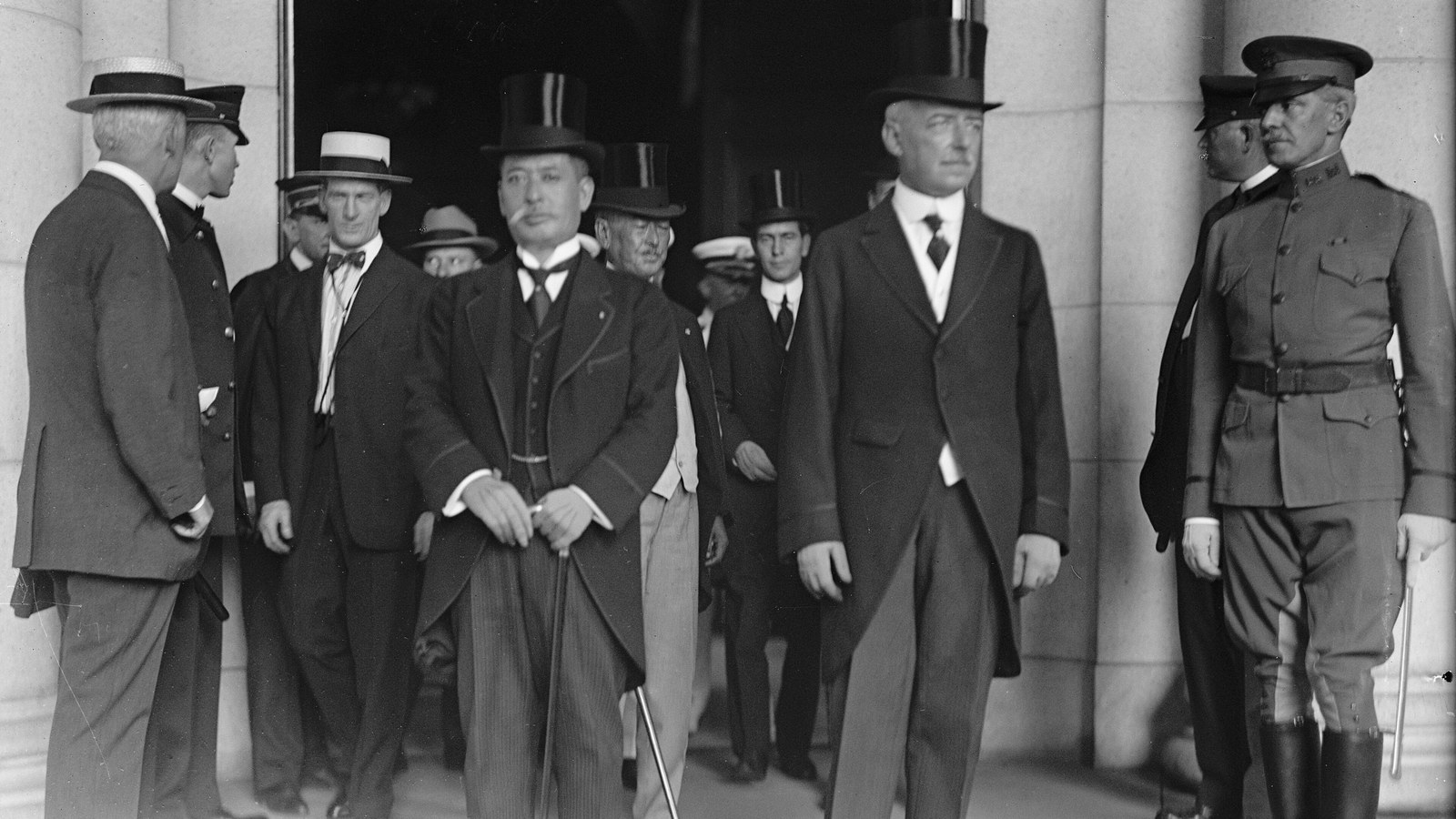
On 2 November 1917, at the Department of State, Washington, Secretary of State Robert Lansing and Viscount Ishii Kikujirō, Ambassador Extraordinary of Japan on special mission, effected an agreement by exchange of notes on mutual interests relating to the Republic of China. Lansing set down the understanding reached in their recent conversations; Ishii confirmed it, under authorization of his Government, in the same terms. That morning they also signed, in duplicate, a confidential protocol. It is not a multilateral treaty and not the Root–Takahira Agreement of 1908. China is not a party.
The notes recognize that territorial propinquity creates special relations between countries; consequently the Government of the United States recognizes that Japan has special interests in China, particularly in the part to which her possessions are contiguous. China’s territorial sovereignty nevertheless remains unimpaired. Washington has every confidence in the Imperial Japanese Government’s repeated assurances that, while geographical position gives Japan such special interests, they have no desire to discriminate against the trade of other nations or to disregard commercial rights already granted by China in treaties with other powers.
Both Governments deny any purpose to infringe the independence or territorial integrity of China and declare that they always adhere to the so-called “open door” or equal opportunity for commerce and industry in China. They mutually declare that they are opposed to the acquisition by any Government of special rights or privileges that would affect China’s independence or territorial integrity or deny to the subjects or citizens of any country the full enjoyment of equal opportunity. The text is a public announcement of shared desires and intentions, to silence mischievous reports.
The confidential protocol records that discussion had arisen of embodying in the public declaration a clause that the two Governments “will not take advantage of the present conditions to seek special rights or privileges in China which would abridge the rights of the subjects or citizens of other friendly states.” The clause was eliminated from the declaration as superfluous in the relations of the two Governments and liable to create an erroneous impression in the public mind. It was well understood that the principle in the suppressed clause remained in perfect accord with the declared policy. The protocol is not the public note.
Publication of the notes was deferred by agreement: the United States on the afternoon of 6 November, Japan on the morning of 7 November, so the times would coincide. The American series numbers them Treaty Series No. 630. This is not the Nine-Power Treaty of 6 February 1922. By an exchange of notes at Washington on 14 April 1923 the two Governments agreed to consider the 1917 correspondence cancelled and of no further force or effect, in the light of the understandings of the Washington Conference.
The notes do not name Manchuria; the formula is “the part to which her possessions are contiguous.” This is not the text of the Twenty-One Demands of 1915. Chinese objections are not part of the day’s instrument.
Viscount Ishii Kikujirō and Robert Lansing, Washington. Wikimedia Commons, public domain. Not confirmed as the room of the exchange of notes.
For context: Lansing–Ishii Agreement. The text: FRUS 1917, Lansing to Ishii.











0 Comments
No comments on this article yet. Be the first!