


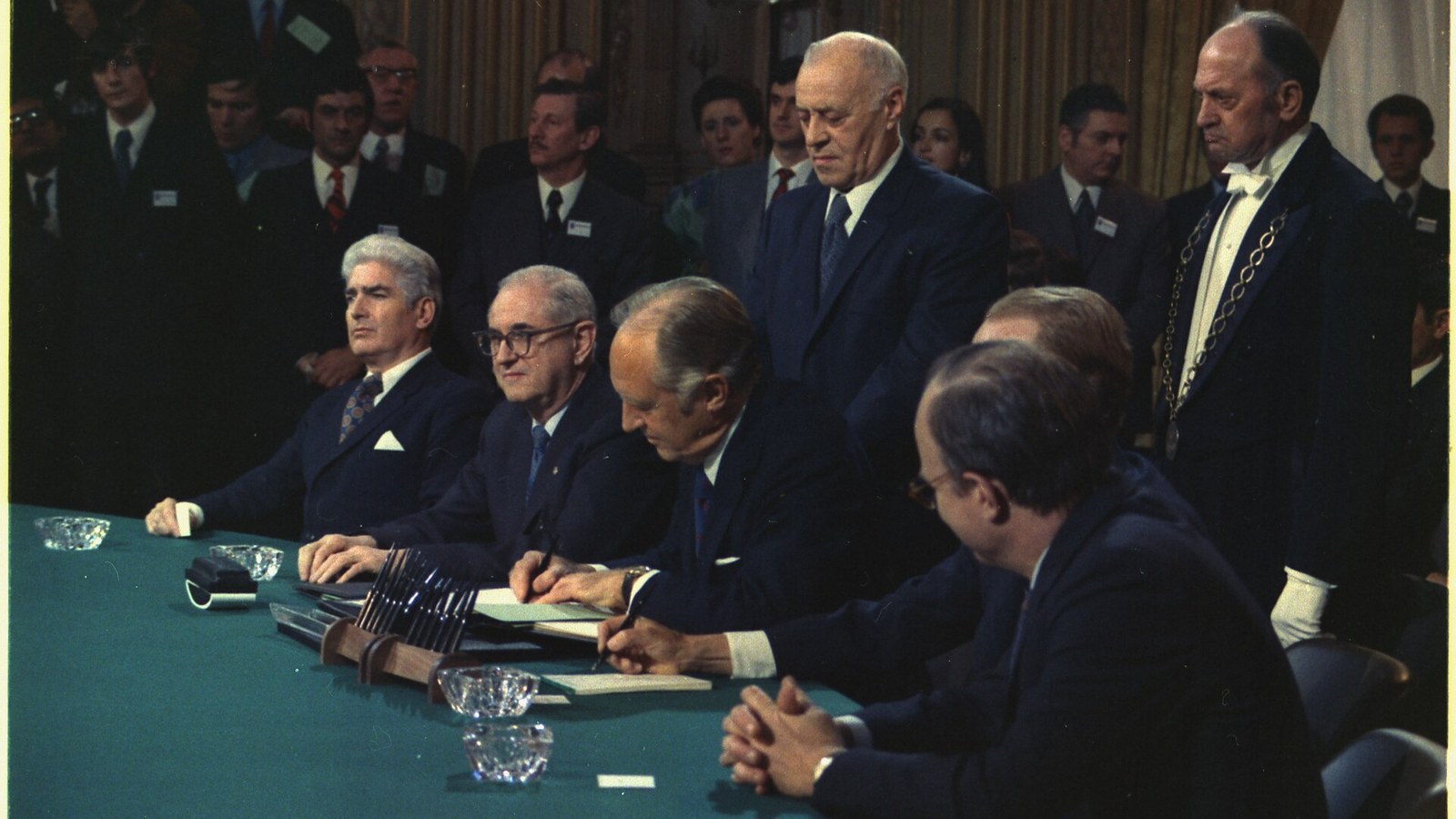
On 27 January 1973, at the Hôtel Majestic in Paris, the Agreement on Ending the War and Restoring Peace in Viet-Nam is signed. Official texts: English and Vietnamese, equally authentic. Plenipotentiary signatories: William P. Rogers, United States Secretary of State; Nguyễn Duy Trinh, for the Democratic Republic of Viet-Nam; Trần Văn Lắm, for the Republic of Viet-Nam; Nguyễn Thị Bình, for the Provisional Revolutionary Government of the Republic of South Viet-Nam. Article 23: it enters into force on signature. It does not go to the United States Senate. The shadow negotiators, Henry Kissinger and Lê Đức Thọ, had initialled the text on 23 January. Both are awarded the Nobel Peace Prize; Thọ declines it.
Article 1: the United States and all other countries respect the independence, sovereignty, unity and territorial integrity of Viet-Nam, as recognised by the 1954 Geneva Agreements. Article 2: a cease-fire throughout the South, as of 24:00 GMT. At the same hour the United States stops all military activities against the North, by ground, air and naval forces, and the mining of its waters; the mines are to be removed, deactivated or destroyed. The cessation is durable and without limit of time.
Article 3: United States and allied forces remain in place pending withdrawal; the armed forces of the two South Vietnamese parties remain in place; offensive acts, terrorism and reprisals are banned. Article 4: the United States will not continue its military involvement or intervene in the internal affairs of South Viet-Nam. Article 5: within sixty days, total withdrawal of troops, advisers, technical personnel and war material of the United States and its allies, including advisers to the police. Article 6: bases dismantled in the same sixty days. Article 7: until the government of Articles 9 and 14 is formed, no new troops or war material into the South, except piece-for-piece replacement, under supervision.
Article 8: captured military personnel and foreign civilians are returned with the withdrawal; lists on the day of signature; the missing and the graves to be identified; detained Vietnamese civilians within ninety days, on the 1954 principles. Article 9: the South Vietnamese people decide their political future through genuinely free general elections under international supervision; no foreign country shall impose a political tendency or personality. Article 12: at once, a National Council of National Reconciliation and Concord, three equal segments, unanimity, the elections. Article 13: the question of Vietnamese armed forces in the South is settled by the two South Vietnamese parties, without foreign interference.
Article 15: reunification step by step, by peaceful means, without coercion, annexation or foreign interference. The line at the 17th parallel is only provisional, not a political boundary. The Demilitarised Zone is to be respected. Articles 16–18: a Four-Party Joint Military Commission, then a Two-Party one; the International Commission of Control and Supervision — Canada, Hungary, Indonesia, Poland — by unanimity. Article 20: respect for the 1954 Geneva Agreements on Cambodia and Laos, neutrality, withdrawal of foreign troops. Article 21: the United States will contribute to healing the wounds of war and to postwar reconstruction of the North.
The cease-fire does not hold for an hour. By March the war is open again. Thiệu proclaims, on 4 January 1974, that the agreement is no longer in effect. The Case–Church Amendment cuts, from August 1973, any American military action without Congress. Saigon falls on 30 April 1975. The agreement is registered with the United Nations on 13 May 1974, UNTS vol. 935, No. 13295.
Image: Robert LeRoy Knudsen, William Rogers signing at the Hôtel Majestic, 27 January 1973, public domain, NARA / Wikimedia Commons. Cropped to 16:9.
Source consulted: Paris Peace Accords. Treaty text: Agreement on Ending the War and Restoring Peace in Viet-Nam.











0 Comments
No comments on this article yet. Be the first!