


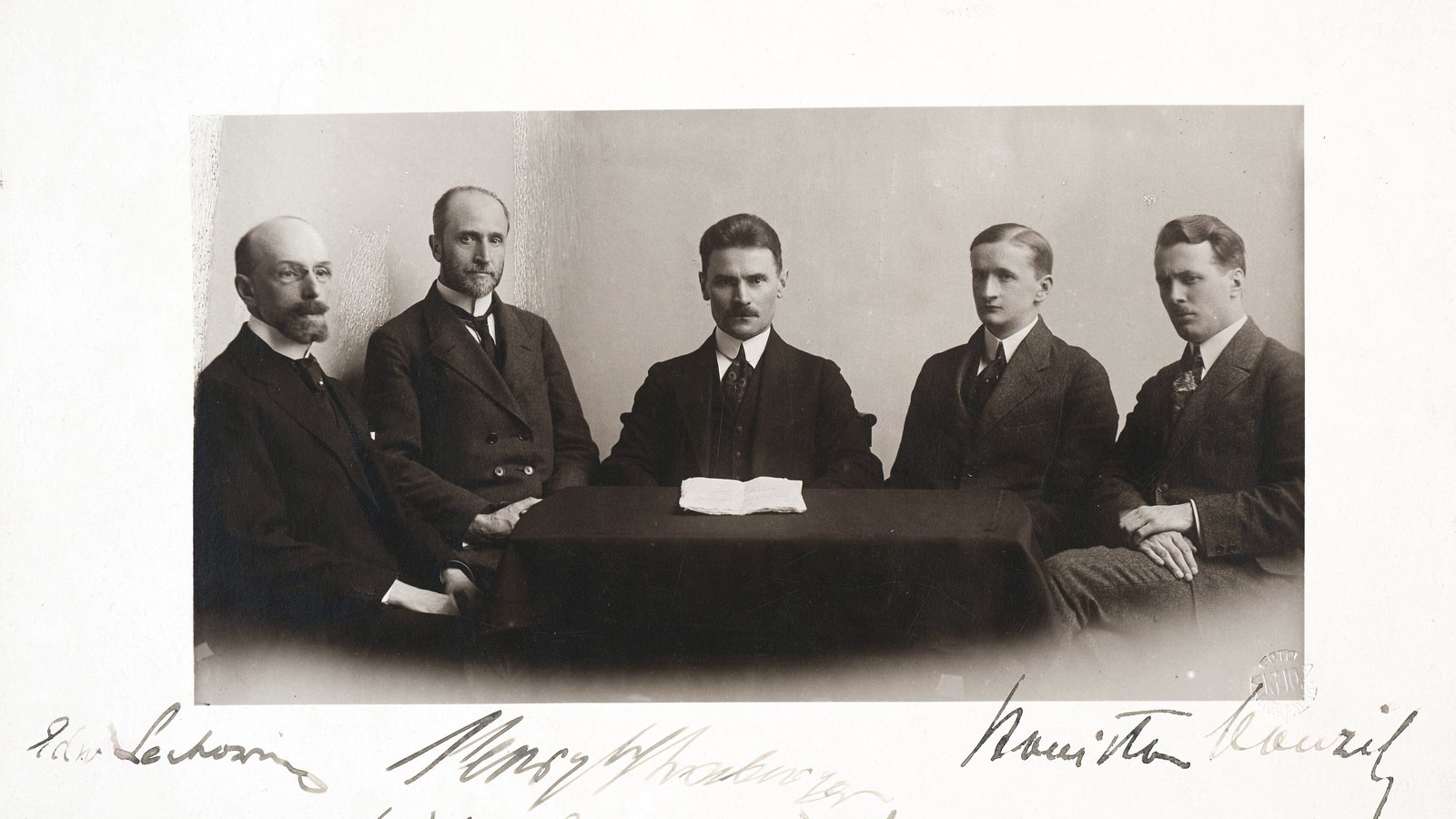
The Polish–Soviet War of 1919–1921 hung in the air after the Vistula. Peace talk began in Minsk, on 17 August 1920, and moved to Riga on 21 September. Preliminaries, on 12 October; the armistice, on 18 October. The Polish delegation, dominated by National Democrats, refused a strip of some 100 kilometres that would have left Minsk on Warsaw’s side: Stanisław Grabski did not want minorities to pass one-third. On the Soviet side, Lenin ordered a close after Tambov and Kronstadt. The solemn signing was on 18 March 1921, in the House of the Blackheads in Riga, from 20.30 to 22.10.
Jan Dąbski presided. He read the first ten articles in Polish; Adolf Joffe the next ten in Russian; Yuriy Kotsiubynsky the rest in Ukrainian. Three originals, plus the additional protocol. For Poland there signed Dąbski, Stanisław Kauzik, Edward Lechowicz, Henryk Strasburger and Leon Wasilewski. For Soviet Russia, also in the name of Soviet Belarus, and for Soviet Ukraine: Joffe, Yakov Ganetsky, Emanuel Kviring, Kotsiubynsky and Leonid Obolensky. The Latvian foreign minister, Zigfrīds Meierovics, spoke at the close. The Sejm authorised ratification on 15 April; Józef Piłsudski ratified the next day; the exchange, in Minsk, on 30 April, when the treaty entered into force.
Article I: the state of war ends. Article II recognises the independence of Ukraine and Belarus and draws Poland’s eastern frontier. Poland keeps Eastern Galicia, the western part of the Volhynia gubernia, the Grodno gubernia, the western part of the Minsk gubernia and the Vilnius gubernia, without the western strip held by Lithuania. The line falls some 250 kilometres east of the Curzon Line. Poland drops its claims to the 1772 border; it recovers, in the Kresy, lands lost at the Third Partition. Russia and Ukraine drop the lands west of the line.
Article III leaves the Polish–Lithuanian dispute to the parties. Article V: sovereignty, with no agitation, propaganda or interference. Articles VI–VII: option of citizenship, language, religion, intellectual development of nationalities. Article VIII: no war indemnities. Article XI: return of treasures taken after 1772 — the Jagiellonian tapestries, the Załuski Library. Article XIII: 30 million gold roubles, within a year, for Poland’s share in the imperial economy. Article XIV: railway material worth 29 million. Article XXIV: diplomatic relations at once after ratification. Twenty-six articles in all.
The treaty abrogates the 1920 alliance with Symon Petliura’s Ukrainian People’s Republic. Piłsudski, an observer at Riga, called the act cowardice; on 15 May 1921 he asked pardon of Ukrainian soldiers interned at Kalisz. The Intermarium programme, a Polish-led federation, falls with Minsk. Into Poland come millions of Ukrainians and over a million Belarusians. The Conference of Ambassadors (Britain, France, Italy, Japan) recognised the eastern frontier on 15 March 1923; the United States, in April.
The cover is the Polish delegation at Riga, photographed in 1921, with signatures on the mount: Lechowicz, Strasburger, Kauzik. The scan of the 26 articles is at the Archiwum Akt Nowych, in Dąbski’s papers, sygn. 5, and in the Foreign Ministry fonds, sygn. 6739. The Polish text was published in Dziennik Ustaw 1921 no. 49, item 300.
Sources: Treaty of Riga; Archiwum Akt Nowych, Treść traktatu.









0 Comments
No comments on this article yet. Be the first!