


On 23 October 1980, in Madrid, José Pedro Pérez-Llorca y Rodrigo, Spain’s foreign minister, and Florencio Mayé Elá, First Vice-President and Commissioner of Foreign Affairs of Equatorial Guinea, signed the Treaty of Friendship and Cooperation, in two copies in Castilian, equally authentic. It is not the cultural convention of 12 October 1969, nor the agreements of 31 October 1979. The preamble starts from 3 August 1979: the new government in Malabo had asked for help in rebuilding the country, after Macías; relations, said to rest on non-interference in domestic politics, then entered a stage of cooperation. Published in BOE no. 178 of 27 July 1981. It applies provisionally from the day of signature; the exchange of ratifications, 14 April 1982.
The principles: mutual respect and institutionalised consultations; cooperation as a fully shared undertaking, on a footing of equality, in the economic, technical, scientific, cultural and social fields; collaboration with international aid bodies and with the Ibero-American countries; as the country recovers, Equatorial Guinea is to contribute progressively to the financing; technical, cultural and educational training; given the emergency then, cooperation aimed at the Equatoguinean people’s priority needs, above all health, education and food. An annexed minute (mentioned, not reproduced in the BOE) holds the balance of cooperation since 3 August 1979.
Article 1 makes the treaty the proper legal frame; complementary agreements and specific projects will follow, as defined by the Joint Commission. Article 2: exchange of technicians and advisers; scholarships and training stays; information, including transfer of technology; studies; seminars and vocational training; materials and equipment; any other activity agreed. Article 3 refers the experts’ status to the protocol of 5 December 1979. Articles 4–5: a Joint Commission, with representatives of both, meets alternately in each country; annual programme, supervision, recommendations, priorities; at the end of each session, a minute by area of cooperation.
Article 6: the Joint Commission sets the financing criteria, on instructions from the two governments. Exceptionally, the Spanish state budget for 1981 was to carry a specific line for cooperation with Equatorial Guinea. Article 7: coordination belongs to the foreign ministries, with the other departments when needed. Article 8: differences of application go to the joint commissions; if a dispute of interpretation is not settled in six months, an arbitral tribunal: each party names an arbitrator within a month, a third by agreement, otherwise the President of the ICJ or the UN Secretary-General; the award within a year; common costs split in half.
Article 9: this is the sole basic text on cooperation. From provisional application, all bilateral cooperation treaties, whatever their name, signed from independence to 30 October 1979, are repealed; obligations under conventions before that date lapse, with the exceptions in the annexed letters. Article 10: civil and economic rights of natural and legal persons, under each country’s law; free disposal of property; in Equatorial Guinea, transfers of immovables need prior government authorisation. Article 11 raises to complementary agreements the instruments after 30 October 1979: fisheries, hydrocarbons, agriculture, finance, maritime and air transport, telecommunications, experts, postage stamps, minerals, economic liberalisation, education, defence and security, social-labour — from 31 October 1979 to 17 October 1980. The transitional provision keeps in force, until new ones are negotiated, the consular, cultural and air-transport conventions of 12 October 1969, 23 December 1971 and 24 June 1971.
Article 12: five years, automatic one-year renewals unless a party objects in writing three months before; denunciation takes effect twelve months after the note. Annexed letter 1: Spain keeps the financing of the water supply to Bata, the Malabo water network, 218 dwellings, the refurbishment of the hospitals in Malabo, Luba, Riaba, Niefang, Mongomo, Añisok, Ebebiyín, Micomeseng, Ebinayon and Bata, and 80 places at the Colegio Mayor Nuestra Señora de África. Annexed letter 2: Equatorial Guinea recognises and undertakes to repay 4,991,316.95 US dollars; the terms, in a financial cooperation protocol.
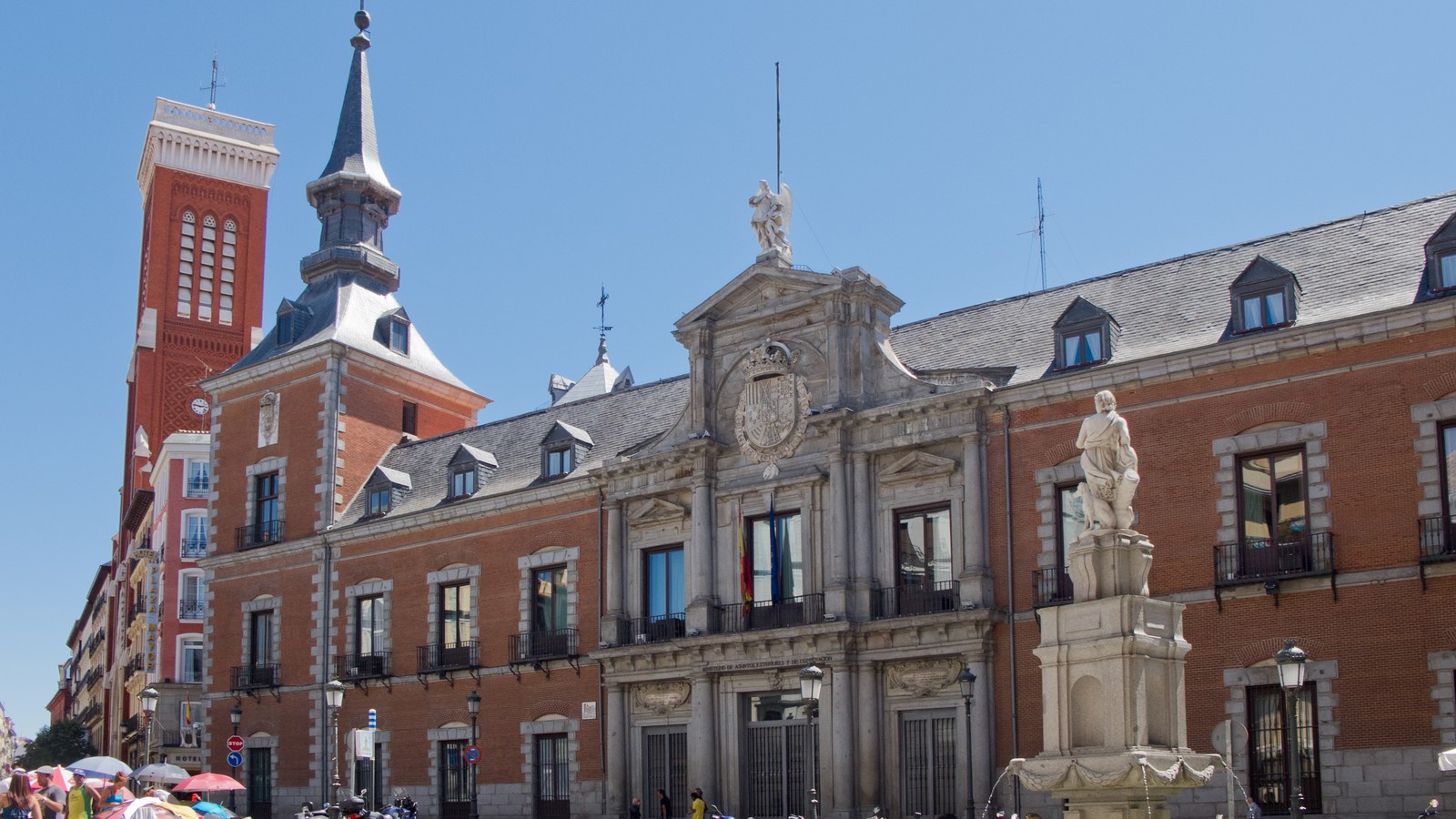
Palacio de Santa Cruz, seat of the Spanish Foreign Ministry. Façade, Carlos Delgado, 2012, not the signing room. Wikimedia Commons, CC BY-SA 3.0.
For context: Treaty of Friendship and Cooperation between Spain and Equatorial Guinea of 1980. The text: Tratado de amistad y cooperación (BOE-A-1981-16874).










0 Comments
No comments on this article yet. Be the first!