


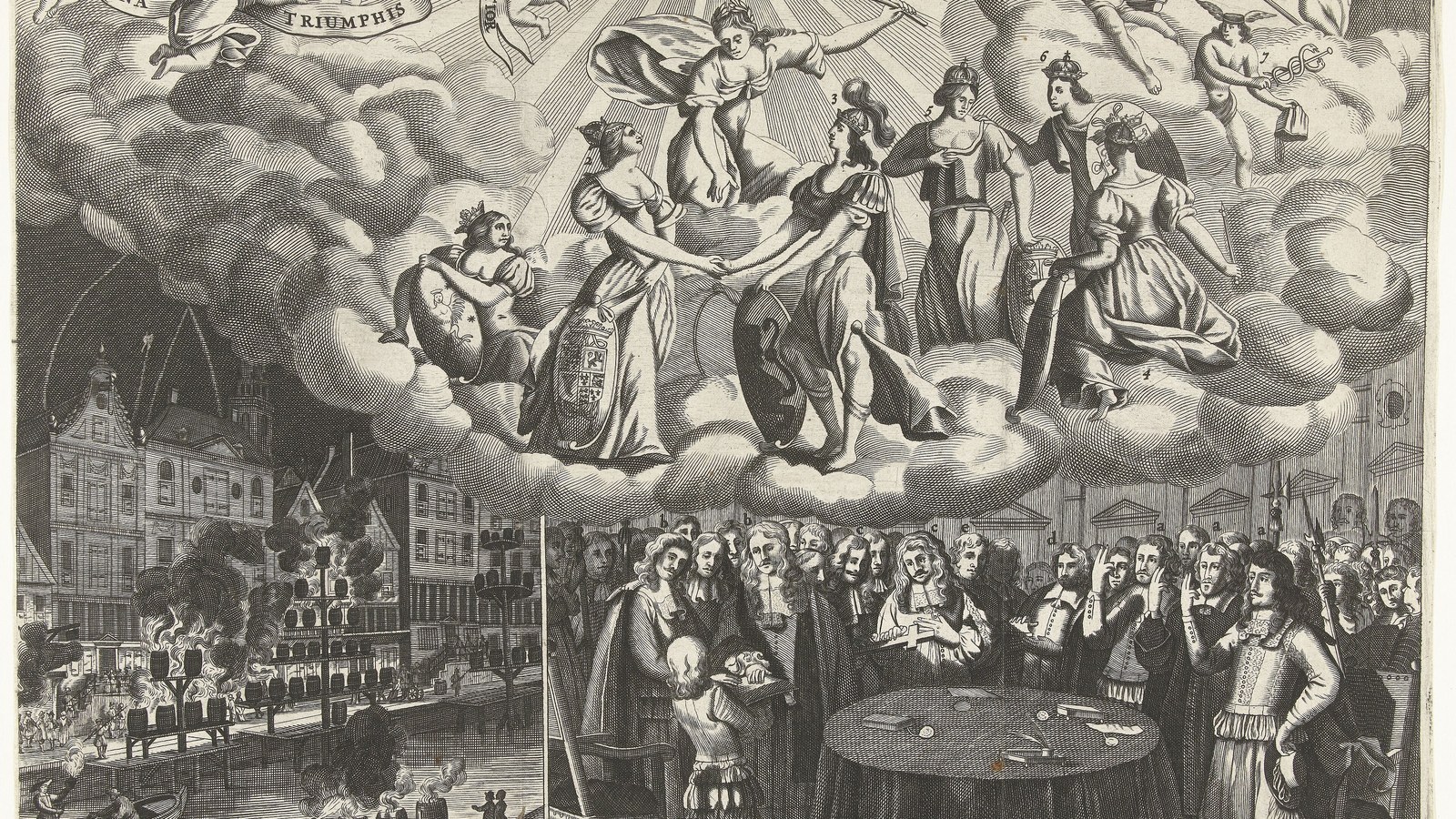
Charles II of England concluded at Breda, on 31 July 1667 (New Style; 21 July Old Style), three separate peace treaties with the United Provinces, Louis XIV’s France and Frederick III’s Denmark–Norway, plus an Anglo-Dutch agreement on navigation and commerce. It is not a single instrument. Swedish mediators: Göran Fleming, Count Dohna, Peter Coyet. English plenipotentiaries: Denzil Holles, Baron of Ifield; Henry Coventry. Dutch delegates present: Hieronymus van Beverningh (Holland), Allart Pieter van Jongestall (Friesland), Pieter de Huybert (Zeeland). French: Godefroy d’Estrades, Honoré Courtin. Danish: Paul Klingenberg, Peter Canizius. Official English text, printed in the Savoy by the assigns of John Bill and Christopher Barker, 1667. Ratifications by 24 August; public celebrations at Breda.
The Anglo-Dutch treaty, Articles of Peace and Alliance. Article 1: a true, firm and inviolable peace, friendship and a nearer alliance; fleets or single ships sailing the same course shall defend each other against a third party. Article 3: uti possidetis, with the reference date 20 May 1667. The Dutch keep Surinam, Fort Cormantine and the island of Run; the English, New Netherland (later New York, New Jersey, Delaware). Articles 4–8: the same rule for goods and ships, including losses before the war; no indemnities; letters of marque void. Article 7: dates of enforcement — 5 September, the Channel and the North Sea; 5 October, the other European seas; 2 November, the African coast north of the Equator; 24 April 1668, the rest of the world. Article 10: prisoners without ransom. Articles 13 and 17: neither side shall protect the other’s rebels; a secret annex on extraditing the 1649 regicides, ignored in practice.
The Anglo-French treaty, Dumont vol. VII, part 1, no. XVII. Perpetual peace, oblivion of offences, navigation and commerce free as before the war, prisoners without ransom. Louis restores the English part of St Christopher (Saint Kitts) as held on 1 January 1665, within six months; Antigua and Montserrat, if still in French hands; England restores Acadia, which the Most Christian King had formerly enjoyed, and Cayenne (the handover delayed until 1670). Inhabitants of Acadia who prefer English rule may leave within a year, with goods and slaves. Reciprocally, whatever each occupied after 1 January 1665 is restored.
The Anglo-Danish treaty, Dumont no. XIX, on the same lines: peace between Frederick III and Charles II, Swedish mediation, waiver of losses. The navigation and commerce agreement, also at Breda, is preliminary: goods carried along the Rhine or Scheldt to Amsterdam, in Dutch ships, without the Navigation Acts’ tariffs; “free ships make free goods”. The definitive text, 17 February 1668.
This is not the Peace of Westminster of 1654, not the 1674 treaty ending the Third Anglo-Dutch War, and not Utrecht in 1713. The Medway raid in June hastened the terms; the French War of Devolution, opened in May, made peace urgent for the Dutch. The cover is a contemporary engraving of the Peace of Breda.
Sources: Treaty of Breda (1667); Traité de Breda, France / Angleterre, Dumont t. VII.











0 Comments
No comments on this article yet. Be the first!