


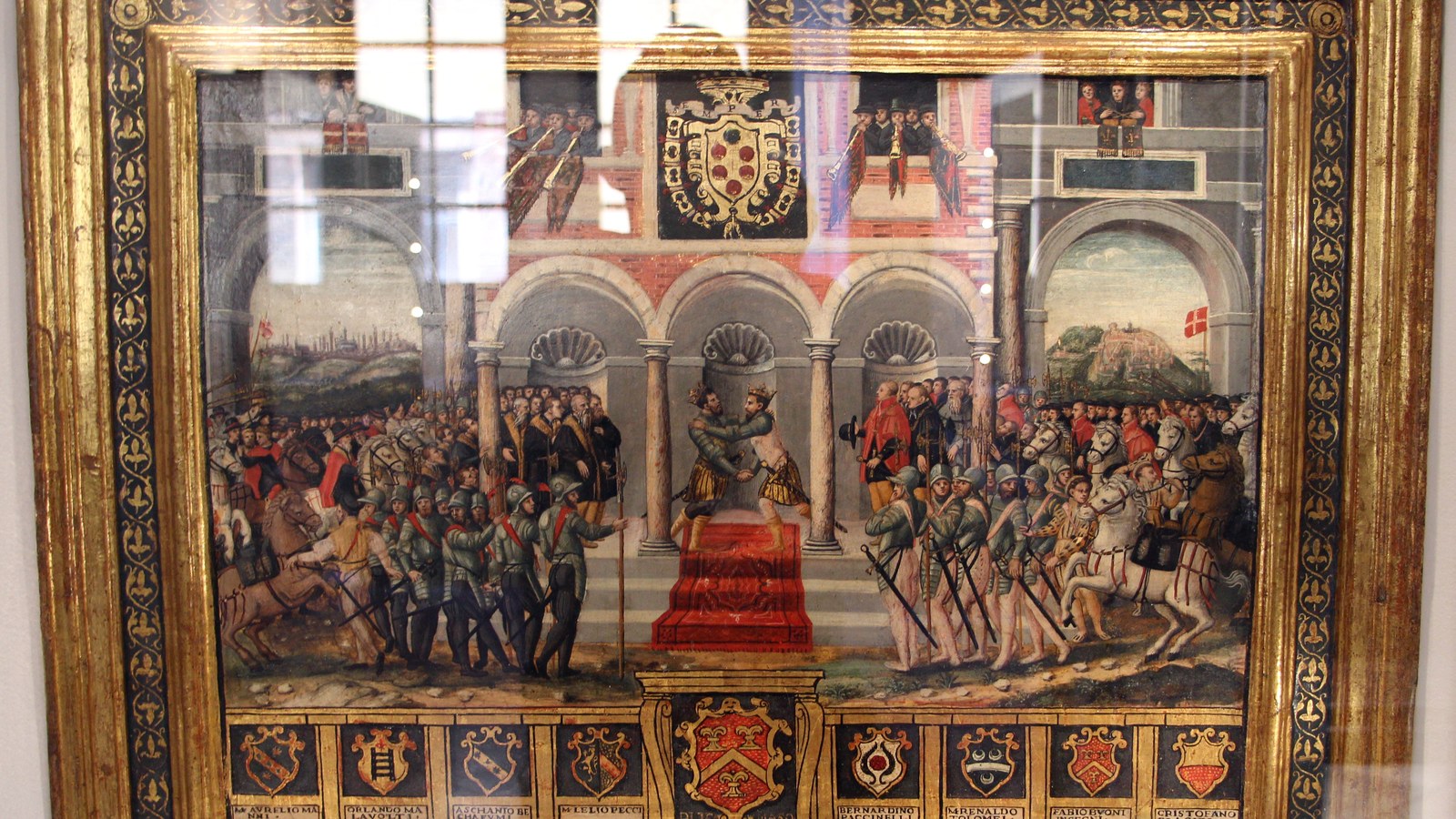
On 3 April 1559, at Le Cateau-Cambrésis, the plenipotentiaries of Henry II, Most Christian King of France, and of Philip II, Catholic King of Spain, conclude the peace, in the presence of Christina, Duchess of Lorraine, and of her son Charles. For France: Cardinal Charles of Lorraine, archbishop and duke of Reims; Anne, Duke of Montmorency, constable; Jacques d’Albon, seigneur de Saint-André, marshal; Jean de Morvillier, bishop of Orléans; Claude de l’Aubespine, secretary of state. For Spain: Fernando Álvarez de Toledo, Duke of Alba; William of Nassau, Prince of Orange; Ruy Gómez de Silva, Count of Melito; Antoine Perrenot, bishop of Arras. The kings do not sign in person. The date is after Easter. This is not the Anglo-French treaty of the day before, 2 April, on Calais.
Article 1: a good, sure, firm peace, confederation and perpetual alliance, without derogating from treaties between their predecessors except as this one disposes otherwise; hostilities cease; past injuries forgotten. Article 2: the two princes shall procure the convocation and celebration of a holy universal council, so necessary for the reformation and reduction of the whole Christian Church into a true unity. Article 3: subjects may go, remain and trade in one another’s countries, by sea and by land, paying the accustomed dues. Article 4: letters of marque and reprisals are suspended, save in case of manifest denial of justice. Articles 5–8: the privileges of Flanders and Artois, and of the French in the Low Countries, as before the rupture of 1551; return to immovable goods, without fruits taken during the war; excepting the outlaws of Naples, Sicily and the duchy of Milan.
Article 11: Philip restores to Henry Saint-Quentin, Le Catelet and Ham, and all occupied on the French since 1551; Henry restores Thionville, Mariembourg, Yvoy, Damvillers and Montmédy, and all occupied on the Spanish; artillery, powder, arms and victuals may be removed; fortifications are not to be demolished. Article 12: the site of Thérouanne, ruined, returns to France; Henry may raze the walls of Yvoy before restitution; Philip shall not refortify Yvoy, nor Henry raise a fort at Thérouanne. Article 15: Hesdin and its bailliage remain with the Catholic King, as his predecessors held them before occupation by Francis I. Article 19: Philip re-enters the county of Charolais, held under the sovereignty of the King of France.
Articles 21–22: the marquisate of Montferrat, entire, to the Duke of Mantua; pardon for the inhabitants, especially Casale. Article 23: Henry quits Valence in the duchy of Milan, to Philip, without demolition, first removing the artillery. Article 24: the Genoese are received into grace; restitution of all places held by France in Corsica, without demolition; reciprocal trade, not in arms; pardon for those who served France; Genoa to ratify. Article 25: Henry withdraws his troops from Montalcino and the other places of Siena and Tuscany and desists from rights; pardon for Sienese gentlemen; the Duke of Florence to ratify.
Articles 26–32: marriage, by proxy, between Philip and Elisabeth, Henry’s eldest daughter; dowry 400,000 écus soleil, within eighteen months, at Antwerp, each écu at eighty Flemish groats; renunciation of her parents’ succession save collaterals; arras 133,333 écus and one third. Articles 33–34: Emmanuel Philibert of Savoy is to have to wife Margaret of France, Duchess of Berry, the king’s only sister; dowry 300,000 écus; dower 30,000 livres a year on Bresse, Bugey and Valromey. Upon solemnization, within two months, with papal dispensation, he is left Savoy, Bresse, Bugey, Valromey, Maurienne, Tarentaise, the vicariate of Barcelonnette, Piedmont, Asti, Ceva, Oneglia, Galtieri and Nice beyond the Var, except Turin, Quiers (Cherasco), Pinerolo, Chivasso and Villanova d’Asti, which France holds until the claims are judged, at latest three years.
Article 39: upon consummation of the marriage, Philip leaves to Savoy the places with Spanish garrisons, and may, with the duke’s consent, keep Vercelli and Asti while France holds the five places; Savoy a neutral prince and common friend. Article 43: France’s restitutions, including Corsica, within two months of the date, beginning within one month; four Spanish hostages until then; Philip then restores within one month. Article 44: comprehended, on the French side, among others, the pope, the emperor, electors, the dukes of Saxony, Württemberg, the landgrave of Hesse, the king and queen dauphin of Scotland, Elizabeth widow of John Zápolya, Venice, the thirteen cantons, Lorraine, Ferrara, Mantua, Lucca, the bishops and chapters of Metz, Toul and Verdun; on the Spanish side, among others, the emperor, Liège, Cambrai, the queen of England according to the capitulation with France and Scotland, Genoa, Florence, Parma. Article 45: the dauphin’s oath, registration in the Parlement and Chambre des comptes of Paris, within three months; Philip, in his Grand Council and the chambers of the Low Countries; within six months, his son the prince of Spain. The deputies sign at Château en Cambrésis.
A treaty of particulars, the same day: among other things, the Prince of Orange is restored to the principality of Orange. This is not the Truce of Vaucelles of 1556, and not the Anglo-French peace of 2 April 1559.
Image: Biccherna panel, peace between Philip II and Henry II, 1559, Siena; photograph Sailko, CC BY 3.0, Wikimedia Commons. Cropped to 16:9.
Source consulted: Treaty of Cateau-Cambrésis. Treaty text: Wikisource: Treaty of Cateau-Cambrésis (France and Spain), 3 April 1559.










0 Comments
No comments on this article yet. Be the first!