


At Constantinople, on 21 July 1832 (23 Safer 1248), the representatives of the three Powers to the Treaty of London of 1827 and two ministers of the Porte signed the Arrangement for the definitive settlement of the continental limits of Greece. For London, Paris and St Petersburg: Stratford Canning, Apollinaire Bouteneff, Baron Jacques Édouard Burignot de Varenne. For the Porte: Mustapha Behdjet Effendi, formerly Cazesker of Rumelia, first physician to the Sultan, and Elhadj Mehemed Akif Effendi, Reis Effendi. Greece does not sign. Formal confirmation by the three Courts, within four months, has the force of a ratification.
The act is not the Treaty of London of 6 July 1827, nor the Protocol of 3 February 1830, nor the Convention of London of 7 May 1832 with Bavaria for Otto, nor the later London Protocol of 30 August which confirmed the line. It is not the Aspropotamos–Spercheios line rejected by Leopold of Saxe-Coburg.
Article 1: the eastern extremity at the mouth of the little river near Gradiza; it ascends to the source, reaches the chain of Mount Othryx, leaving Greece the passage of Klomo without crossing the crest; follows the crest, the peak of Varibovo, the height of Veluchi; descends the valley of the Aspropotamos to the Gulf of Arta, between Coprina and Menidi. The bridge of Tartarina, the defile and the tower of Macrinoros remain to Greece; the bridge of Coracos and the salt springs of Coprina, to the Porte. The fort of Punta remains to the Porte, with a radius of not less than half an hour nor more than an hour. Alternative: if Zeitoun on the left of the Sperchius remains Ottoman, the eastern line begins at the mouth of the Sperchius.
Article 2: indemnity of 40 million Turkish piastres if left-bank Zeitoun goes to Greece; 30 million if it remains to the Porte. Article 3: commissioners of the three Courts and one of the Porte mark the line within six months; a Greek commissioner may co-operate; majority in case of difference. Article 4: payment at Constantinople on 31 December, by drafts on London, Paris, Vienna or Petersburg, at the exchange of the day of signature. Article 5: evacuation of all territories to constitute Greece, including those previously assigned and still occupied, by 31 December or sooner.
Article 6: at Punta, a garrison sufficient for the post; Greek vessels pass without obstacle, save customs if they put into Punta, Prevesa or other Turkish ports of the gulf. Article 7: eighteen months from demarcation to quit the territories and sell estates; the same advantages to the inhabitants of Euboea and Attica and the proprietors of Thebes; the vakufs pass to the Greek State. Article 8: commercial and navigation relations on reciprocity; accredited agents; Ottoman subjects may traffic in Greece, and Greeks shall cease to have recourse to foreign protection in Ottoman ports.
The July act is not the Protocol of 30 August, which chose the line with Zeitoun for Greece and fixed 40 million, nor the later union of the Ionian Islands.
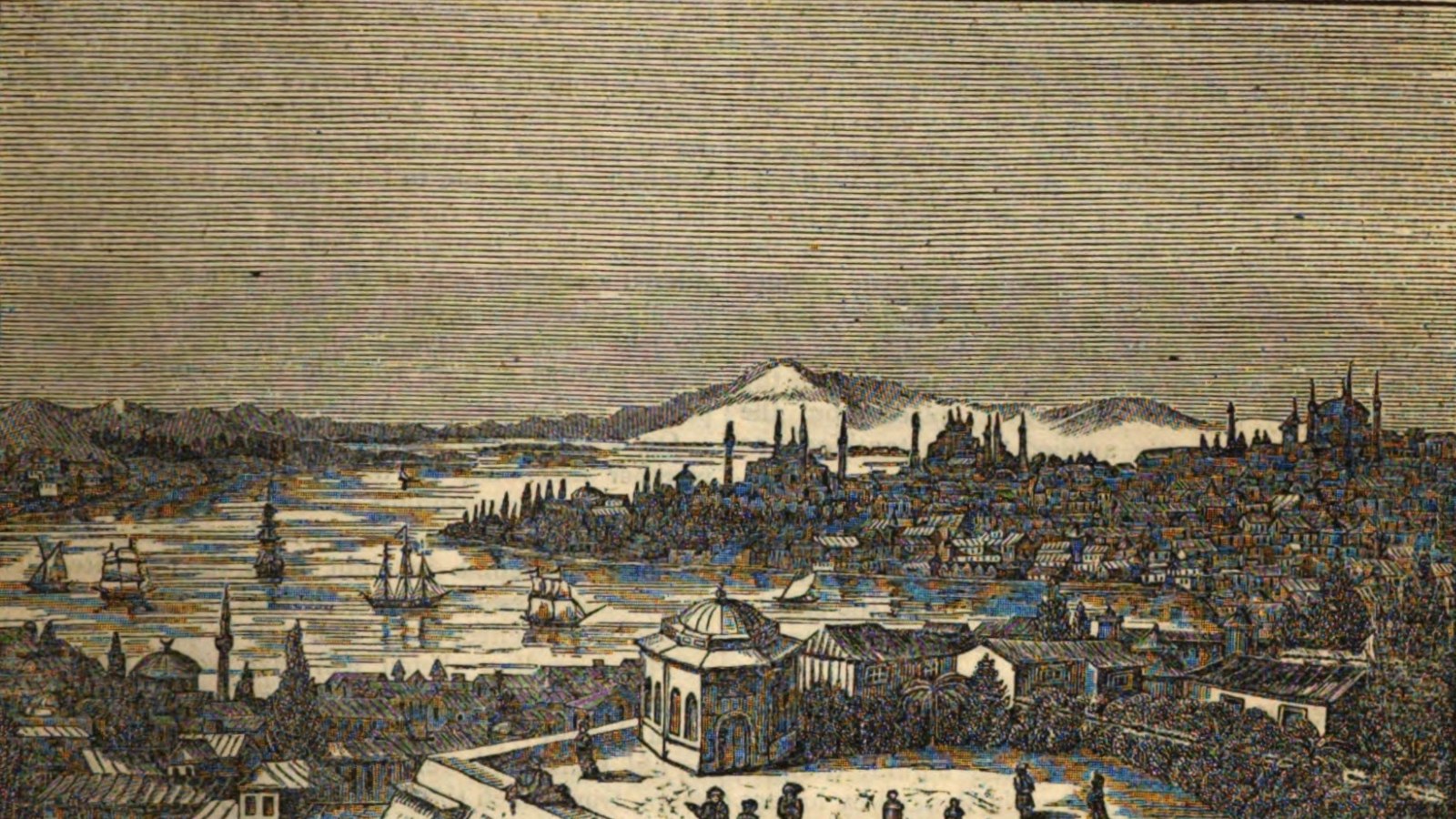
Image: Constantinople from Galata, The Penny Magazine, 18 August 1832; public domain, Wikimedia Commons. Cropped to 16:9. The signing took place in the same year, in the city.
Source consulted: Treaty of Constantinople (1832). Treaty text: Arrangement between Great Britain, France, Russia, and Turkey, Constantinople, 21 July 1832.










0 Comments
No comments on this article yet. Be the first!