


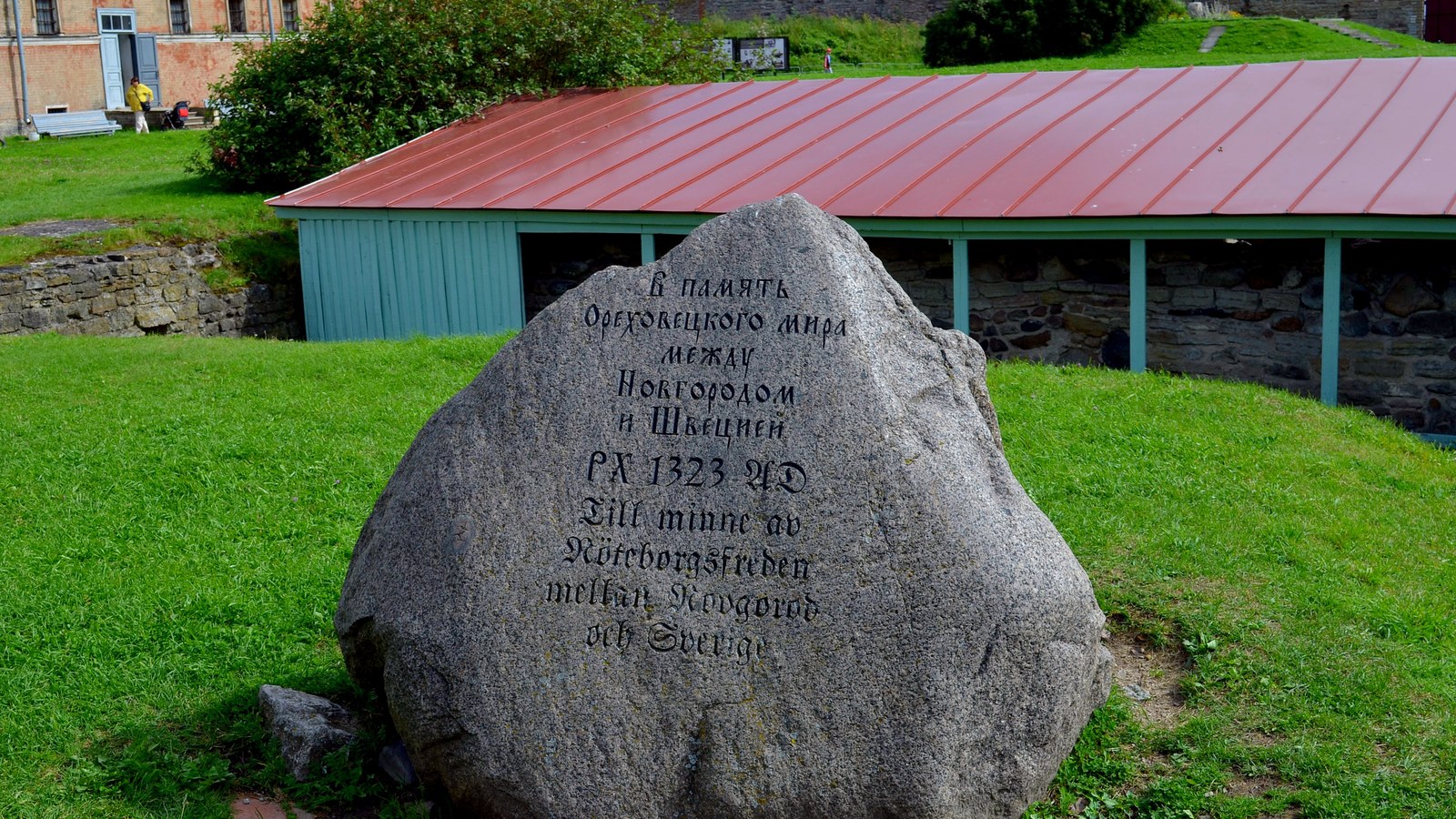
On 12 August 1323, at Oreshek fortress at the head of the Neva, the Novgorod Republic and the Kingdom of Sweden concluded the first agreement that set their border on the Karelian Isthmus. The fortress, raised that year, is Nöteborg in Swedish and Pähkinälinna in Finnish. Novgorod signed in the form of a letter of Grand Prince Yury Danilovich of Moscow, with posadnik Varfolomey Yuryevich, tysyatsky Avram and the city community. King Magnus Eriksson, then seven, was represented by Erik Turesson, Hemming Ødgislason, Peter Jonsson, the chatelain of Viborg, and the priest Waemundus. Two Gotland merchants, Ludovicus and Fodra, stood for the Hanse. Surviving Latin copies record perpetual peace and the kissing of the Cross.
The originals are lost. The Swedes received, as was then usual, a Russian text with a Latin rendering; those pieces, still at Viborg in 1493, were moved to Sweden and almost certainly burned in the Tre Kronor fire of 1697. Novgorod held a Swedish-language version; Swedish envoys copied it in 1537, and that copy remains in Stockholm. The Latin, Russian and Swedish copies agree on the isthmus points and on the cession of three pogosts, but they diverge on the last northern landmark.
Novgorod ceded to Sweden three gislalag, or pogosts: Savolax (Savilahti, around present-day Mikkeli), Jääski and Äyräpää. The Latin copy edited by Henrik Gabriel Porthan in the Sylloge monumentorum (Åbo, 1803) names them Savolax, Jeskis and Aegrepae Karelsk Gislalagh. The border is a list of eighteen points. The first twelve, from south of Viborg, follow the Sestra (in Latin, amnem Sester) and Volchya to the Vuoksi, then north-west to Särkilahti on Lake Saimaa. Historians agree here: the line splits the isthmus and stayed, in the main, stable deep into the Middle Ages.
North of the settled country, the remaining six points are vague. The 1537 Swedish copy ends nor i haffuit, north into the sea. The Russian text has Kajano more; the Latin, Helsingh haff. Jalmari Jaakkola in 1925 drew the line to the Gulf of Bothnia. Jarl Gallén and, after him, John Lind argued for a common-use zone in Ostrobothnia and Lapland, with two branches: one to Bothnia, the other to the White Sea or the Arctic Ocean. The Finnic tribes on both sides of the line did not sign.
The Latin copy opens trade: merchants from all Almania, Lübeck, Gotland and Sweden, by land and water, through Nyen (Nyo) to Novgorod, without hindrance. The Viborg garrison must not harm Novgorod merchants. Neither side is to raise new castles in Russia or in Karelia. Fugitives, sureties and malefactors are to be returned. Swedes must not buy land or water from Novgorod Karelians, and the converse. If Narva does not make amends to the king or to Novgorod, the Swedes are not to help it. An individual delict does not break the peace: it is to be amended where it was done.
This is not Teusina, 18 May 1595, which first settled the North Calotte. It is not Stolbovo 1617. It is not the 1326 treaty between Novgorod and Norway. In 1339, after two years of fighting and a Karelian rising at Korelsky Gorodok, the peace was renewed, with a clause on fugitives. In 1348 Magnus took Oreshek on a Neva crusade and could not hold it. In theory the 1323 line lasted until Teusina. The cover is the peace memorial stone, with Russian and Swedish inscriptions, inside Oreshek fortress.
Sources: Treaty of Nöteborg; Latin text of the 1323 Oreshek treaty (Porthan, Sylloge, 1803).










0 Comments
No comments on this article yet. Be the first!