


On 14 October 1809, at Vienna, Jean-Baptiste Nompère de Champagny, duke of Cadore, and Field Marshal Prince Johann of Liechtenstein signed the peace between Napoleon, emperor of the French, king of Italy, protector of the Confederation of the Rhine, and Francis, emperor of Austria, king of Hungary and Bohemia. It is not Pressburg of 1805, not Campo Formio of 1797 and not the Congress of Vienna of 1815. Napoleon’s ratification is from the imperial camp at Schönbrunn, the next day. The Armistice of Znaim, after Wagram, is another instrument, from July.
Article 1 sets perpetual peace from the exchange of ratifications. Article 2 makes it common to the kings of Spain, Holland, Naples, Bavaria, Württemberg, Saxony, Westphalia, the prince-primate and the grand dukes of the Confederation. Article 3 cuts: Salzburg and Berchtesgaden, plus a strip of Upper Austria beyond the line from Strass on the Danube to the Atter lake, pass to the emperor of the French, to be disposed of for the Rhine sovereigns; Francis keeps only the property of the Mondsee woods of the Salzkammergut, without sovereignty. To him as king of Italy go Görz, Montefalcone, Trieste, Carniola, the circle of Villach, the whole right bank of the Sava as far as Bosnia — part of provincial Croatia, six military districts, Fiume and the Hungarian littoral, Austrian Istria or Castua, the islands, and the lordship of Rhäzüns in the Grisons. The thalweg of the Sava is the bound.
To the king of Saxony go the Bohemian enclaves inside Saxony and, to be united to the Duchy of Warsaw, all West or New Galicia, a district round Cracow on the right bank of the Vistula, and the circle of Zamość in East Galicia. Wieliczka and the salt mines remain common to Austria and Saxony, with equal police troops; Austrian salt crosses the Vistula without toll. To the tsar, in the easternmost part of Galicia, a tract of four hundred thousand souls, Brody excepted. Article 4: the Teutonic grand master, Archduke Anthony, abdicates in the Austrian states, the Order having been suppressed in the Confederation.
Article 10 pardons the Tyrol and Vorarlberg, on the French side, and recovered Galicia, on the Austrian, with six years to sell even fidei commissa. Article 12 evacuates Moravia in fifteen days, Hungary, retained Galicia and Vienna in one month, Lower Austria in two, the rest in two and a half. Article 15 recognizes the changes in Spain, Portugal and Italy. Article 16 accedes to the prohibitory system against England, as before the war. The separate articles, of the same force: the peace is common to Russia; Austrian cadres shall not exceed one hundred and fifty thousand men for the duration of the maritime war; the contribution of two hundred millions is cut to eighty-five, thirty before Vienna is evacuated.
It is not Tilsit of 1807 and not the marriage of 1810 with Marie-Louise. Friedrich Staps, with the knife in the petition, is from the palace courtyard two days earlier, not from the articles.
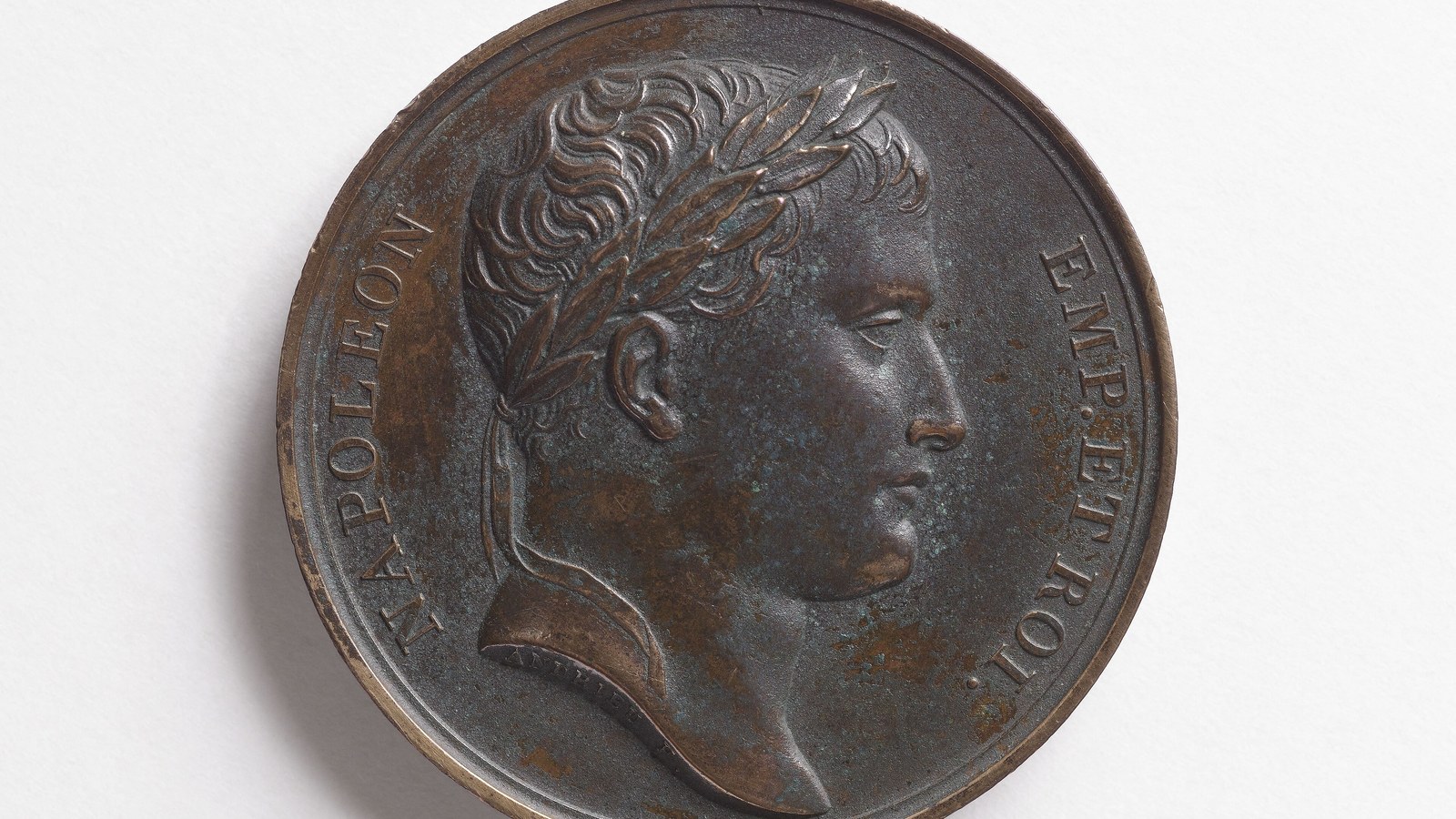
Medal of the Peace of Vienna, engraver Bertrand Andrieu. Image: Wikimedia Commons, CC0.
For context: Treaty of Schönbrunn. The text: Treaty of Schoenbrunn of 14 October 1809.










0 Comments
No comments on this article yet. Be the first!