


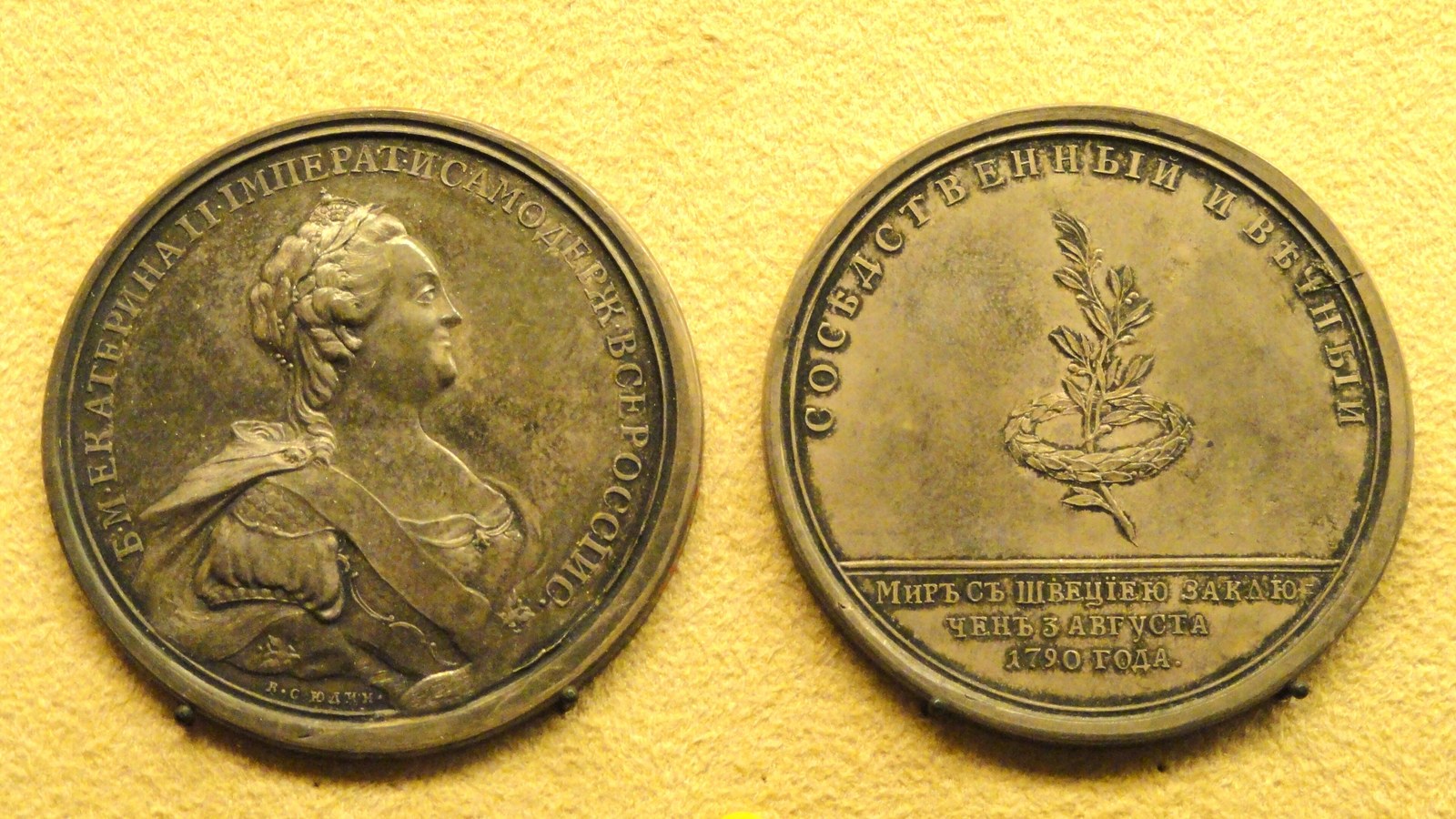
On 14 August 1790, on the plain of Värälä beside the Kymmene, between the outposts of the two camps, Sweden and Russia signed the peace that closed Gustav III’s war. Gustaf Mauritz Armfelt signed for the king; Otto Heinrich Igelström, governor of Simbirsk and Ufa, for Catherine II. The printed Swedish and French title dates the act 3/14 August, ratified in the Swedish camp on the 19th and at Tsarskoe Selo on 6/17 of the same month. The ground is in Finland today, then a Swedish province. The naval victory at Svensksund on 9 July underpinned the talks; Russia was still at war with the Porte.
The text has eight short articles. Article 1 speaks of lasting peace and good neighbourliness, not the “perpetual peace” of Nystad and Åbo. Article 2, two lines: the borders remain those of before the war. Status quo ante bellum. Sweden does not recover what it had ceded in 1743; Russia does not move the line. Gustav wanted land in Russian Finland and to force his cousin to make peace with the Turks; Catherine refused.
Articles 3 and 4: troops on the other party’s soil leave within fourteen days; prisoners are freed without ransom. Article 5, the longest, sets the salutes: Swedish warships passing Russian forts give the Swedish call, Russian ships passing Swedish forts the Russian call; a meeting at sea is also prescribed. Article 6 restates the duty-free export of grain that the Swedish crown may take from Russian ports, to the value of 20,000 rubles a year. Article 7 leaves lesser questions for separate settlement. Article 8: ratification in six days, or sooner if it can be done.
Gustav wrote to Evert Vilhelm Taube the next day: the Åbo and Nystad treaties are not named, on purpose and by agreement, so Russia’s claims to meddle in Swedish internal affairs vanish. The right came from Nystad 1721; after the coup of 19 August 1772 it was a dead letter. Entry into force, on 19 August, falls eighteen years to the day after that coup. The exchange of ratifications was staged on a platform on the plain, both armies on parade; Armfelt received a gold snuffbox and the Order of St Andrew.
A year later, on 19 October 1791, a convention in Stockholm bound the two courts against a foreign attack, with Russian subsidies of 300,000 rubles a year, aimed at revolutionary France. That is not the Peace of Värälä. The Gatchina alliance of 1799 is another instrument: it confirms the Peace of Werele as the only public act still standing between the two empires.
This is not Nystad 1721, not Åbo 1743, not Fredrikshamn 1809, which passed Finland to Russia. It is not the Convention of Moss, in the same month of another year. The cover is the Peace of Värälä medal, Samuil Judin, 1790, National Museum of Finland.
Sources: Treaty of Värälä; Freds-fördrag ... 3/14 augusti 1790 (Kansalliskirjasto).










0 Comments
No comments on this article yet. Be the first!