
Today, 15 September 2026, marks 196 years since the opening of the Liverpool and Manchester Railway, an event widely regarded as one of the defining moments in the birth of the modern railway. Opened on 15 September 1830, the line demonstrated on a commercial scale that steam locomotives could provide regular, fast inter-city transport. The opening day was also marked by tragedy when British politician William Huskisson was struck by the famous Rocket locomotive and later died from his injuries.
That morning thousands gathered to see something that would change how people moved. It was not the first railway ever built, nor the first use of a steam locomotive. What it combined, in a new way, were the elements that would define the modern railway: locomotives, passengers, goods, an inter-city distance and a timetable.
Why it mattered
Historic England describes the opening as a pivotal moment in history. The line is regarded by many historians as the birth of the modern main-line railway: the first locomotive-hauled inter-urban public railway to operate a timetabled passenger service alongside the transport of goods. The University of Liverpool describes it as the world’s first inter-city passenger and freight railway running a timetabled service with carriages hauled by steam locomotives. The wording matters. Railways existed before 1830 — among them the Stockton and Darlington, opened in 1825. What was new at Liverpool–Manchester was the combination: inter-city, public, locomotive-hauled, passengers and freight, to a timetable.
Why Liverpool and Manchester
In the early decades of the nineteenth century Liverpool and Manchester were two of the most important centres of Britain’s Industrial Revolution. Liverpool was one of the great commercial ports. Manchester had become a vast textile centre. Cotton arrived at Liverpool and had to be moved to the region’s mills; finished goods went back to Liverpool for export. Transport depended largely on roads and canals, including the Bridgewater Canal. Canals could move large volumes, but they were relatively slow. Expanding industry needed more capacity, speed, predictability and competitive costs.
The Science Museum Group records that the project was proposed as early as 1821 by William James and Joseph Sandars (the museum catalogue spells the name Sanders). It faced financial trouble, opposition, engineering difficulties and complicated parliamentary procedure. Parliament eventually authorised construction. In 1826 George Stephenson was appointed chief engineer. The route had to cross hills, valleys, bog and built-up ground. The University of Liverpool notes a historic cost of £820,000 and heavy works: dozens of bridges, a viaduct over the Sankey Valley, the Olive Mount cutting, a tunnel under Liverpool, and the crossing of Chat Moss, a great stretch of peat. Many thought a heavy railway could not be laid on the bog. Stephenson developed a structure that spread the weight; the line was built successfully across the moss.
The Rainhill Trials and Rocket
Even after the line was built, the directors were not fully convinced that steam locomotives were the best solution. One alternative was stationary engines hauling trains by cable. To decide, the company held the Rainhill Trials in October 1829. The Science Museum Group notes 6 October; the National Railway Museum describes trials run over several days. The winner was Rocket, built by Robert Stephenson and Company. It is associated with George Stephenson and with his son Robert, who had a central role in the design and construction. Rocket was not the first steam locomotive. Its design did, however, show an effective combination of speed, reliability, power and boiler technology. Success at Rainhill was decisive in choosing locomotive haulage for the new line.
15 September 1830: eight locomotives and a tragedy
The opening was staged as a national occasion. Politicians, businessmen, engineers and aristocrats attended. Among the most important guests was Arthur Wellesley, the Duke of Wellington, then prime minister. The procession included eight locomotives, among them Rocket. Thousands lined the route. For many spectators it was the first time they had seen a vehicle move at such speed without horses.
The trains stopped at Parkside. Several important passengers stepped down, including William Huskisson, MP for Liverpool and a former minister. On the adjoining line Rocket approached. Accounts of the opening place the engineer Joseph Locke, Stephenson’s assistant, at the controls. The Science Museum Group’s memorial description names John Locke — a forename that does not match the documented engineer. Huskisson tried to get clear and failed. Rocket struck him badly in the leg. He was taken for treatment; the injuries proved fatal. He died the same day, in the evening, according to the University of Liverpool. The Science Museum Group holds the memorial tablet that marked the accident site.
William Huskisson is often popularly described as “the first person killed by a train”. That formulation is incorrect. There had been fatal locomotive accidents before 1830. His death did, however, become one of the first and best-known fatal accidents of the modern railway age. The accident turned the festive mood to shock. The inaugural event continued even so. The trains reached Manchester. The new railway was open.
The ceremonial opening, then regular service
The Science Museum Group notes that the line opened ceremonially on 15 September 1830, and that the first passengers on the regular service travelled two days later. Goods traffic began on 1 December 1830. 15 September is the official opening, not the start of every kind of commercial service.
Liverpool Road Station in Manchester also opened on 15 September 1830. The National Transport Trust describes it as the world’s oldest surviving railway station building. It served as a passenger terminus until 1844. It is now part of the Science and Industry Museum.
Timetables, freight and a business
Before the railway, travel between cities depended on horses, stagecoaches and canals. Trains changed how people thought about distance. A revolutionary element was the scheduled service: the railway became a public transport system, not merely an industrial machine that moved coal when needed. Liverpool could send raw materials to Manchester more quickly; Manchester could send factory goods to the port. The Liverpool and Manchester Railway showed that locomotive railway transport could be practical, reliable and profitable. Success attracted investors. In the years that followed Britain entered a period of rapid railway expansion. The model was followed in Europe, North America and then in other regions.
Railways would also produce an unexpected consequence: the standardisation of time. Before trains, towns could keep local time. A system that ran to timetables needed a common time, later known as Railway Time. The Liverpool and Manchester Railway did not by itself introduce Greenwich Mean Time in 1830; standardisation developed later as the network grew.
The train also changed mobility, the post, the press, food distribution and the growth of towns. Historic England says the opening is regarded by many as the birth of the modern main-line railway not because nobody had laid rails before, but because here steam locomotives, inter-city travel, passengers, goods, scheduled services and a commercial model met.
Today, 15 September 2026, is the 196th anniversary. In less than four years, 15 September 2030 will mark the bicentenary. From experiment to infrastructure, the line showed that a technical invention can reorganise society. Britain’s railway continues to change — from Underground extensions to new trains built in historic centres such as Derby — and the history of technology, from steam to digital storage, remains a succession of such thresholds.
On 15 September 1830 eight locomotives set out between Liverpool and Manchester. The day was meant to be a demonstration of British engineering. It also became a tragedy through the death of William Huskisson. What had been demonstrated could no longer be ignored: the steam locomotive could carry people and goods between great cities in a regular system. 196 years on, the Liverpool and Manchester Railway remains one of the moments when an invention passed from experiment to infrastructure capable of changing society.
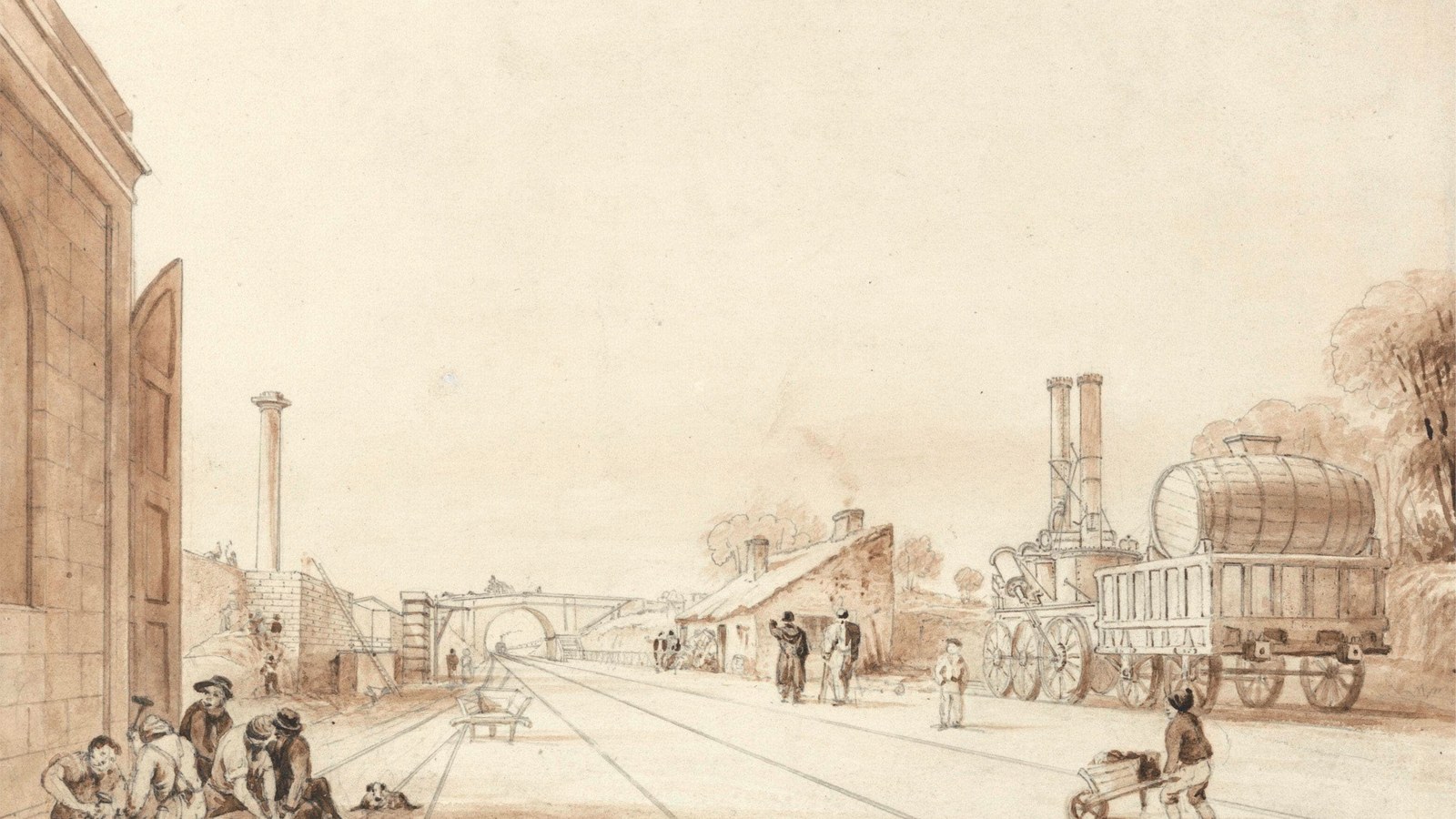
Image: Isaac Shaw, view of the Liverpool and Manchester Railway at Parkside watering station, circa 1830, with the locomotive Twin Sisters. Public domain. This is not a photograph of the opening ceremony; it is a contemporary depiction of the line. The image was cropped to 16:9.
Sources consulted: Edge Hill Engine Station, Liverpool & Manchester Railway (Historic England); Liverpool & Manchester Railway (Science Museum Group Collection); Huskisson Memorial (Science Museum Group); Liverpool and Manchester Railway (University of Liverpool, Victoria Gallery & Museum); Liverpool Road Station, Manchester (National Transport Trust); Making the Liverpool and Manchester Railway (Science and Industry Museum); Stephenson’s Rocket, Rainhill and the rise of the locomotive (National Railway Museum).





0 Comments
No comments on this article yet. Be the first!