


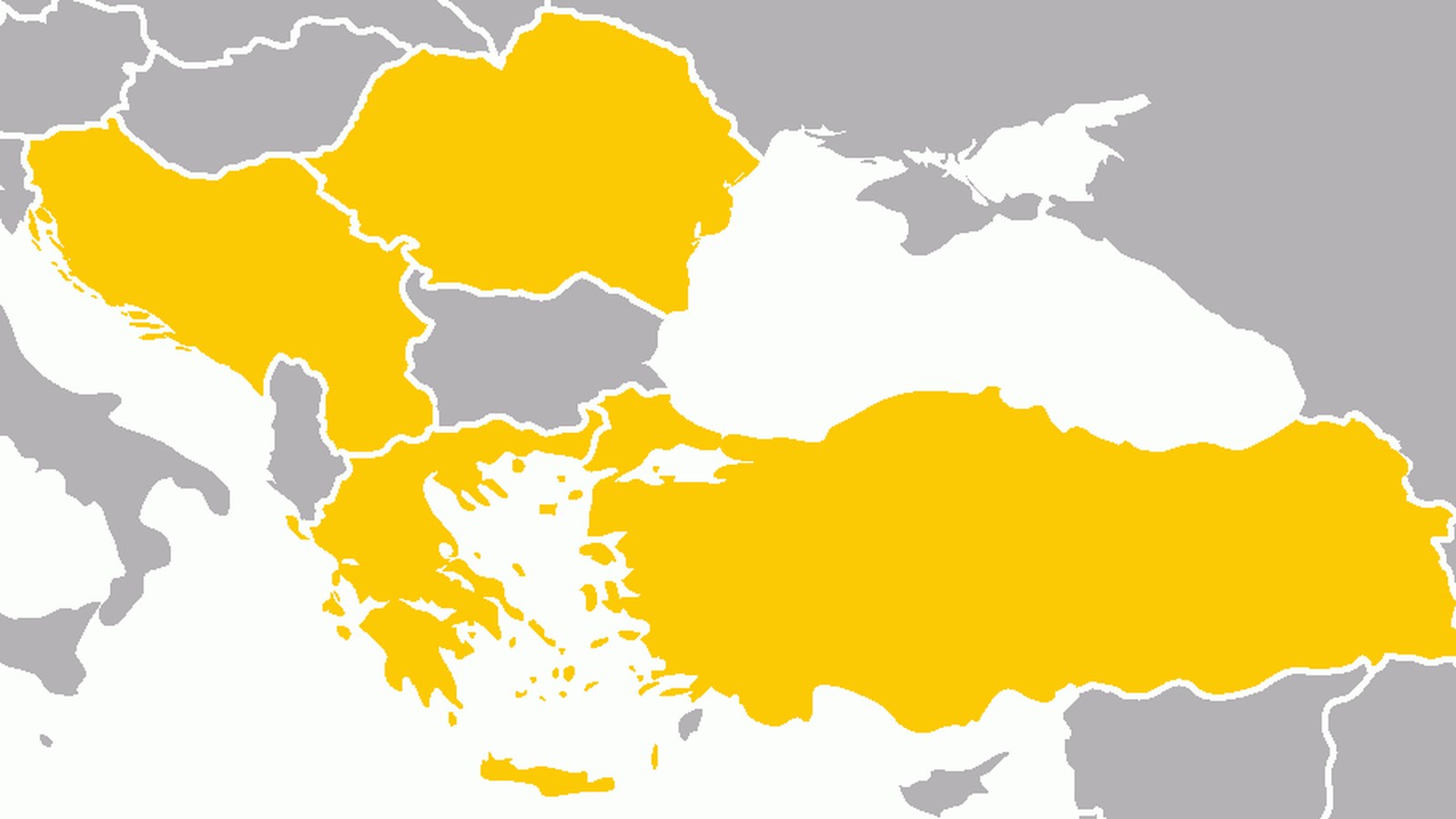
In Athens, on 9 February 1934, Greece, Romania, Turkey and Yugoslavia sign the Pact of Balkan Entente. The plenipotentiaries are the foreign ministers Demetre Maximos (Greece), Nicolae Titulescu (Romania), Tevfik Rüştü Bey (Turkey) and Bogoljub Jevtić (Yugoslavia). The instrument is executed in four copies, one for each party. The Pact comes into force on the day of signature by all the Contracting Parties and is open to accession by any Balkan country favourably regarded by the signatories.
The preamble states the desire to contribute to the consolidation of peace in the Balkans, in the spirit of the Briand–Kellogg Pact and the decisions of the Assembly of the League of Nations relating thereto, and the firm resolve to ensure observance of existing contractual obligations and the maintenance of the territorial situation in the Balkans as then established.
Article 1 provides that Greece, Romania, Turkey and Yugoslavia mutually guarantee the security of each and all of their Balkan frontiers. Article 2 undertakes that the High Contracting Parties shall concert together on measures in contingencies liable to affect their interests as defined by the Agreement; that they shall not embark upon any political action in relation to any other Balkan country not a signatory without previous mutual consultation, nor incur any political obligation to any other Balkan country without the consent of the other Contracting Parties.
The Protocol-Annex, an integral part of the Pact, defines as aggressor any country committing an act of aggression under Article 2 of the London Conventions of 3 and 4 July 1933. The object of the Pact is to guarantee the security of the several Balkan frontiers against aggression on the part of any Balkan State; it is not directed against any Power. If one of the High Contracting Parties is the victim of aggression by any non-Balkan Power and a Balkan State associates itself with such aggression, the Pact shall apply in its entirety in relation to that Balkan State.
The Protocol further undertakes to conclude appropriate Conventions for the furtherance of the objects of the Pact, negotiations to begin within six months. The text is registered in the League of Nations Treaty Series, volume 153, No. 3514, on 1 October 1934. Italy, Albania, Bulgaria, Hungary and the Soviet Union do not sign the instrument.
The Pact helps to ensure peace among the signatories but does not end regional intrigues. On 31 July 1938 its members sign the Salonika Agreement with Bulgaria, which repeals demilitarised-zone clauses at Bulgaria’s borders under the post–First World War settlement and allows Bulgaria to rearm. With pressure on Romania, the 1940 Treaty of Craiova and the 1941 Axis invasions of Yugoslavia and Greece, the Balkan Entente effectively ceases to operate.
Image: map of the Balkan Entente, 1934; public domain, Wikimedia Commons. Cropped to 16:9.
Source consulted: Balkan Pact. Treaty text: Pact of Balkan Entente between Greece, Roumania, Turkey and Yugoslavia, Athens, 9 February 1934 (LNTS No. 3514 text).











0 Comments
No comments on this article yet. Be the first!