


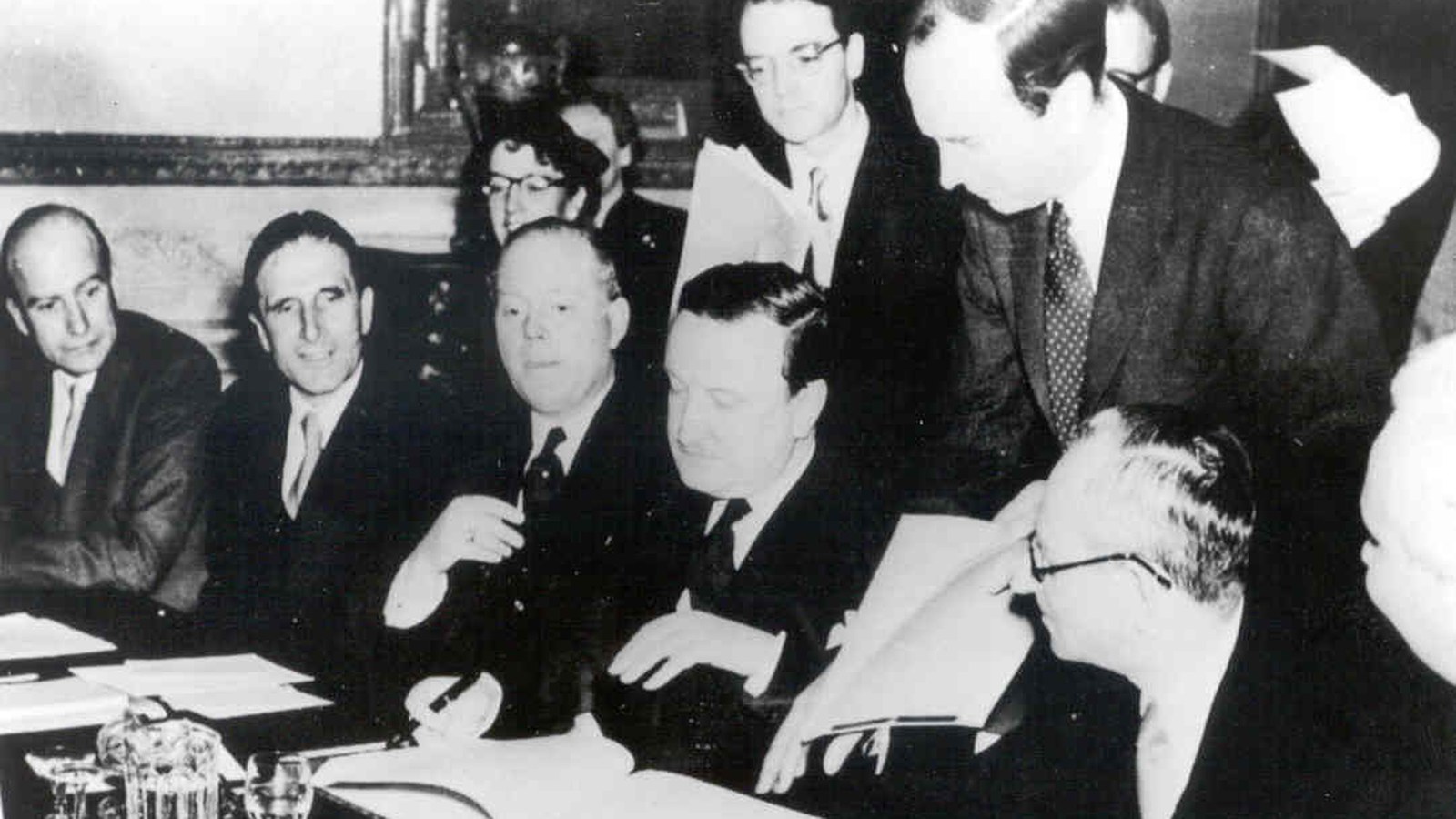
In London, on 27 February 1953, the Governments of Belgium, Canada, Ceylon, Denmark, the French Republic, Greece, Iran, Ireland, Italy, Liechtenstein, Luxembourg, Norway, Pakistan, Spain, Sweden, Switzerland, the Union of South Africa, the United Kingdom, the United States and Yugoslavia, of the one part, and the Government of the Federal Republic of Germany, of the other part, sign the Agreement on German External Debts (Londoner Schuldenabkommen). The authentic texts are English, French and German; the depositary is the Government of the United Kingdom. The Agreement enters into force on 16 September 1953 upon deposit of the ratifications of the Federal Republic, France, the United Kingdom and the United States, in accordance with Article 35; it is registered in the UNTS as No. 4764 (volume 333).
The preamble desires to remove obstacles to normal economic relations between the Federal Republic and other countries; notes that for about twenty years payments on German external debts had not generally conformed to contractual terms, that war prevented many payments and that since 1945 such payments had been generally suspended; recalls postwar economic assistance by France, the United Kingdom and the United States and the exchange of letters of 6 March 1951 forming the basis of the Agreement; and mentions the Tripartite Commission on German Debts.
The Agreement covers pre-war public and private indebtedness and debts arising from postwar economic assistance (including GARIOA and the Marshall Plan); it does not relate to claims arising out of the war, which can only be dealt with in connexion with a peace treaty. Eastern Bloc states are not parties. The Conference on German External Debts runs from 28 February to 28 August 1952; Hermann Josef Abs signs for the German side in London.
In total the amounts negotiated include about DM 16 billion of pre–Second World War debts (including Dawes/Young-plan loans) and about DM 16 billion of postwar loans; the Agreement reduces the repayable amount by roughly 50% to about DM 15 billion over a long horizon. Payments are linked to Germany’s ability to make transfers: repayments due while the Federal Republic runs a trade surplus, limited to about 3% of export earnings; for the first five years, until 1958, Germany pays mainly arrears of interest.
Annexes I to X and subsidiary agreements regulate types of pecuniary obligations (non-contractual amounts fixed and due before 8 May 1945; loan or credit contracts entered into before that date; other contracts due before that date) and technical detail. After 1958 Germany pays a fixed annual sum (DM 765 million); debts covered are largely paid off in the 1970s, with later reunification-linked payments until 3 October 2010.
The present text concerns the Agreement signed in London on 27 February 1953; it is not a peace treaty and does not settle war reparations owed to victim states.
Image: Hermann Josef Abs at the signing of the London Agreement, 27 February 1953; CC BY-SA 3.0, Wikimedia Commons. Cropped to 16:9.
Source consulted: London Agreement on German External Debts. Treaty text: Agreement on German External Debts, London, 27 February 1953 (UKTS / Cmnd. 626).











0 Comments
No comments on this article yet. Be the first!