
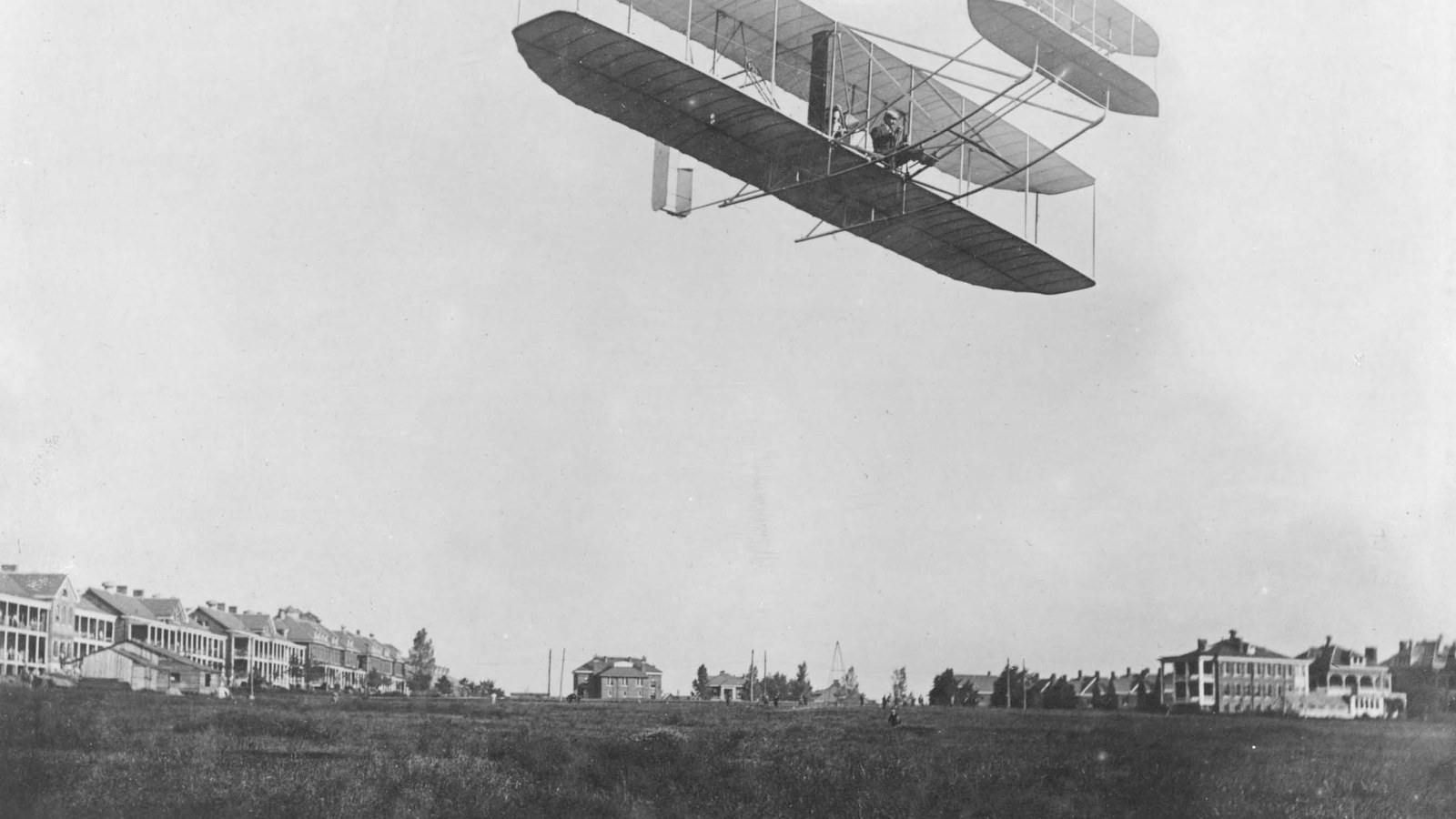
On 17 September 1908 the demonstration programme through which the Wright brothers were trying to prove the military usefulness of their aeroplane was abruptly interrupted by a crash at Fort Myer, Virginia. Orville Wright was flying with Lieutenant Thomas E. Selfridge as passenger. Selfridge’s death is treated separately; what remains here is the fate of the military programme and of Orville himself.
During the flight a mechanical problem in the propeller system affected control of the aircraft. The machine lost altitude and crashed. Orville survived but was seriously injured and needed a long recovery. For the Wright brothers the crash came at a moment when the military demonstrations were crucial to the commercial and institutional future of their invention.
The programme did not end with the crash. After Orville recovered and the design was developed further, Wilbur and Orville returned to Fort Myer in 1909 with a new aeroplane. The Smithsonian National Air and Space Museum notes that the new demonstrations succeeded and that on 2 August 1909 the Signal Corps officially accepted the Wright machine — the first aeroplane purchased and put into service by any government.
The aircraft, designated Signal Corps No. 1, served until 1911 training Army pilots and was then transferred to the Smithsonian Institution. The museum presents it today as the world’s first military aeroplane and as the seed of the military aerospace industry.
The crash of 17 September 1908 showed both the potential and the risks of a technology still in its infancy. Within only a few years the aeroplane would move from experiment to military tool. The continuation of the programme after Orville’s injury shows that the Army did not abandon the idea; it waited for a machine that could pass the trials.
RoAdevăr has also recorded, in the same anniversary window, the death of Thomas Selfridge, the first fatality in a powered-aircraft crash.
One hundred and eighteen years later, the episode remains an essential chapter in the Wright story after 1903: not only the invention, but the negotiation with a military customer, the failure of a test, and its resumption a year later.
Photo: the Wright aircraft at Fort Myer. Historical photograph, public domain via Wikimedia Commons.
Source consulted: Smithsonian — World’s First Military Airplane; Wright Military Flyer, Smithsonian collection.




0 Comments
No comments on this article yet. Be the first!