


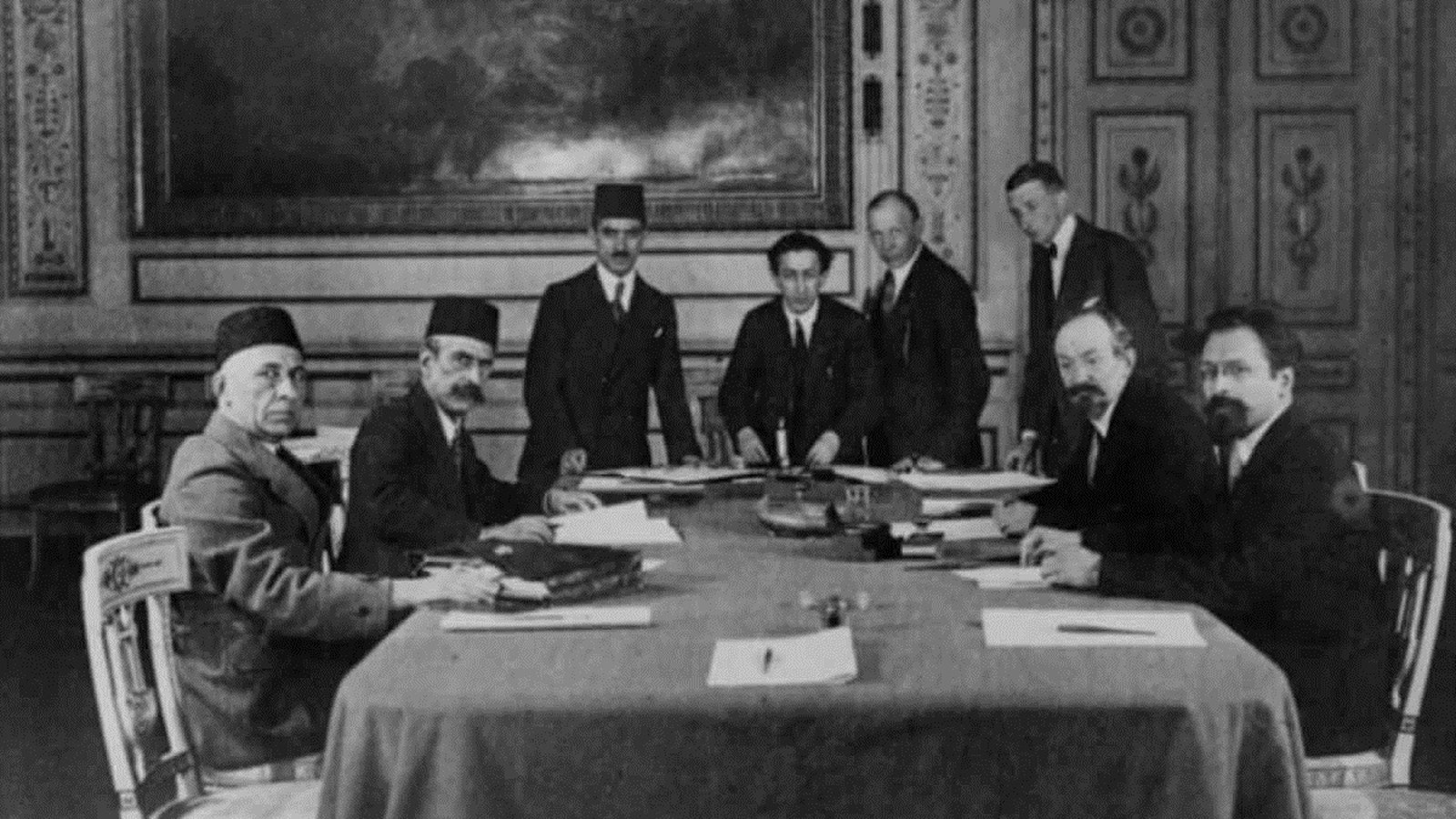
In Moscow, on 26 February 1921, the Persian Government and the Russian Socialist Federal Soviet Republic sign the Treaty of Friendship. The plenipotentiaries are Ali Gholi Khan Moshaver ol-Mamalek (ʿAli-Qoli Masʿud Ansari) for Persia and G. V. Chicherin together with L. M. Karakhan for Russia. The authentic texts are Russian and Persian. The Treaty comes into force immediately upon signature; ratifications are exchanged at Tehran on 26 February 1922; it is registered in the League of Nations Treaty Series, volume 9, No. 268.
Article 1 reaffirms Soviet Russia’s renunciation of Tsarist policy towards Persia and declares null and void the whole body of treaties and conventions concluded with Persia by the Tsarist Government which crushed the rights of the Persian people. Article 2 repudiates Federal Russia’s participation in any action which might destroy or weaken Persian sovereignty and nullifies Tsarist treaties with third parties in respect of Persia or to its detriment.
Article 3 accepts the Russo-Persian frontiers drawn by the Frontier Commission in 1881; Russia renounces the Achouradeh Islands and other islands on the Astrabad littoral and restores to Persia the village of Firouzeh and adjacent land ceded under the Convention of 28 May 1893; Persia agrees that Russian Sarakhs (“old” Sarakhs) and land adjacent to the Sarakhs River shall be retained by Russia; the Parties have equal rights of usage over the Atrak River and other frontier waterways.
Article 4 undertakes that each Party shall abstain from any intervention in the internal affairs of the other. Article 5 requires prohibition within their territories of organisations hostile to the other Party, of the formation of troops with that object, of transit of material usable against the other, and prevention of the presence of third-party forces that would menace the frontiers, interests or safety of the other Contracting Party.
Article 6 provides that if a third party attempts usurpation by armed intervention in Persia, or seeks to use Persian territory as a base against Russia, or threatens the frontiers of Federal Russia or its Allies, and if the Persian Government cannot stop the menace after being once called upon to do so by Russia, Russia shall have the right to advance troops into the Persian interior for the military operations necessary for its defence, undertaking to withdraw them as soon as the danger has been removed.
Article 11 restores equal rights of free shipping under their own flags in the Caspian Sea after abrogation of the 1828 Treaty of Turkmenchay. Articles 5 and 6, debated in the Persian parliament, later serve as a basis for the 1941 Soviet occupation and are repudiated by Iran in 1979.
Image: signing of the Russo-Persian Treaty of Friendship, Moscow, 26 February 1921; public domain, Wikimedia Commons. Cropped to 16:9.
Source consulted: Russo-Persian Treaty of Friendship (1921). Treaty text: Treaty of Friendship between Persia and the RSFSR, Moscow, 26 February 1921 (LNTS No. 268).











0 Comments
No comments on this article yet. Be the first!