


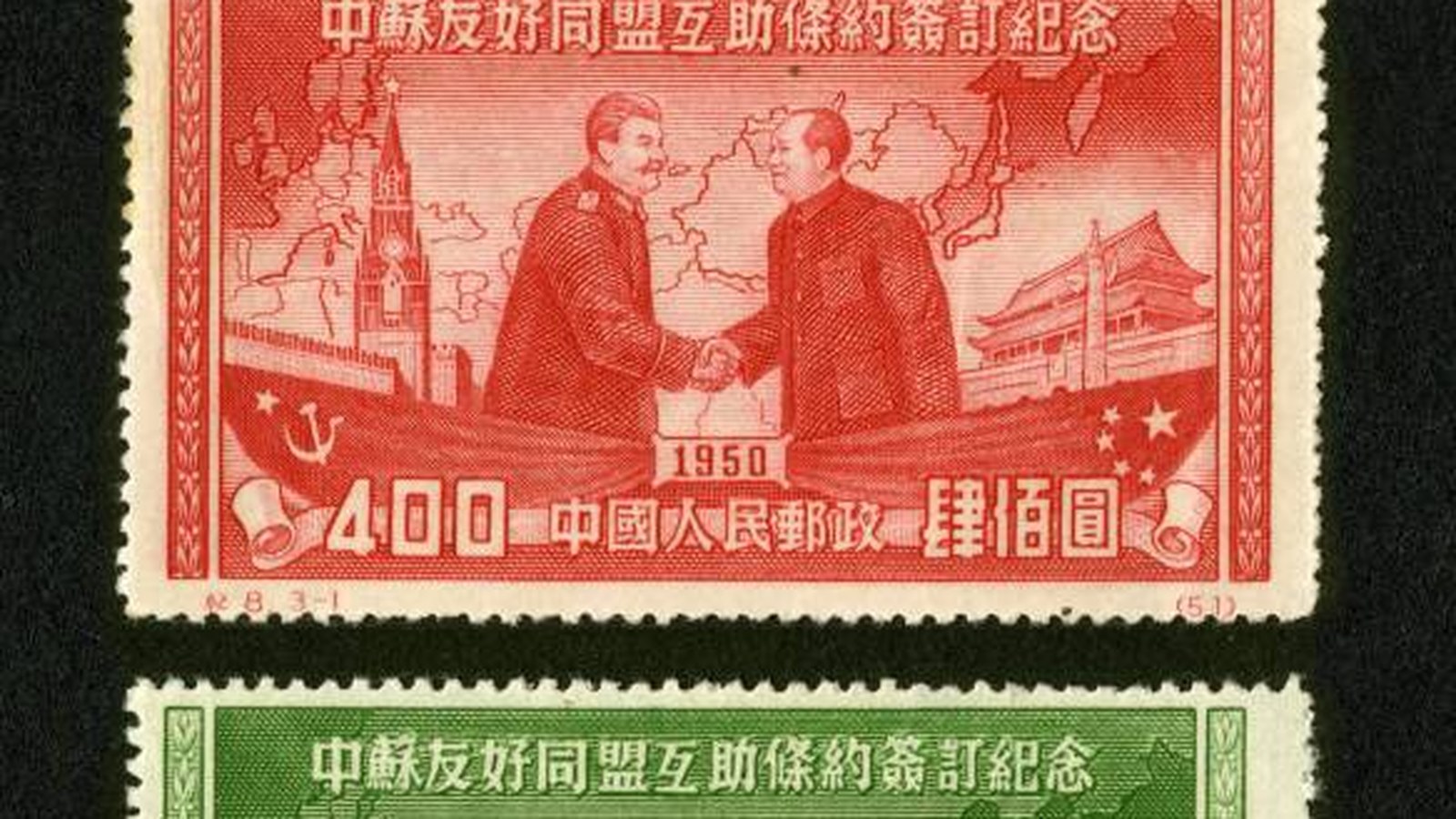
In Moscow, on 14 February 1950, the Union of Soviet Socialist Republics and the People’s Republic of China sign the Treaty of Friendship, Alliance and Mutual Assistance. The plenipotentiaries are Andrei Yanuaryevich Vyshinsky, Minister of Foreign Affairs of the USSR, and Zhou Enlai (Chou En-lai), Chairman of the State Administrative Council and Minister of Foreign Affairs of China. The official texts are Russian and Chinese. The Treaty is later registered in the United Nations Treaty Series, volume 226, No. 3103.
The preamble states the determination, by consolidating friendship and co-operation, jointly to prevent the revival of Japanese imperialism and the repetition of aggression by Japan or any other State that might join with Japan; the desire to consolidate lasting peace and general security in the Far East and throughout the world in accordance with the purposes and principles of the United Nations; and the conviction that good-neighbourly relations serve the fundamental interests of the peoples of both States.
Article 1 undertakes that the Parties shall jointly take all necessary measures to prevent a repetition of aggression and breach of the peace by Japan or any State allied with Japan; should either Party be attacked by Japan or by States allied with Japan and thus find itself in a state of war, the other shall immediately extend military and other assistance with all means at its disposal. The Parties declare readiness to participate in international action to safeguard peace and security.
Article 2 undertakes, by common agreement and with the other Powers which were Allies in the Second World War, to strive for the earliest conclusion of a Peace Treaty with Japan. Article 3 forbids either Party to enter into any alliance directed against the other, or to participate in any coalition or in any action or measures directed against the other. Article 4 requires consultation on all important international questions involving common interests, with a view to strengthening peace.
Article 5 undertakes, in a spirit of friendship and co-operation and in accordance with equal rights, mutual interests, mutual respect for State sovereignty and territorial integrity and non-intervention in domestic affairs, to develop and strengthen economic and cultural ties and to render each other all possible economic assistance. Article 6 provides that the Treaty comes into force immediately upon ratification, the exchange of instruments to take place in Peking; it remains in force for thirty years, with automatic five-year extensions unless denounced one year before expiry.
On the same day separate agreements are signed concerning the Chinese Changchun Railway, Port Arthur and Dairen, a Soviet credit of US$300 million over five years, and notes on the annulment of the 14 August 1945 Treaty with the Republic of China and recognition of the independence of the Mongolian People’s Republic. The Friendship Treaty enters into force on 11 April 1950.
Image: Chinese stamp commemorating the Sino-Soviet Friendship Treaty, 1950; public domain, Wikimedia Commons. Cropped to 16:9.
Source consulted: Sino-Soviet Treaty of Friendship, Alliance and Mutual Assistance. Treaty text: Treaty of Friendship, Alliance and Mutual Assistance, Moscow, 14 February 1950 (English text).











0 Comments
No comments on this article yet. Be the first!