


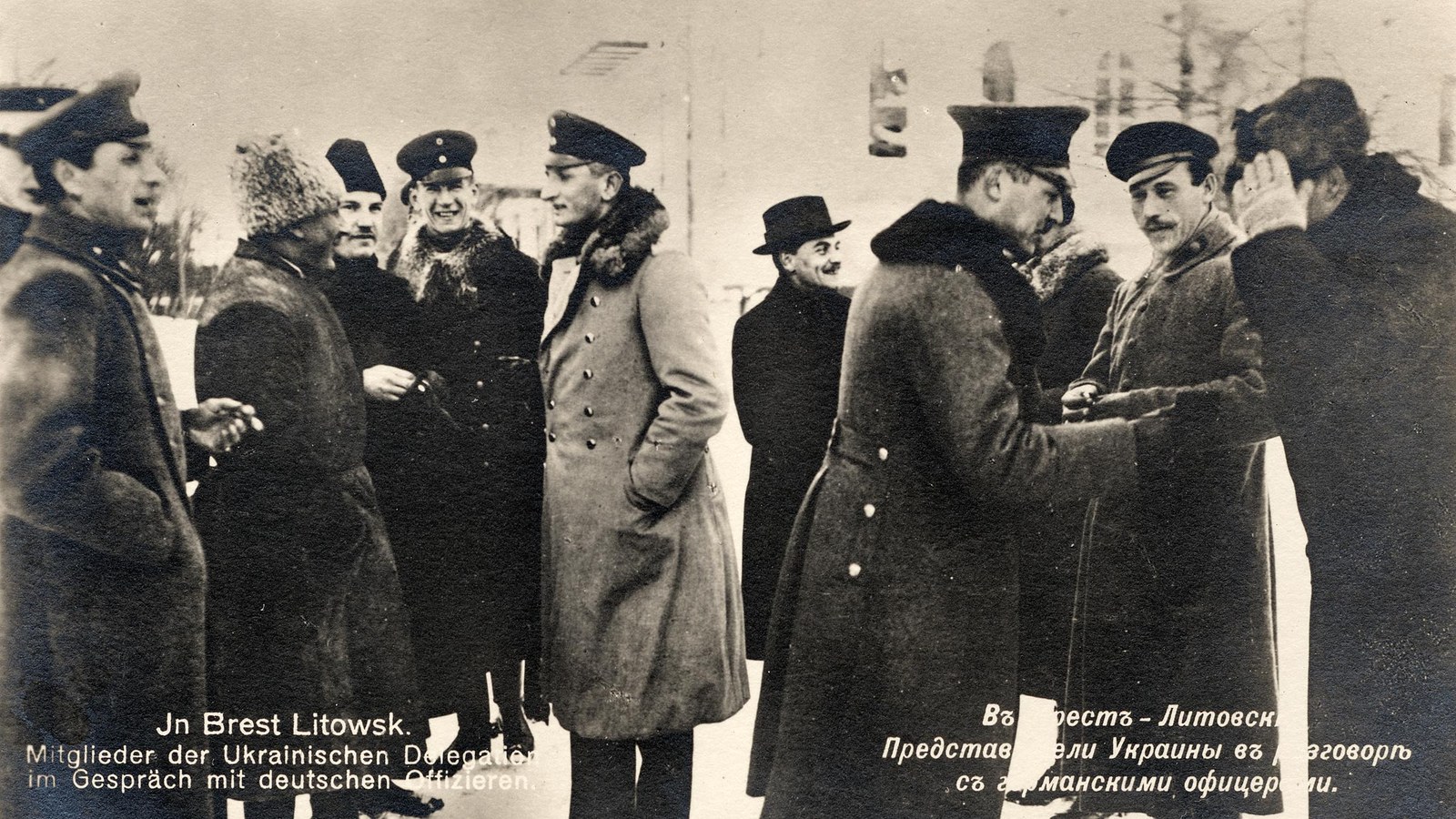
At Brest-Litovsk, on 9 February 1918, Germany, Austria-Hungary, Bulgaria and Turkey, on the one hand, and the Ukrainian People’s Republic, on the other, sign the Treaty of Peace. The plenipotentiaries, after presenting their full powers, agree upon the text; the instrument is executed in quintuplicate. For Germany, Richard von Kühlmann signs; for Austria-Hungary, Count Ottokar Czernin; for Bulgaria, Vasil Radoslavov and the other Bulgarian plenipotentiaries; for the Ottoman Empire, Talaat Pasha and the others; for the Ukrainian People’s Republic, Oleksandr Sevriuk, Mykola Liubynsky and Mykola Levytsky, members of the Ukrainian Central Rada.
The preamble proceeds from the fact that the Ukrainian People has, in the course of the world war, declared its independence and expressed the desire to establish a state of peace with the Powers at war with Russia. The Governments of the Central Powers resolve to conclude peace with the Government of the Ukrainian People’s Republic as a first step towards a lasting world peace, honourable for all parties, which shall put an end to the horrors of the war and restore friendly relations in the political, legal, economic and intellectual spheres.
Article I declares that the state of war between them is at an end and that the contracting parties are resolved henceforth to live in peace and amity. Article II fixes the frontiers: between Austria-Hungary and the Ukrainian People’s Republic the frontiers which existed before the outbreak of the war are preserved; further north, the frontier of the Ukrainian People’s Republic, starting at Tarnograd, generally follows the line Bilgoray–Szczebrzeszyn–Krasnostav–Radzin–Miedzyzheche–Sarnaki–Melnik–Vysokie-Litovsk–Kameniec-Litovsk–Prujany and Vydonovsk Lake, to be delimited in detail by a mixed commission according to ethnographical conditions and the wishes of the inhabitants. Article III requires evacuation of the occupied territories to begin immediately after ratification, the manner being determined by the Plenipotentiaries of the interested parties.
Article IV provides that diplomatic and consular relations shall commence immediately after ratification, with special agreements reserved for the admission of consuls. Article V mutually renounces repayment of war costs and payment for war damages, including requisitions in enemy territory. Article VI provides for the release of prisoners of war to their homeland, in so far as they do not desire, with the approval of the State in whose territory they are, to remain or to proceed to another country.
Article VII organises economic relations: until 31 July of the current year, a reciprocal exchange of the surplus of more important agricultural and industrial products, with quantities and prices settled by parity commissions, calculated in gold (1,000 German Imperial gold Marks equal to 462 gold Roubles; 1,000 Austrian and Hungarian gold Kronen equal to 393 Karbowanjec 76 Grosh gold), through Government central offices; other exchange on the basis of a provisional commercial treaty. For Germany, adapted provisions of the Germano-Russian Commercial and Maritime Treaty of 1894/1904 apply; for Austria-Hungary, those of the Austro-Hungarian–Russian Commercial and Maritime Treaty of 15 February 1906; separate regimes are provided for Bulgaria and Turkey.
Article VIII reserves separate Treaties on public and private legal relations, the exchange of prisoners of war and interned civilians, the amnesty question and the treatment of merchant shipping in the enemy’s hands, as an essential part of the Peace Treaty. Article IX declares that the agreements form an indivisible whole. Article X fixes the authoritative texts: German and Ukrainian for relations between Germany and the Ukraine; German, Hungarian and Ukrainian for Austria-Hungary; Bulgarian and Ukrainian for Bulgaria; Turkish and Ukrainian for Turkey.
The final provision requires ratification and the exchange of ratifications in Vienna at the earliest possible moment; the Treaty of Peace shall come into force on its ratification, in so far as it contains no stipulation to the contrary. The text is not the later Treaty of Brest-Litovsk between the Central Powers and Soviet Russia.
Image: signing of the Ukraine–Central Powers Peace Treaty, Brest-Litovsk, 9 February 1918; public domain, Wikimedia Commons. Cropped to 16:9.
Source consulted: Treaty of Brest-Litovsk (Ukraine–Central Powers). Treaty text: Treaty of Peace between Ukraine and the Central Powers, Brest-Litovsk, 9 February 1918 (Wikisource).











0 Comments
No comments on this article yet. Be the first!