


On 10 December 1982, at Montego Bay, Jamaica, the United Nations Convention on the Law of the Sea was opened for signature, together with the Final Act of the Third United Nations Conference on the Law of the Sea. The closing formula: done at Montego Bay. Six authentic texts: Arabic, Chinese, English, French, Russian and Spanish; the original, subject to Article 305(2), is deposited with the Secretary-General (Article 320). Open for signature until 9 December 1984 at the Ministry of Foreign Affairs of Jamaica and also, from 1 July 1983 until that same date, at United Nations Headquarters in New York (Article 305). Article 308(1): this Convention shall enter into force 12 months after the date of deposit of the sixtieth instrument of ratification or accession. Entry into force: 16 November 1994. Registration ex officio: UNTS I-31363, volume 1833. Article 309: no reservations or exceptions unless expressly permitted. Article 310: declarations that do not purport to exclude or modify the legal effect.
The preamble: to settle, in a spirit of mutual understanding, all issues relating to the law of the sea; a contribution to peace, justice and progress. 320 articles and nine annexes. Article 2: the sovereignty of a coastal State extends, beyond its land territory and internal waters, to the territorial sea, the air space over it and its bed and subsoil, subject to this Convention. Article 3: every State has the right to establish the breadth of its territorial sea up to a limit not exceeding 12 nautical miles, measured from baselines determined in accordance with this Convention. Article 17: ships of all States enjoy the right of innocent passage. Article 33: the contiguous zone, not extending beyond 24 nautical miles from the same baselines.
Part V: the exclusive economic zone. Article 57: the EEZ shall not extend beyond 200 nautical miles from the baselines from which the breadth of the territorial sea is measured. Article 56: sovereign rights for the purpose of exploring and exploiting, conserving and managing the natural resources, whether living or non-living, of the waters, seabed and subsoil, and jurisdiction with regard to artificial islands, marine scientific research and the protection of the marine environment. Article 58: in the EEZ all States, whether coastal or land-locked, enjoy, subject to this Convention, the freedoms referred to in Article 87 of navigation, overflight and the laying of submarine cables and pipelines. Part VI, Article 76(1): the continental shelf comprises the seabed and subsoil of the submarine areas that extend beyond the territorial sea throughout the natural prolongation of the land territory to the outer edge of the continental margin, or to 200 nautical miles where that edge does not extend up to that distance; not beyond the limits in points 4 to 6.
Part VII: the high seas. Article 87: open to all States; freedom of navigation, overflight, cables and pipelines, artificial islands, fishing and scientific research, under the conditions laid down by this Convention. Part XI: the Area (the seabed and ocean floor beyond national jurisdiction) and its resources are the common heritage of mankind (Article 136). Article 137: no claim or exercise of sovereignty; all rights in the resources of the Area are vested in mankind as a whole, on whose behalf the Authority shall act. An Agreement of 28 July 1994 on the implementation of Part XI is a later instrument, not this text.
Part XV: settlement of disputes; Article 287, a choice among the International Tribunal for the Law of the Sea, the International Court of Justice, arbitration (Annex VII) or special arbitration (Annex VIII). Fiji deposited its ratification on the day of opening. This is not a treaty delimiting land sovereignty; it is a framework for ocean space.
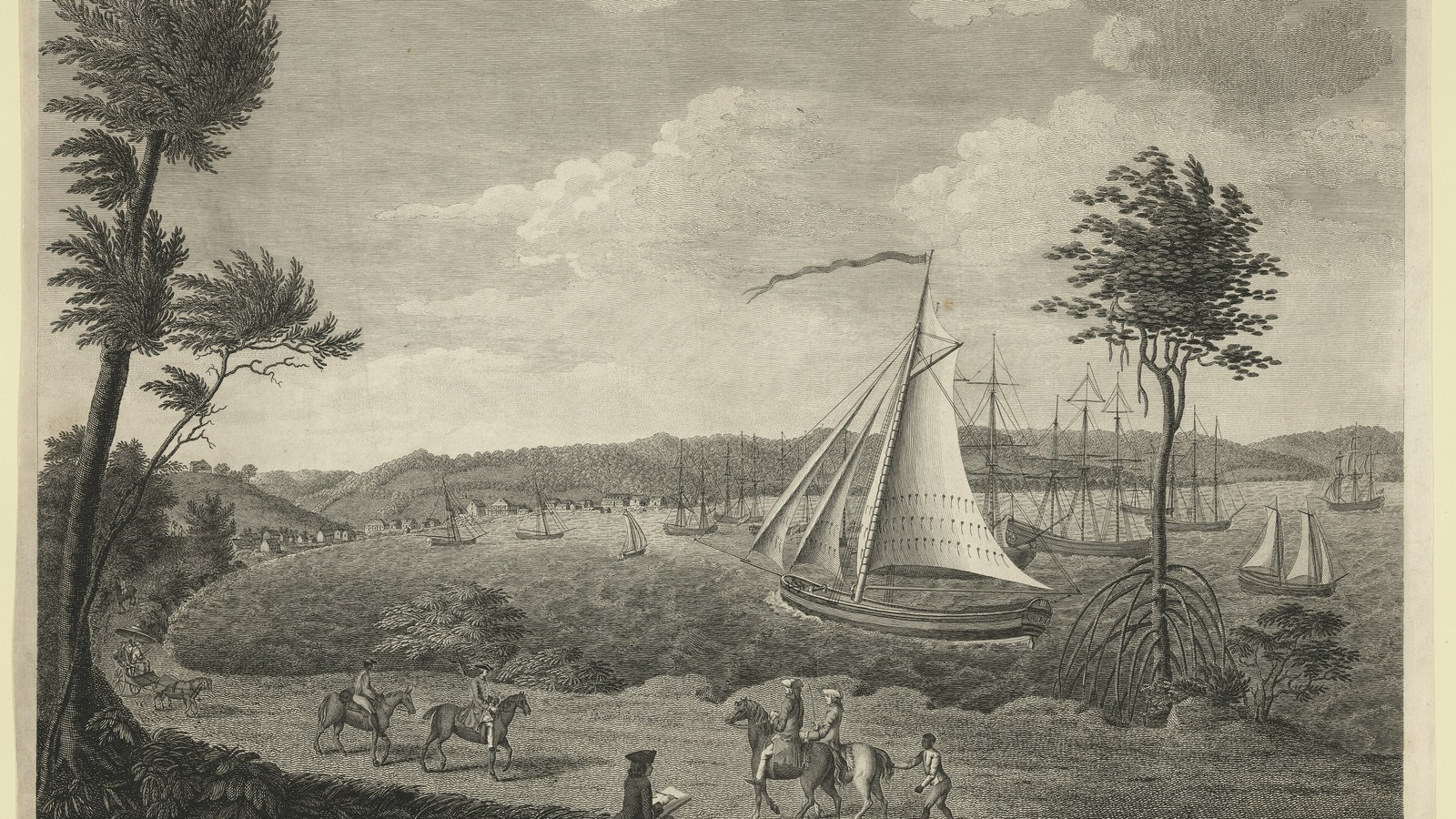
Montego Bay harbour, Jamaica, the city of signature, not the signing room. A historic view of the town and bay. Wikimedia Commons, public domain.
For context: United Nations Convention on the Law of the Sea. The text: DOALOS, United Nations Convention on the Law of the Sea.











0 Comments
No comments on this article yet. Be the first!