
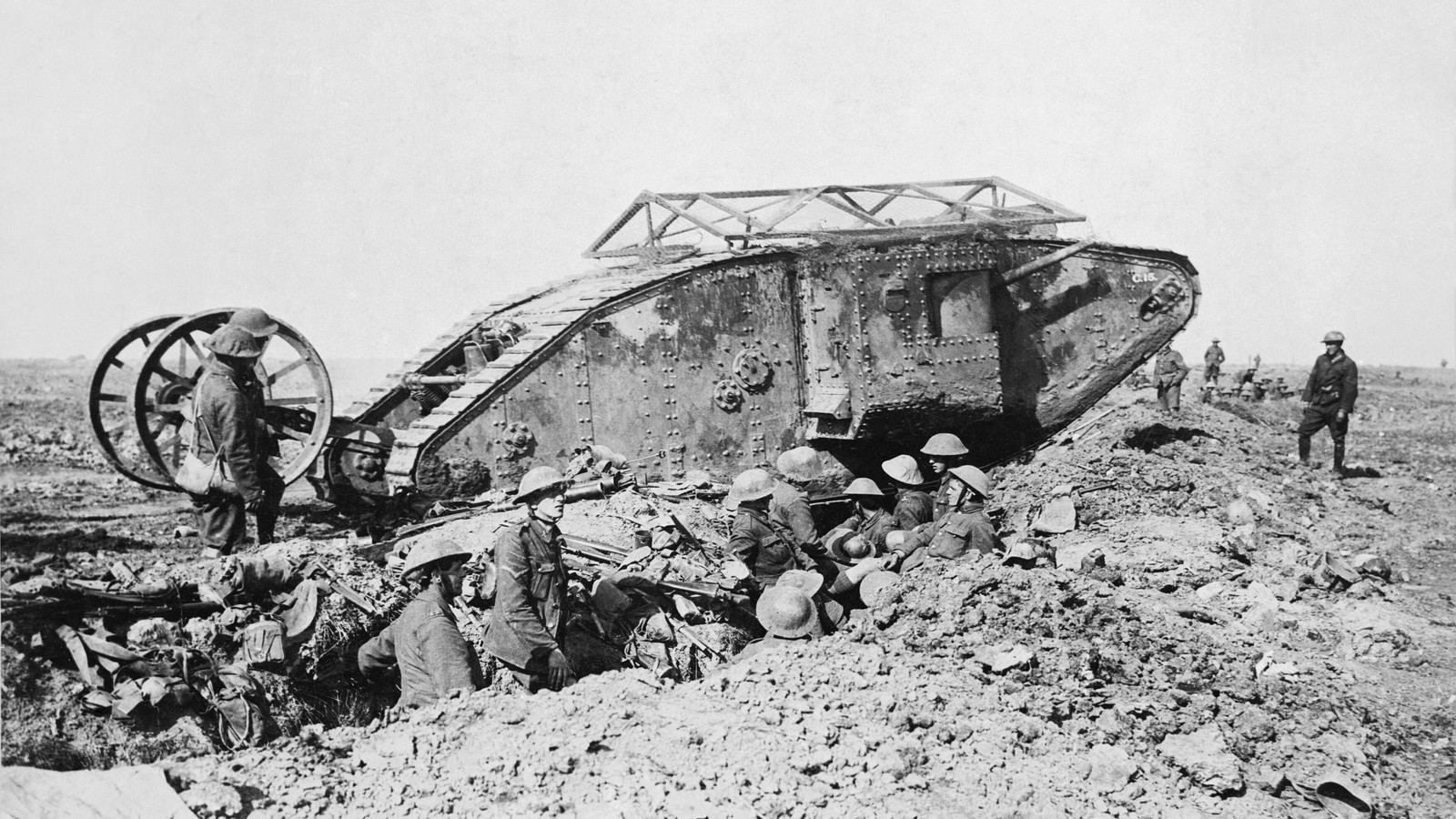
On the morning of 15 September 1916, German soldiers on the Western Front met a weapon they had never seen in battle: armoured, tracked vehicles moving towards the trenches. They were British Mark I tanks. It was the first time tanks were used in a combat operation. The place: Flers-Courcelette, on the Somme front in France. Today, 15 September 2026, marks 110 years since that moment.
Of the 49 tanks of the Heavy Section, Machine Gun Corps, allocated to the attack, many failed to reach combat because of breakdowns. The National Army Museum records that when the attack began only 15 moved into no man’s land. The debut was far from a decisive success, but the concept would transform land warfare.
Why a tank was needed
The First World War had begun in 1914. After the first months of mobile fighting, the Western Front became a system of trenches, barbed wire, machine-gun posts, fortifications and artillery positions, from the Belgian coast towards the Swiss frontier. Infantry attacks on fortified positions could produce enormous losses for tiny gains. The machine gun, the wire and ground smashed by artillery made open ground almost impossible to cross. Armies needed a machine that could cross difficult ground, span trenches, crush or pass barbed wire, protect the crew and attack fortified positions.
Lieutenant Colonel Ernest Swinton, Royal Engineers, proposed an armoured, armed, tracked vehicle. The National Army Museum says his ideas at first met little interest from the War Office. The Admiralty first embraced the idea of “land ships”. Winston Churchill, then First Lord of the Admiralty, was an important backer: Imperial War Museums record that he established the Landships Committee in early 1915 to investigate armoured vehicles able to cross trenches. Churchill did not invent the tank. Development involved engineers, soldiers, inventors, institutions and successive designs — including the Royal Naval Air Service and Fosters of Lincoln.
Little Willie, Mother, Mark I
One of the first British prototypes, Little Willie, was built in 1915. It helped test tracks, engine, transmission and mobility, but its shape was not enough for wide trenches. In January 1916 a prototype known as Mother (or His Majesty’s Landship Centipede) passed important tests. The rhomboid form, with tracks running almost all round the hull, gave a better chance of crossing trenches and obstacles. From that evolution came the Mark I. In February 1916 the Minister of Munitions, David Lloyd George, ordered 100.
The project was secret. The National Army Museum says that in training the men told civilians they were working on water cisterns or “tanks” for the Russian Army. IWM records that the name “tank” came from attempts to disguise the new weapons as water tanks. The temporary name stuck. The Mark I had tracks around the hull, armour, armament and a crew of eight. The “male” was armed with six-pounder guns and machine guns; the “female” mainly with machine guns. The interior was noisy, hot and full of fumes; the museum notes that crews were given masks against metal splinters, hard to wear because of the heat and darkness. The Tank Museum describes a maximum speed of about 4 mph — roughly 6 km/h — varying with ground and the state of the vehicle. It was not fast: it moved about as quickly as a walking man.
15 September 1916: 49 allocated, 15 into no man’s land
The Battle of the Somme had begun on 1 July 1916. On the first day the British Army suffered more than 57,000 casualties, the National Army Museum writes — the bloodiest day in its history. The offensive continued through summer and autumn. By the end of July General Sir Douglas Haig, commanding the British Expeditionary Force, had decided the first group of tanks would go to France. The move, in great secrecy, was known as Operation Alpaca: in August, C and D Companies left with the vehicles.
For the attack at Flers-Courcelette, 49 tanks were allocated to support six divisions, to hit strongpoints, machine-gun nests, wire and dugouts, with infantry to follow. The Ministry of Defence notes they were slow, mechanically unreliable, the crews inexperienced and untrained alongside infantry. Before Zero Hour the tanks moved towards the start line. Some broke down. Others never arrived. The National Army Museum records: when the attack commenced, only 15 of 49 moved into no man’s land. We do not mix that figure with others (machines that reached the start, were later engaged, or still ran). Fifteen does not mean only 15 tanks existed.
For the Bavarian troops the appearance was unexpected; some were terrified. A few tanks pushed far into the German defences. Flers was captured. The National Army Museum estimates an advance of about 1.5 miles (2.4 km). A complete breakthrough of the German front did not come. The tanks did not win the Battle of the Somme and were not a spectacular victory for the new weapon. Many broke down, stuck, were hit or never reached their objectives. Co-ordination with infantry and artillery was still crude: infantry could overtake the slow tanks; gaps left in the bombardment for the machines could leave German positions intact. Some tank officers later felt the weapon had been used too soon, with too few vehicles, and that surprise had been spent.
The idea worked. The technology did not, yet
Even so, the attack had shown that an armoured tracked vehicle could cross ground infantry found extremely hard, protect the crew from some small-arms fire and support an advance. The concept worked. The tactics needed work. The British used tanks again in November 1916 at the Battle of the Ancre. In 1917, at the Battle of Cambrai, they were used on a much larger scale and showed more clearly the potential of concentrated armoured attacks. They did not win the battle alone: the National Army Museum notes that without adequate infantry reinforcements the gap could not be exploited, and the early gains were not held in full.
Germany developed the A7V, produced however in small numbers. France developed the Renault FT, with the engine at the rear, the crew in the hull and a rotating turret — the layout that would become the classic form of the modern tank. In the Second World War armoured formations played a fundamental role. From the Mark I, which barely exceeded walking pace, to the modern main battle tank — powerful engines, large-calibre guns, composite armour, optics, thermal sights, communications — the principle remains recognisable: mobility, protection, firepower.
At 110 years, the tank’s role is again debated. Recent wars have shown the vulnerability of armour to drones, anti-tank missiles, mines, precision artillery and loitering munitions. Large armies nonetheless keep modernising them. We do not turn the anniversary into a commentary on a current conflict.
RoAdevăr has also written about moments that changed war and technology: Napoleon’s occupation of Moscow in 1812 and the first human-made object to reach the Moon.
On 15 September 1916 the tank was an experimental weapon. Most of the machines allocated did not do what had been hoped. Engines failed. Co-ordination was hard. The decisive breakthrough did not come. But that morning, in the fields at Flers-Courcelette, an idea that would change warfare had been demonstrated in combat: an armoured, armed, tracked vehicle could accompany troops through the wrecked ground of the battlefield.
Photo: a British Mark I “male” tank (C-15) near Thiepval on the Somme, 25 September 1916 — the same type used ten days earlier at Flers-Courcelette. Photograph by Ernest Brooks, Imperial War Museums Q 2486, public domain (expired Crown Copyright) via Wikimedia Commons. The NAM photograph from Chimpanzee Valley, 15 September 1916 (NAM. 1952-01-33-55-89, Out of Copyright) exists, but the publicly available scan is under 1,200 px wide.
Source consulted: National Army Museum — Attack of the tanks; Battle of the Somme; UK Ministry of Defence; The Tank Museum; IWM: development of the tank.




0 Comments
No comments on this article yet. Be the first!