
BioNTech, known to the public through the COVID-19 vaccine developed with Pfizer, reported updated oncology data on Monday, 14 September 2026. The German company and its US partner OncoC4 presented, at the World Conference on Lung Cancer 2026 in Seoul, results from PRESERVE-003, a global Phase 3 trial of gotistobart (BNT316 / ONC-392), an experimental treatment for squamous non-small cell lung cancer. The drug is not approved for this indication. The pivotal stage of the trial is still running.
According to the companies’ statement, also reported by Reuters, median overall survival in the non-pivotal stage 1 of the study was 18.5 months with gotistobart and 10.0 months with docetaxel. The 8.5-month gap is the difference between two group medians, not a guaranteed extra 8.5 months of life for every patient. BioNTech describes the finding as close to a doubling of median survival; 18.5 months is about 85% longer than 10 months. The safe wording is that median survival was nearly twice as high in the experimental arm, in this analysis.
Hazard ratio 0.56, not “44% saved”
At the 17 July 2026 data cut-off, with a median follow-up of 25.4 months, the hazard ratio for overall survival was 0.56 (nominal p=0.0295). That corresponds to an estimated 44% relative reduction in the risk of death over the period analysed. A hazard ratio does not mean that 44% of patients “were saved”. It describes the relative difference in risk between groups during follow-up. The p-value is nominal: stage 1 is not the confirmatory analysis of the pivotal trial.
Which patients were enrolled
The analysis covered squamous non-small cell lung cancer (squamous NSCLC), a subset of NSCLC, which accounts for most lung cancers. The squamous form often arises in the central airways and is strongly, but not exclusively, associated with smoking; not every patient with this disease is a smoker. The 87 randomised patients (45 gotistobart, 42 docetaxel) had metastatic disease that had progressed after PD-(L)1 inhibitor immunotherapy and chemotherapy. They were not receiving first-line treatment. Remaining options in this setting are limited.
Gotistobart is not an mRNA vaccine
Gotistobart is an experimental monoclonal antibody that targets CTLA-4, an immune checkpoint. Some tumours exploit such checkpoints to evade T cells. BioNTech describes it as a candidate designed to deplete regulatory T cells selectively in the tumour microenvironment, with the aim of restoring anti-tumour immunity. That is the proposed mechanism, not proof that the drug will work in every patient. Unlike the COVID-19 vaccine, gotistobart is not an mRNA product. BioNTech’s oncology pipeline also includes mRNA, bispecific antibodies, antibody-drug conjugates and checkpoint inhibitors.
In the experimental arm, gotistobart was given as monotherapy (6 mg/kg, with two 10 mg/kg loading doses), without conventional cytotoxic chemotherapy. The comparator was docetaxel 75 mg/m², a chemotherapy long used in lung cancer. If later stages confirm a benefit, the treatment could become a chemotherapy-free option for some patients. It is not, today, “the alternative” to chemotherapy.
Stage 1 does not close the trial
PRESERVE-003 (NCT05671510) is a two-stage, open-label Phase 3 trial comparing gotistobart with docetaxel. Stage 1 was a non-pivotal dose-confirmation stage. The 87 cases do not replace the pivotal analysis. Stage 2, with overall survival as the primary endpoint, is ongoing at more than 160 sites, according to the company. Until that stage reads out, effectiveness is not definitively shown.
Safety: severe events were common in both arms
Grade 3 or higher treatment-related adverse events were reported in 20 of 45 patients on gotistobart (44.4%) and 20 of 42 on docetaxel (48.8%). In oncology, severe events are common. In this analysis the rates were similar between groups. That does not mean the treatment is “safe”, or “safer than chemotherapy”. Grade 3, in short, means a severe event.
Fast Track is not approval
The FDA granted gotistobart Fast Track status in 2022 for metastatic NSCLC that had progressed after anti-PD-(L)1 therapy, and Orphan Drug designation in 2026 for squamous NSCLC. Fast Track can speed development and review of treatments for serious diseases with unmet need. It is not a marketing authorisation. Gotistobart remains experimental.
BioNTech’s context and what to watch
The company was founded with an oncology aim; the COVID-19 vaccine made it famous, but cancer remains a strategic focus. In August, ahead of WCLC, BioNTech said it had more than 16 lung-cancer trials, including five Phase 3 studies. The gotistobart data were scheduled for Monday, 14 September, in a mini-oral session (abstract MO07.04), 17:00–18:15 Seoul time.
For patients with advanced squamous disease that has progressed after chemotherapy and immunotherapy, a survival difference of this size could matter clinically — if it is confirmed. Open questions include whether the benefit holds in the pivotal stage, whether the safety profile stays similar, which patients benefit most, whether a biomarker will emerge, and whether regulators will judge the benefit-risk balance sufficient for a possible approval.
The accurate message is not that BioNTech has found a new, approved cancer treatment. It is that an experimental drug produced, in a non-pivotal stage of a Phase 3 trial, median overall survival of 18.5 months versus 10 months with docetaxel. Medicine does not rest on a single preliminary result. This article describes a clinical trial, not a treatment recommendation.
RoAdevăr has also covered how to read Phase 3 oncology results, in the SERENA-4 breast cancer trial, and other live health files, from WHO talks on the PABS annex to the UK blueprint for regulating AI in healthcare.
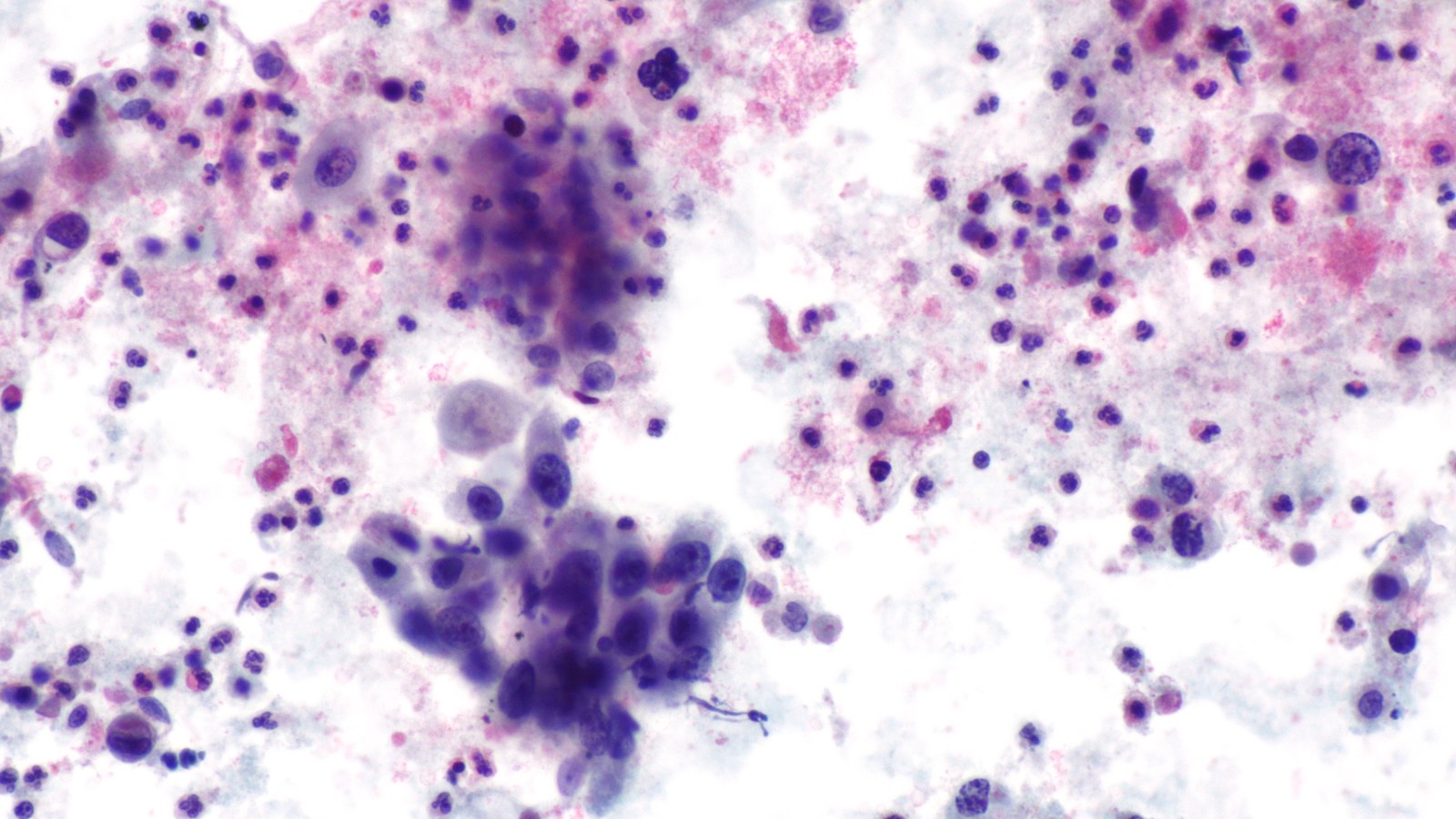
Photo: Librepath / Wikimedia Commons, CC BY-SA 3.0. Fine-needle aspiration micrograph of squamous carcinoma of the lung. Illustration of research, not a gotistobart product. The image was cropped to 16:9.
Sources consulted: BioNTech says lung cancer drug candidate prolonged lives in trial | Reuters; BioNTech and OncoC4 present updated PRESERVE-003 data | company release via GlobeNewswire; BioNTech Highlights Late-Stage Lung Cancer Pipeline Momentum at WCLC 2026; PRESERVE-003 | ClinicalTrials.gov NCT05671510; FDA Orphan Drug Designation for gotistobart | BioNTech.








0 Comments
No comments on this article yet. Be the first!