
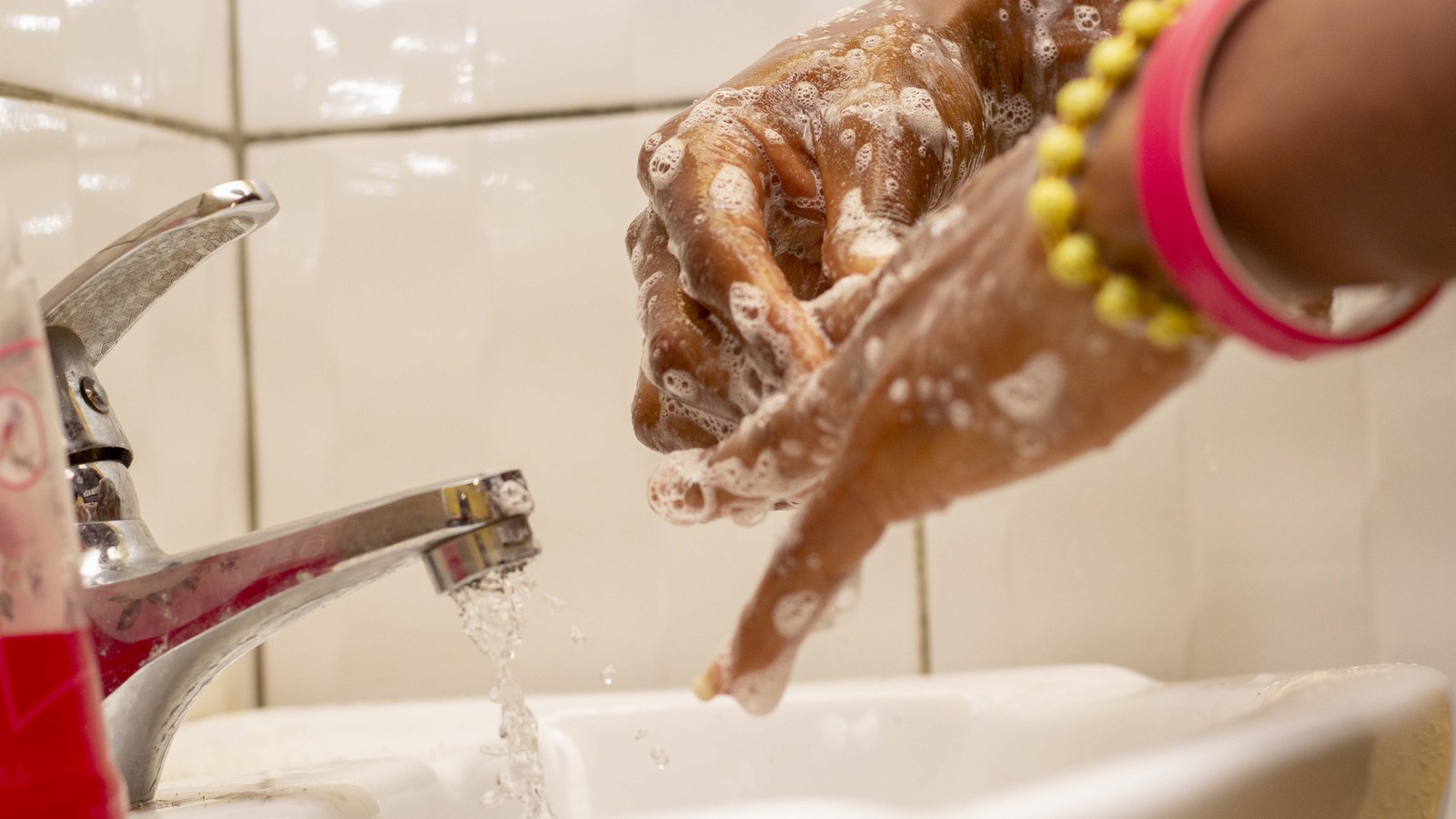
Water alone is poor at washing grease. Water molecules attract one another; non-polar oils stay separate, as a film. Soaps and detergents build a chemical bridge between the two.
A surfactant molecule has a hydrophilic head that sits well in water and a hydrophobic tail drawn to oil. The tails enter greasy dirt; the heads stay oriented toward water. Rubbing breaks the film into smaller pieces.
At sufficient concentration the molecules assemble into micelles: dirt is held inside, hydrophilic heads facing out. Rinsing can then carry the particles away. Without rubbing and rinsing the chemical bridge does not do its job.
Soap also lowers water’s surface tension, helping it spread. Foam shows that air is trapped in a surfactant-stabilised film. The amount of foam does not measure cleaning power.
In handwashing, time and covering every surface matter. Ordinary soap does not need to “kill everything” to lift oils, particles and some microbes. Products should not be mixed without instructions; hygiene follows health guidance, not internet tricks.
Hard water, with calcium and magnesium, can form insoluble deposits with soap. Synthetic detergents are often formulated for those conditions. The head–tail principle remains the same.
The picture shows washing with soap, not a laboratory diagram of micelles. It illustrates the gesture, not a detergent formula.
Image: Davyimage, washing hands with soap. Wikimedia Commons, CC BY-SA 4.0. A cleaning gesture, not a micelle diagram. Cropped to 16:9. Licence. Original file.
Sources consulted: Royal Society of Chemistry — The Chemistry of Soap; CDC — About Hand Hygiene; Soap and detergent | Encyclopaedia Britannica.







0 Comments
No comments on this article yet. Be the first!