
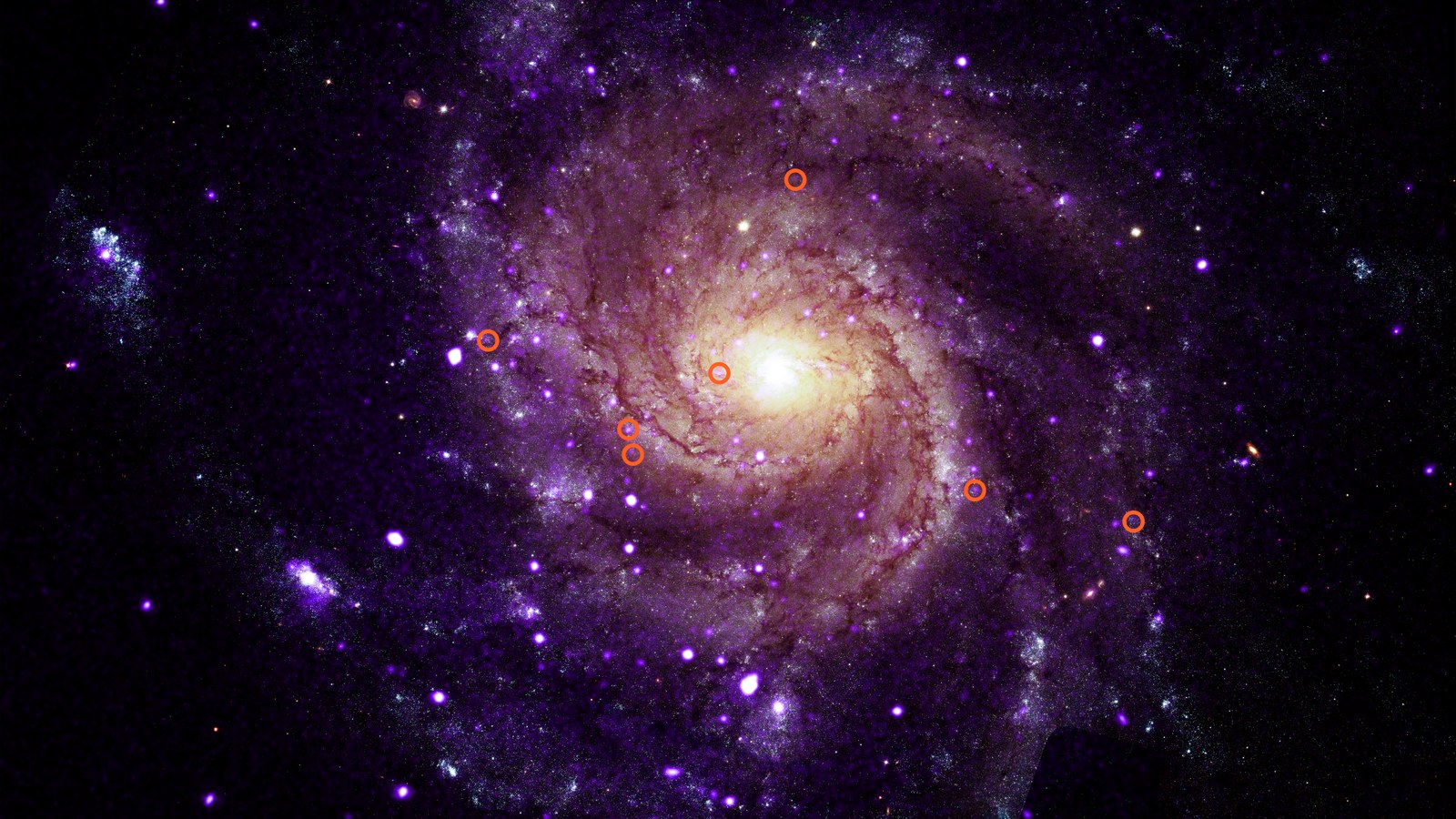
Astronomers have identified a class of cosmic objects unlike previously known X-ray sources. Using data from NASA's Chandra X-ray Observatory archive, researchers found 84 objects across six galaxies and named them “hypersoft X-ray sources”. Their exact nature remains uncertain, but a study published in Nature Astronomy suggests they may involve black holes, neutron stars or white dwarfs pulling material from companion stars.
Known X-ray sources normally emit a substantial amount of radiation at higher energies. The new objects appear strongly below about 0.3 keV, but become very faint or vanish in images taken at higher energies. That behaviour suggests that much of their energy is emitted in the extreme ultraviolet, not only in X-rays. The 84 sources were found in publicly available Chandra archive data. The galaxies searched include M31 — the Andromeda Galaxy — and M101, known as the Pinwheel Galaxy. The other four are elliptical galaxies. The team found hypersoft X-ray sources both in regions of active star formation and in areas with older stars.
One reason they were not seen until now is that they sit in a genuine observational blind spot. Extreme ultraviolet radiation is absorbed very readily by hydrogen, helium and interstellar gas. At the same time, very soft X-rays are harder to detect than those at higher energies. An entire population of highly energetic objects may therefore have remained hidden for a long time. NASA says the discovery may point to a large population of energetic binary systems missed by earlier observations; the 84 objects are not necessarily the complete population.
Researchers have not yet established a single explanation for all of these sources. The main scenarios include binary systems in which a compact object — a black hole, a neutron star or a white dwarf — pulls material from a companion star. The material is heated strongly before it falls into a black hole, reaches the surface of a neutron star, or accumulates on a white dwarf. This process normally produces X-rays; the new sources, however, have an unusually “soft” spectrum. These remain possibilities, not confirmed identities for each of the 84 sources. The Nature Astronomy study shows that the most luminous examples can radiate near 1038 erg/s in the narrow X-ray band observed, and models suggest that the true total energy output could be even higher because most of the radiation is emitted in the extreme ultraviolet. Some of these sources may have luminosities hundreds of thousands or even millions of times greater than that of the Sun.
Researchers think the objects could help explain the origin of some Type Ia supernovae and how gas in galaxies is ionised. Some of the sources may be white dwarfs accumulating material from a companion star — systems considered candidates for such explosions. Type Ia supernovae are used as “standard candles” for measuring cosmic distances and played a major role in the discovery that the Universe’s expansion is accelerating, an acceleration associated in modern cosmology with dark energy. The new objects do not explain dark energy. They might, at most, help clarify the origin of certain Type Ia supernovae used in cosmological measurements.
The second problem concerns ultraviolet radiation. If these objects emit large amounts of extreme ultraviolet, they can ionise hydrogen, helium and other gases in the interstellar medium. That could account for some of the ionisation observed in certain galaxies. Hot, massive stars already play a role, but NASA notes that they do not fully explain the process.
M31, the Andromeda Galaxy, is the nearest large spiral galaxy to the Milky Way. M101, the Pinwheel Galaxy, appears in a NASA composite that combines Chandra X-ray data with optical images from NASA/ESA/Hubble. Seven of the new sources are marked in that image. Visually they do not look spectacular: they appear as small points of light among many other sources. The difference emerges when astronomers analyse the energy of the radiation.
The discovery was made with NASA's Chandra X-ray Observatory, launched in 1999 and still one of the most important space observatories for studying the Universe in X-rays. The researchers did not necessarily need a new telescope: they analysed observations accumulated over decades, in very low energy bands. Rosanne Di Stefano, a co-author of the study and a researcher at the Center for Astrophysics | Harvard & Smithsonian, said that combing through the Chandra archive made it possible to eliminate what had long been a blind spot for telescopes. The paper is by Mustafa Muhibullah, Jimmy A. Irwin and Rosanne Di Stefano. Muhibullah and Irwin are affiliated with the University of Alabama. “Hypersoft X-ray sources as a low-energy class of luminous cosmic emitter” was published on 9 September 2026 in Nature Astronomy (DOI: 10.1038/s41550-026-02959-7). NASA continues to publish results from other science missions, including Parker Solar Probe.
The main question remains what these objects actually are. Astronomers must determine whether there is a single physical category or several types of system — white dwarfs, neutron stars, black holes, post-nova systems — producing the same kind of signal. The existence of the unusual radiation source is confirmed. It has not yet been definitively shown what type of object produces each of the 84 sources.
The 84 objects found with Chandra do not yet have a definitive identity. That is precisely what makes them important: they are highly energetic, hard to detect, rich in ultraviolet radiation and different from previously known populations. If future research confirms the present hypotheses, hypersoft X-ray sources could help astronomers better understand binary systems, Type Ia supernovae, the ionisation of galaxies and a previously hidden part of the compact-object population in the Universe. RoAdevăr has also reported on space exploration in the article on Luna 2 and on European space observatories in the FLEX and Sentinel-3C launch preview.
Image: X-ray: NASA/CXC/Univ. of Alabama/M. Muhibullah et al.; Optical: NASA/ESA/STScI; Image Processing: NASA/CXC/SAO/N. Wolk. Galaxy M101 (the Pinwheel), with some of the hypersoft X-ray sources marked. The image was cropped to 16:9.
Sources consulted: NASA’s Chandra Unveils Mysterious X-Ray Objects | NASA Science; Hypersoft X-ray sources as a low-energy class of luminous cosmic emitter | Nature Astronomy; NASA's Chandra Unveils Mysterious X-ray Objects | Chandra X-ray Center; M101 | Chandra Photo Album.










0 Comments
No comments on this article yet. Be the first!