
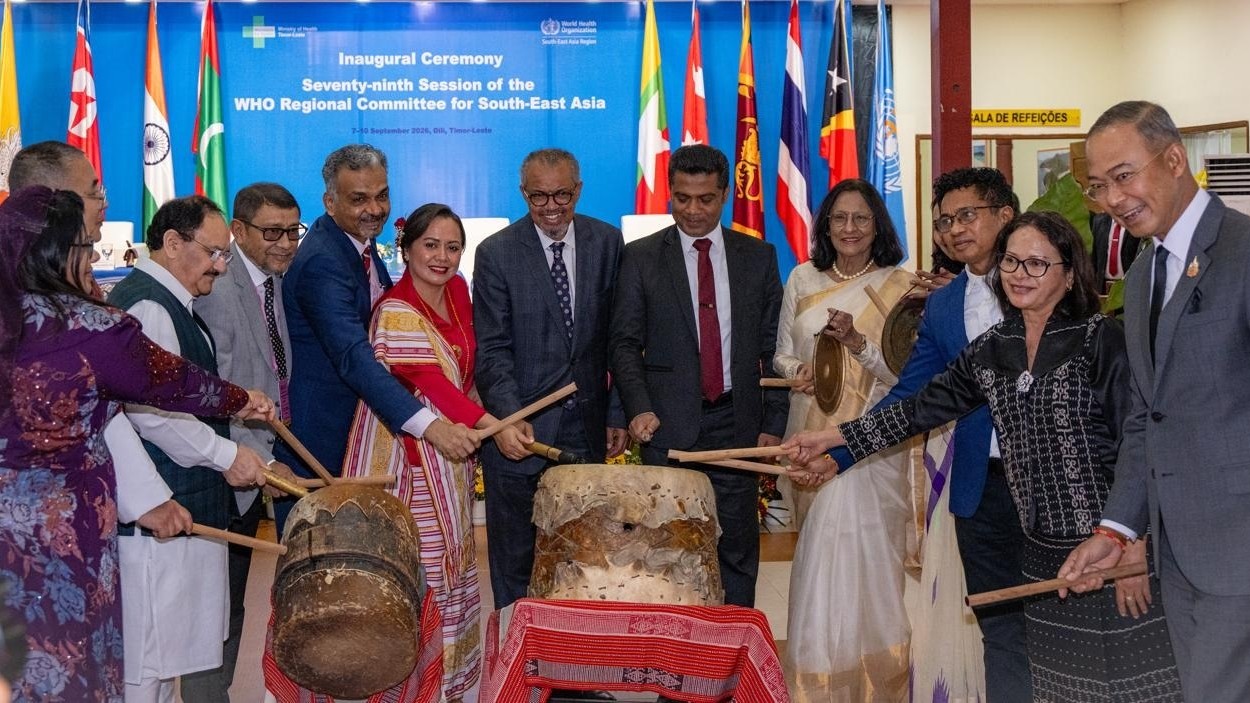
Member States of the World Health Organization’s South-East Asia Region adopted a resolution on 10 September 2026 aimed at more equitable access to quality-assured medical devices, in vitro diagnostics and assistive technologies. The decision was taken at the Seventy-ninth Session of the WHO Regional Committee in Dili, Timor-Leste. The text is not a programme under which WHO will purchase and distribute equipment to every country: Member States adopted a regional framework and commitments to strengthen their own national systems.
For the first time at a WHO Regional Committee, medical devices were discussed as a dedicated agenda item. The resolution sets timelines for how medical technologies are planned, regulated, procured, installed, maintained, monitored, replaced and eventually decommissioned safely. It addresses a familiar weakness in health systems: buying a machine does not, by itself, mean patients will benefit from it throughout its working life.
Equipment needs trained staff, consumables, maintenance, spare parts, suitable infrastructure and records showing whether devices remain functional. WHO and Member States are therefore shifting towards a life-cycle approach, rather than focusing mainly on the moment of purchase.
By 2027, countries have agreed to designate a national lead mechanism or focal unit for the life-cycle management of medical devices and in vitro diagnostics, with responsibilities clearly assigned across institutions. By 2028 they are expected to complete a national baseline assessment covering service and diagnostic gaps, essential device and diagnostic lists, regulatory capacity, and the location, functionality and maintenance status of priority equipment. By 2030 they are expected to develop or update costed national implementation plans linking essential diagnostics and priority devices with clinical services, primary health care, referral pathways, benefit packages, annual budgets, procurement, workforce needs and emergency preparedness.
Procurement decisions, WHO says, should not rest on acquisition price alone. Authorities are encouraged to weigh quality, total cost of ownership, installation, consumables, warranties, maintenance, staff training, interoperability, cybersecurity, environmental considerations and continuity of supply. The aim is to reduce cases in which equipment is bought but then sits unused because parts, consumables or trained operators are missing. Access in rural, remote, island and underserved communities is to be matched with infrastructure, quality assurance and financing that can be sustained.
Assistive technologies are part of the same package. They can include wheelchairs, walking aids, hearing aids, glasses and prostheses that support independence and participation for people with disabilities or other functional limitations. The resolution also calls for stronger oversight of software and artificial intelligence used as medical devices, so countries can assess digital diagnostic and care tools as well as conventional hardware.
Regional cooperation is to be strengthened through the South-East Asia Regulatory Network (SEARN) and other platforms, including safety-information exchange, training, regulatory work-sharing and common technical specifications. The resolution also provides for Regional Centres of Regulatory Excellence for medical devices and in vitro diagnostics. Countries may choose, voluntarily, to collaborate on pooled or coordinated procurement, forecasting, strategic reserves, regional production, technology transfer and emergency supply continuity.
WHO is expected to develop a regional implementation framework by 2027, covering governance, essential lists, regulation, procurement, maintenance, post-market surveillance and monitoring. A regional monitoring framework is planned by 2028. Progress reports are due to the Regional Committee in 2028 and 2030, with a final report in 2032 containing recommendations for the next phase. Those dates are implementation deadlines, not measures already completed.
Several countries in the Region have already developed National Essential Diagnostics Lists. According to WHO, South-East Asia has the highest number of countries with such lists among all WHO regions. India was the first country globally to develop a National Essential Diagnostics List; Nepal was the third. Thailand was the first ASEAN country to do so, followed by Timor-Leste, while Myanmar and Maldives are now working on their own lists. The Dili resolution seeks to turn those lists into a broader system in which access to health technology does not end when a purchase order is signed.
Source consulted: WHO South-East Asia Region to improve access to medical devices, in vitro diagnostics and assistive technologies | WHO South-East Asia
Image credit: WHO SEARO. Inaugural ceremony of the Seventy-ninth Session of the WHO Regional Committee for South-East Asia, Dili, Timor-Leste, 7 September 2026. Original source: https://cdn.who.int/media/images/default-source/who-governance/regional-committee-sear/sea-rc79---2026/inaugural-group-photo-for-who-sear-rc79-in-dili--timor-leste.jpeg?sfvrsn=3c85d1de_3









0 Comments
No comments on this article yet. Be the first!