
Some companies that shifted production and sourcing away from China towards India, Vietnam and other Asian manufacturing hubs to avoid US tariffs are now moving part of their orders back. Reuters reports that businesses are finding China’s industrial ecosystem difficult to replicate, with dense supplier networks, skilled labour, access to equipment and reliable power continuing to give Chinese factories a significant advantage. There is not yet hard data showing how much sourcing is returning. These are increasingly visible cases, not a generalised reversal.
The strategy through which companies tried to reduce their dependence on China is running into an unexpected problem: China is much harder to replace than it appeared. About a year after new US tariffs prompted many firms to shift production and orders to India, Vietnam, Indonesia, Thailand and other Asian industrial centres, some companies are restoring part of those orders to China. There is no single reason. Firms are encountering production difficulties, a lack of local suppliers, power problems, insufficient equipment, logistics costs and smaller tariff gaps than before.
A customer came back from India
One example in the Reuters report is Dawang Metals, a family-owned metal-casting firm in Dandong, in north-eastern China. Last year a major American customer — an agricultural-machinery company that vice-president Heather Kuang declined to name — shifted some orders to India to reduce exposure to tariffs on Chinese goods. After running into problems there, the customer returned with new orders. Dawang also explored moving some production offshore before abandoning the plan. “China’s supply-chain advantage is still too great, and it is difficult to replicate domestic production elsewhere,” Kuang said.
“China plus one” is harder in practice
The approach adopted by many companies is known as China plus one: keep some production in China while building a second base in another country, to reduce geopolitical risk, tariff exposure and dependence on a single state. Reuters reports that the strategy has proved harder to execute than some firms expected. A factory does not operate in isolation. It needs raw materials, subcontractors, parts, packaging, machines, tools, electricity, logistics, engineers and skilled workers. China built those networks over decades.
One of China’s advantages is a very dense concentration of suppliers. A plant can often find nearby producers of screws, moulds, electronic components, packaging, metal parts, motors, plastics and industrial equipment. In other countries some of these goods have to be imported — sometimes from China itself.
A manufacturer closed its Vietnam workshop
Jin Chaofeng, an outdoor-furniture exporter in Hangzhou, opened a workshop in Ho Chi Minh City in 2024. In 2026 he shut it and moved production back to China. The company had trouble finding the equipment, screws, moulds and other basic components it needed; some had to be brought from China, including moulds for cup holders. Once all costs were included, the financial advantage of producing in Vietnam almost disappeared. “Once I factored everything in, the overall cost was not much different, so there was no point,” he told Reuters.
Tariffs triggered the move, then the gap narrowed
One of the main reasons for relocating production out of China was US tariff policy. President Donald Trump’s administration raised duties on a wide range of imported goods, and companies tried to produce in countries with lower tariffs. The picture then changed. According to Economist Intelligence Unit estimates for July, cited by Reuters, the effective US tariff rate was about 20% for China, 6.1% for Vietnam, 13.4% for Indonesia and 4.5% for Thailand. These figures are estimates of average effective rates, not a single tariff applied to every product. Washington later extended tariffs to more countries. The smaller the tariff gap, the more productivity, quality, logistics, energy and industrial infrastructure matter.
Target and Shein, according to Reuters sources
According to Reuters sources, the American retailer Target has moved some orders back to Chinese suppliers. Two people familiar with the matter cited supply-chain disruptions and production constraints in other countries. The sources did not disclose the value or duration of the orders. Target did not immediately comment; this is not an official confirmation by the company.
The fast-fashion retailer Shein is also scaling back some operations in Vietnam, according to people familiar with its activity there, cited by Reuters. The company did not immediately comment. Reuters describes a reduction of some operations, not a withdrawal from Vietnam.
Energy and oil prices
Labour costs are no longer the only important criterion. Access to stable electricity has become essential. Guan Baokui, a Qingdao lawyer who advises manufacturers, told Reuters that Vietnam and Indonesia suffer from an “unstable and not continuous” electricity supply, a problem that intensified as global oil prices surged. Higher energy prices in 2026 — including after tensions that lifted oil benchmarks — can raise costs across electricity, transport, raw materials, plastics, chemicals and logistics.
Stanislaw Krykun, chief executive of the Polish packaging firm DST Pack, worked with his six-year Chinese manufacturing partner through a period when plastic input costs spiked 15% in April because of soaring oil prices. “In case of any crisis, the Chinese production plants will be the most stable plants you can use,” he said. DST Pack sources about 80% of its production from a factory in Shenzhen, with 10% each from long-established backup plants in the United States and Europe. Those US and European alternatives cost, according to the company, two to three times more per unit. The firm had considered moving to South-East Asia but dropped the idea after seeing a partner struggle in Vietnam.
China is not the only winner
The return of some orders does not mean that global diversification has ended, or that India and Vietnam have failed. Reuters notes that India, Indonesia and Vietnam continue to attract investment from electronics, automotive and other manufacturers despite persistent concerns. Vietnam remains one of the biggest beneficiaries of supply-chain diversification and is attracting billions of dollars in foreign investment.
Yu Yangxian, who sells electric lockers and vending machines, said her company is keeping roughly one-eighth of total capacity in Vietnam as a hedge against a possible further wave of US tariffs. The firm could expand there again if tariffs spiked. For many companies the strategy is not China or Vietnam, but China and Vietnam. Nor are all exporters seeing US demand return: Summer Hu, a Ningbo-based sales agent for gift and outdoor sports products, said her company had not seen US orders increase and was not optimistic, because competition is too intense.
Political risk remains ahead of a Trump–Xi meeting
Even where some orders are returning to China, companies remain aware of geopolitical risks, tariffs, trade restrictions and US–China tensions. That is why many firms are not abandoning alternative capacity altogether. The shifts are unfolding ahead of an expected meeting this month between Donald Trump and Chinese President Xi Jinping. Businesses will watch it for possible clarity on tariffs, trade, non-strategic goods and commercial barriers. Reuters says they will also watch a proposed mechanism to lower barriers on some non-sensitive goods. Exporters quoted do not expect the summit to resolve their problems. Kuang said she had given up pinning hopes on Trump and that the firm has to find export markets to sustain itself.
This is the central point: Reuters says there is not yet hard data showing the scale of orders returning to China. This is not an exodus from Vietnam, a total failure of India, or the end of China plus one. There are increasingly visible cases of companies and buyers restoring part of their orders to China. Structural advantages remain — dense supplier networks, infrastructure, ports, experienced industrial labour, large capacity, access to components and domestic logistics — and they cannot be rebuilt quickly. China also has disadvantages: labour costs higher than in the 2000s and 2010s, higher tariffs, technology restrictions and geopolitical tension. That is why companies keep looking for alternatives, including in chains where advanced equipment, from semiconductor lithography systems to the trade networks discussed at international meetings such as the BRICS summit, remains part of the same reorganisation.
The lesson: a factory is not just a building
The past year’s experience shows that moving a factory means rebuilding suppliers, logistics, staff, equipment, energy, procedures and quality control. That network can take years or decades. The trend does not necessarily point back to the previous model. Supply chains are becoming more distributed: China, South-East Asia, India, the United States, Europe, Mexico. The aim is not to depend entirely on a single region.
US tariffs gave companies a strong reason to look for alternatives to China. After the first wave of relocations, some firms are discovering that a cheaper factory in another country is not automatically a cheaper alternative. Once transport, electricity, imported parts, delays, missing suppliers and start-up costs are added, the gap can vanish quickly. For some companies the answer has been to bring part of production back to China. For others it is to keep a China plus one strategy. China can be reduced in the global production chain, but it is much harder to replace completely.
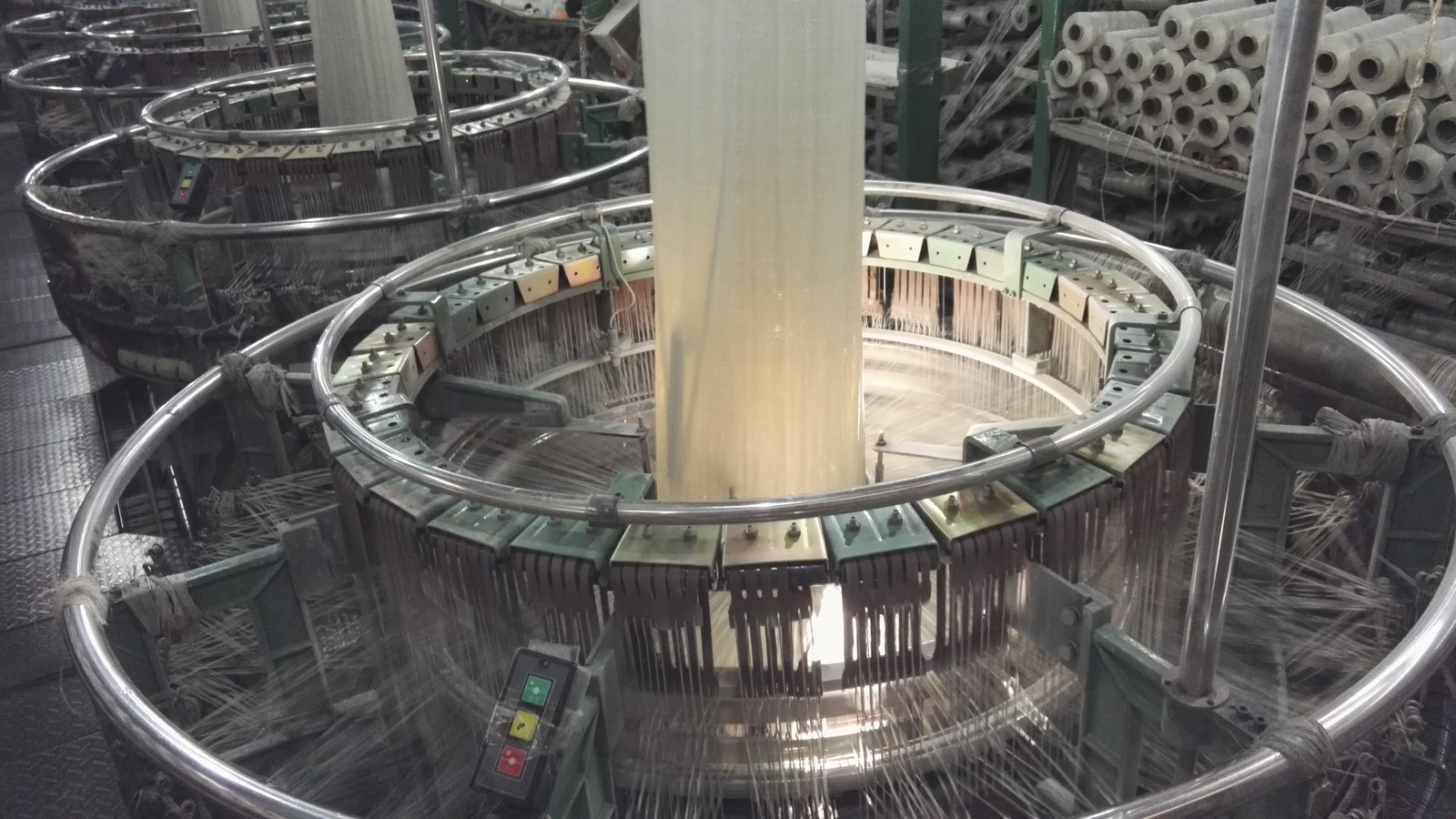
Image: plastic woven-bag production line in south-west China, 2017. Zhangzj cet, Wikimedia Commons, CC BY-SA 4.0. The image was cropped to 16:9.
Source consulted: Companies left China to dodge tariffs. Now some are heading back (Reuters).








0 Comments
No comments on this article yet. Be the first!